In 1911, a Detroit company filed a federal trademark application that asked for the year its soda first went on sale. The company had told a different story for 45 years — one printed on every bottle, every sign, and every advertisement. On the trademark form, it wrote down a different date entirely. That original story involved a Civil War cavalryman and a sealed oak barrel.
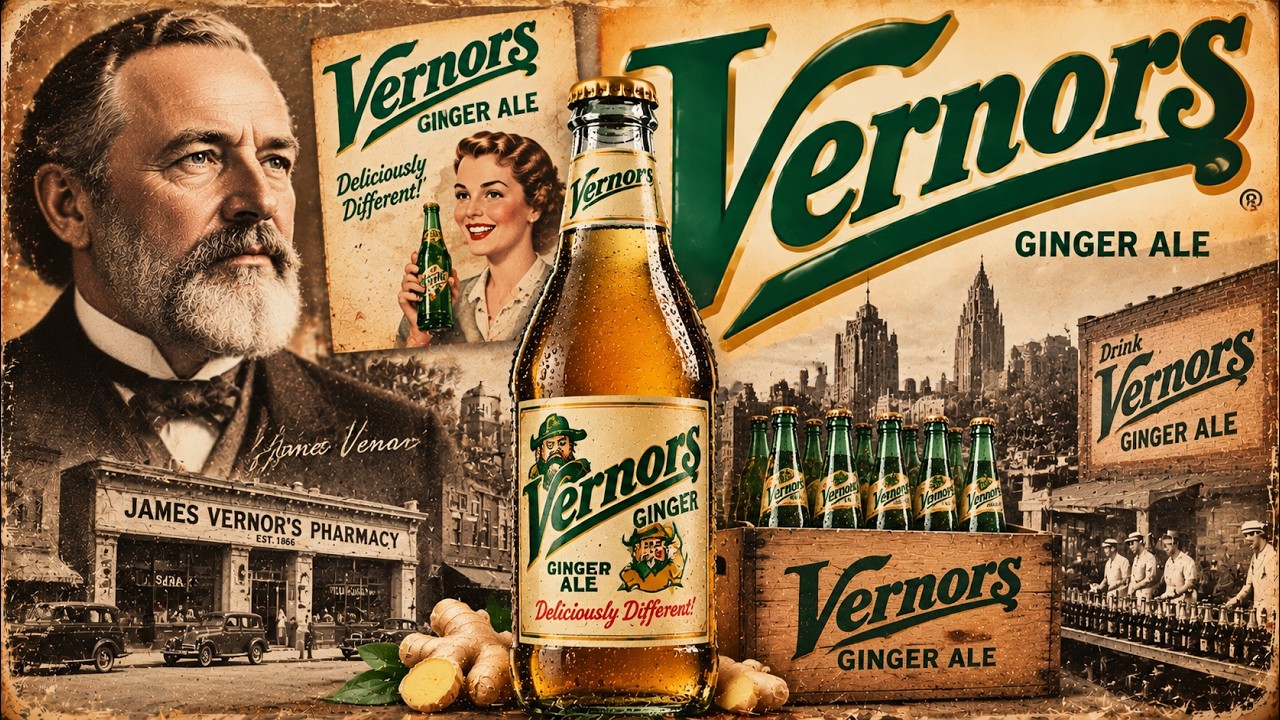
A young Detroit druggist, the legend claimed, packed his ginger recipe away before riding off with the unit that would later capture the Confederate president. Four years passed. He came home, opened the barrel, and found something new inside. Customers believed it.
Employees repeated it for generations. Then the founder’s own son quietly admitted the barrel story wasn’t true. The real story of Vernors was never about which year was accurate. It is the story of a city that believed a myth so completely, it refused to let the company disappear.
Through six owners, a demolished factory, and a rival that ended up bottling its most sacred drink, the brand survived because Detroit refused to let it go. The story begins in Detroit, Michigan, in 1858. Detroit was a city still finding its shape — a lake port thickening with foundries, breweries, and drugstores that doubled as gathering places for men who wanted something cold, something fizzy, something that felt like relief. Into that world walked a 15-year-old boy named James Vernor looking for work.
He found it at Higby and Sterns, a drugstore on Woodward Avenue, Detroit’s central artery. Vernor started as an errand boy, wrapping parcels, running deliveries, and learning without knowing it yet the trade that would define the rest of his life. A drugstore in 1858 was not what the word suggests today. The pharmacist behind the counter mixed medicines by hand — tonics, elixirs, and syrups meant to settle stomachs, calm coughs, and mask the taste of whatever ailed the customer.
Many of those pharmacists also ran a soda fountain, a marble-topped counter where carbonated water was mixed to order with flavored syrup and sold by the glass. Vernor apprenticed in all three roles at once. By his early 20s, he had become a full pharmacist trusted with the store’s most delicate work — mixing compounds where a wrong measurement could sicken a customer instead of healing one. At the time, the beverage on offer at most soda counters was ginger beer, usually shipped in from Ireland.
It was harsh, sharp enough to make a customer wince, inconsistent from batch to batch, and priced like an import because it was one. Nothing sold in an American drugstore matched it for flavor, and nothing matched it in price either. There was a gap on that marble counter, and for years nobody in Detroit had filled it. Vernor did not stumble onto that gap.
He worked toward it the way a pharmacist works toward any formula — through trial, through failure, through small adjustments made one batch at a time. Ginger itself was the problem: straight ginger extract burned on the way down. Customers wanted the bite without the punishment. Vernor spent years testing blends of ginger, vanilla, and spice, trying to do what he later described as taming the fire — keeping the heat of the root while softening its edge into something a customer would order twice in one sitting.
In 1866, Vernor and a fellow Detroit druggist, Charles A. L’Hommedieu, opened their own pharmacy on Woodward Avenue. It was a modest storefront — a counter, a soda fountain, a back room for mixing — but it gave Vernor something he had never had at Higby and Sterns: full control over what went into the glass. That same year, according to the account Vernor and his family would repeat for the next half century, the ginger formula he poured at his new soda fountain was already unlike anything else being served in Detroit.
By 1888, the business built on that counter was moving more than 300,000 gallons of ginger ale a year — an extraordinary figure for what had started as one man’s private mixture behind a drugstore counter. But 23 years after that formula first reached a customer’s glass, a piece of paper would surface with a different date on it, and the story Detroit thought it knew would need a second look. What made Vernor’s work was not one invention. It was four decisions made over three decades that turned a drugstore syrup into a regional institution.
First came the formula. Vernor blended the ginger root with vanilla and a set of spices, softening the burn without erasing it, then aged the syrup base until the sharp edges rounded into something warmer — a flavor with caramel undertones and a lingering gingery bite that built slowly instead of arriving all at once. The exact recipe was never published and remains proprietary to this day. Vernor treated the mixing process the way he treated his prescription work: exact measurements, consistent sourcing, no shortcuts on the carbonated water that carried the flavor.
Second came the branding. In the early 1900s, Vernor’s introduced a bearded, green-hatted gnome created by the artist Noble Fellows, appearing on signage, delivery trucks, and print advertising across Michigan. The gnome had no official name for decades; company lore would eventually attach the name Woody, a nod to the wood barrel aging story the brand had built its identity around. Long before soda companies thought of mascots as a science, Vernor’s had one doing exactly that job — turning a bottle on a shelf into a face a child could recognize before they could read the label.
Third came the price point. Soda fountain drinks across the Midwest in this era were priced to be an impulse purchase, not a luxury — a few cents a glass, well within reach of a factory worker’s daily wages, and consistently cheaper than imported ginger beers shipped in from overseas. Vernor’s ginger ale was positioned from the start as the domestic alternative, something a Detroit customer could afford to drink regularly rather than treat as an occasional indulgence. Fourth came the go-to-market strategy.
As demand spread beyond his own soda fountain to other Detroit drugstores, Vernor required any vendor who wanted to carry his product to purchase specialized equipment to mix and serve it properly, refusing to let a diluted or mishandled glass carry his name. That strategy built on scarcity and standards worked: by the 1880s, Vernor’s ginger ale had spread from a single Woodward Avenue counter to soda fountains across the Midwest, still years before a single bottle of it existed. That changed in 1896, when Vernor closed the pharmacy entirely and opened a dedicated bottling plant at the foot of Woodward Avenue. The moment the product stopped being something a customer had to visit a specific counter to drink, it became something they could carry home.
By the time the operation matured into full-scale bottling, Vernor’s had achieved something few regional soda makers of the era could claim: total control over its own production, from formula to fountain to bottle. By the turn of the 20th century, James Vernor was no longer just a druggist with a popular soda recipe. He had become a fixture of Detroit’s civic life, serving on the city council for 25 years — long enough to fight a very public battle over how the city should move its people. Vernor argued for private ownership of Detroit’s streetcar system, insisting that public control would breed corruption and inefficiency.
On the other side stood Mayor Hazen Pingree, who would go on to become governor of Michigan. The two clashed repeatedly and publicly. Vernor was not opposed to raising taxes when the cause was right — schools, infrastructure — but on transportation, he would not bend. He ultimately lost the fight, but it revealed something about the man behind the ginger ale: he wanted a hand in shaping the city that was making him wealthy.
As Detroit’s downtown grew denser through the early 1900s, Vernor’s expanded along the riverfront. A massive illuminated sign bearing the company’s name and logo rose along the Detroit River, visible to every passenger boarding the ferries that ran to Windsor and Belle Isle. For a generation of Detroiters, a trip across the river meant passing beneath that sign. Vernor’s was not advertised to the city so much as woven into its skyline.
Inside the plant, production climbed toward a capacity that would eventually reach 75,000 cases a day — roughly 6 million bottles, more than a thousand leaving the line every single minute. The same obsessive quality control James Vernor once applied to prescription medicine now applied at industrial scale, ensuring that a bottle bought in Flint tasted exactly like one bought on his own Woodward Avenue counter. In 1927, at the age of 84, James Vernor died. His family would later joke that he hadn’t retired until just hours before his death — a man who had spent nearly 70 years behind one counter or another, still checking the work when the work finally stopped checking back.
The company passed to his son, James Vernor II, who had already been steering day-to-day operations for years. That era of growth was built in part around a ritual the company hadn’t invented and would spend decades fighting to own. The Boston Cooler — Vernor’s ginger ale blended smooth with vanilla ice cream — became Detroit’s own version of a drink it hadn’t created but would come to define. By the 1930s and 1940s, ordering a Boston Cooler at a Vernor soda fountain had become something close to a courtship ritual.
The Sanders family, whose Woodward Avenue candy shop was already a Detroit institution, helped cement the drink’s popularity across the city. In 1967, Vernor’s moved to claim the Boston Cooler as legally its own, trademarking the name not for the ice cream float Detroit already loved but for a new ginger ale-flavored ice cream bar. The bar itself met only modest success, but the trademark held. From that point forward, every Boston Cooler poured in Michigan was legally and culturally a Vernor’s product.
By the 1950s, the plant itself had become a landmark worth visiting. A land swap with the city, struck when Detroit needed the old riverfront site for its civic center development, moved Vernor’s into the former convention hall building at 4501 Woodward Avenue. The company poured $5 million — more than $60 million in today’s terms — into a quarter-million-square-foot showplace spanning over seven acres. A block-long glass front let passersby watch the entire bottling process in motion, a piece of industrial theater the company actively encouraged.
On June 4, 1954, a new illuminated sign atop the plant was switched on for the first time — so large and so bright it required its own dedicated air conditioning system just to manage the heat its own lights produced. Tourists rode ferries down river specifically to see it. Schoolchildren pressed their faces to the glass to watch six million bottles a day roll past. None of it gave any indication of what was coming.
The same features that made the plant a beloved civic landmark also made it enormously expensive to maintain: an aging, oversized facility sitting on prime downtown real estate that a distant, cost-conscious owner would one day look at very differently than Detroit ever had. The first warning sign arrived in 1966, and it looked nothing like a crisis. It looked like a birthday. That year marked the 100th anniversary of the company James Vernor had built — and the year his family sold it.
Control passed out of Vernor’s hands entirely into an investment group with no personal history at the Woodward Avenue counter. That pattern accelerated fast. In 1971, Vernors was sold again to American Consumer Products. By 1979, it had changed hands once more, landing with United Brands — a company headquartered not in Detroit, not even in Michigan, but in Cincinnati, Ohio.
Each sale moved decision-making further from the city the brand had spent a century calling home. The decision that could not be undone came in January 1985. United Brands, weighing the enormous cost of maintaining an aging downtown facility against the economics of outsourced bottling, made its choice abruptly. On January 18, the last bottle of Vernors ever filled at the Woodward Avenue plant rolled off the line.
The next day, the company announced it was closing the plant entirely, along with its headquarters and its distribution centers in Taylor and Pontiac. Production of the syrup itself would move to the suburb of Southfield. The actual bottling would be handed off to outside firms — among them Pepsi-Cola, the company’s most direct national competitor. More than 300 employees lost their jobs in the closure.
On January 25, 1985, they lined up to collect their final paychecks. For a plant that had once let schoolchildren press their faces against its glass front, the end came with no public ceremony at all — just a locked door and a workforce walking out for the last time. The plant stood abandoned for two full years, its bottling machinery stripped out and hauled away, its interior still stuffed with crates, signage, and decades of company ephemera — a factory frozen mid-sentence. In 1986, the property was purchased by a group with plans to raise it for a shopping mall.
Those plans dragged, stalled, and finally moved forward in November 1987, when Metro Wrecking Company began tearing the building down piece by piece. The sign that had once required its own air conditioning system came down with the rest of it. The ownership churn didn’t stop with the demolition. Just two years after abandoning Detroit, United Brands sold the Vernors brand to A&W Beverages in 1987, the same year the plant itself was reduced to rubble.
A&W was absorbed by Cadbury Schweppes in 1993. When Cadbury Schweppes spun off its American beverage operations in 2008, Vernors went with the new entity, Dr Pepper Snapple Group. A decade later, in 2018, Keurig Green Mountain acquired that company outright, folding Vernors into what is now Keurig Dr Pepper — the sixth owner in 52 years, and the furthest in every sense from the Woodward Avenue pharmacy where the whole story began. By then, the city had already answered the only question that mattered.
The recipe changed owners. The bottling changed hands. The building came down. The people kept asking for it anyway.
Today, the ginger ale that once defined an entire riverfront skyline is produced at a Keurig Dr Pepper bottling plant in Holland, Michigan — still within the state, still Michigan-made, but nearly 200 miles from the Woodward Avenue counter where James Vernor first mixed it by hand. The formula that survived six changes of ownership is by every account the company has offered the same one refined over those early decades, still sold today as Vernors and in a low-sugar form as Vernors Zero Sugar. What did not survive was the building — the block-long glass front, the illuminated sign, the sense that this drink belonged to one specific street in one specific city. The product is real and largely unchanged.
The place is gone. That gap between the product and the place is where the loyalists live. Detroit has never fully let go of Vernors, and the proof is organized. A Vernors collectors club trades in vintage bottles, tin advertising signs, and memorabilia.
In 2016, on the brand’s 150th anniversary, the Detroit Historical Museum partnered with that same collectors club to mount an exhibition of vintage Vernors artifacts — bottles, signage, and the gnome himself pulled out of attics and basements across Michigan. Painted advertising murals from the company’s peak decades, faded but never fully erased, have been restored on building walls in Detroit and in Flint. Ask a Michigander why the original still matters, and the answer rarely comes as nostalgia in the abstract. It comes as a specific memory repeated across generations with almost identical wording: warm Vernors poured into a mug when a child had a stomach ache or a cold — a home remedy passed down not because it was medically proven, but because it was what a grandmother did, and her grandmother before her.
It comes as a Boston Cooler, still served at Detroit soda counters and bars the same way it was served in the 1940s. No national ginger ale carries that weight in Michigan because no national ginger ale was ever poured into a sick child’s mug by three generations of the same family. The physical site of the original plant offers no such continuity. Where the block-long glass front once stood on Woodward Avenue between Canfield and Forest, there is now student housing, a high-rise apartment building serving Wayne State University, and a four-story residential building with ground floor retail facing Woodward itself.
Nothing marks the spot as the place where six million bottles a day once rolled past a public viewing window. The surprise came from an unlikely direction: the kitchen. Aretha Franklin, Detroit’s own, was known among those close to her for a Christmas ham recipe built around a Vernors glaze — the ginger ale’s sharp caramelly bite cutting through the richness of the meat the same way it once cut through the sweetness of a Boston Cooler. Decades after the factory came down, Vernors had quietly worked its way into home kitchens, wedding recipes, and holiday tables across Michigan — not as a marketed product, but as an ingredient in the private, unadvertised rituals of the people who grew up with it.
What Vernors represents in the end is not really about ginger ale. It is about what happens when a product outlives the place that made it matter. Six corporate owners, a demolished factory, a rival bottler filling the bottles — by any conventional business logic, this is a brand that should have dissolved into a shelf label with no identity left behind it.
Instead, it became a regional inheritance, defended not by marketing budgets but by grandmothers, collectors, and a city that decided on its own that some things are worth remembering even after the building comes down.