She was filmed in a scandalous European movie that Adolf Hitler reportedly ordered destroyed, and the reaction to it drove her into a marriage that resembled confinement more than partnership. That marriage, to an Austrian munitions magnate, gave her a front-row seat at dinners where fascist politicians and arms dealers discussed military technology — conversations she absorbed and would later use as the basis for an invention that helped lay the groundwork for Wi-Fi, Bluetooth, and GPS. Hedwig Eva Maria Kiesler was born on November 9, 1914, in Vienna, Austria, the only child of a successful Jewish bank director and a pianist from Budapest. She was raised in a prosperous, intellectually rich household, and from an early age her father took her on long walks explaining how everyday mechanisms worked — how a printing press functioned, how a tram engine moved it forward.
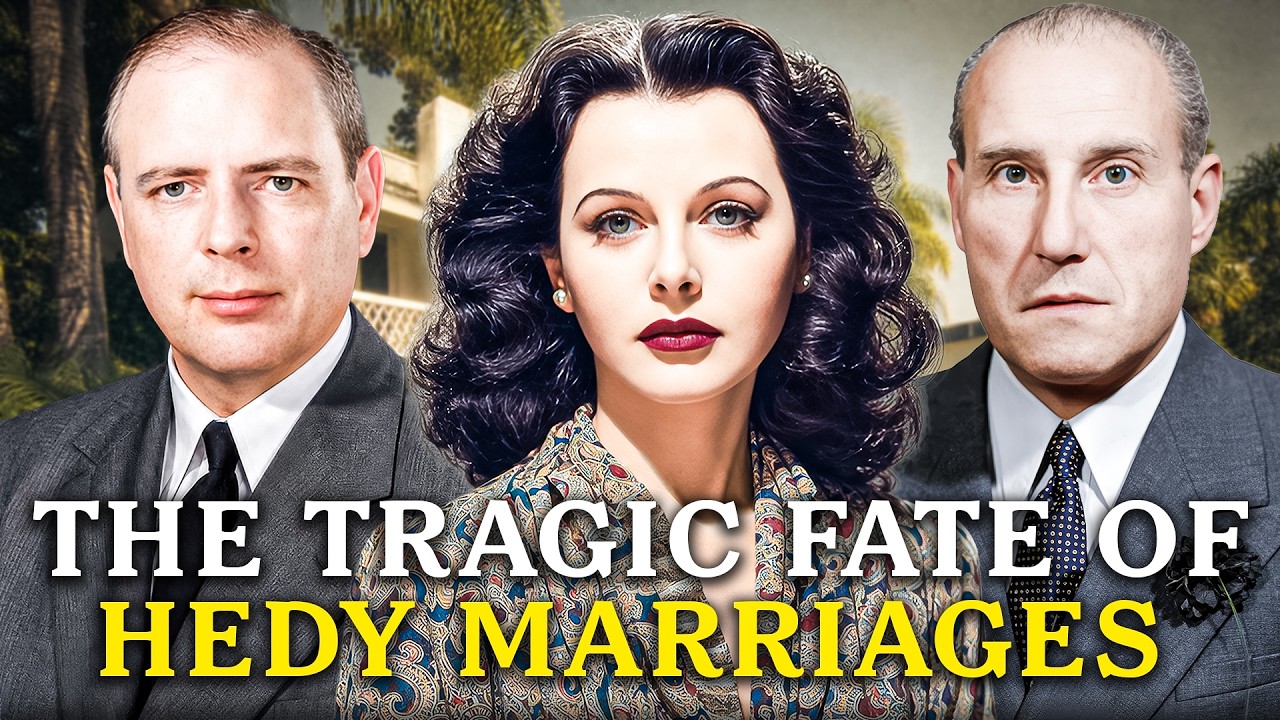
She had what colleagues would later describe as an engineer’s mind, an instinct to look at any system and see its weaknesses and how to fix them. She also had a face that stopped rooms. By her early teens she was being noticed in Vienna for reasons that had nothing to do with her family. She discovered theater at around 14, studied with the celebrated director Max Reinhardt, and made her first professional screen appearance in a minor German film in 1930.
Two years later, she accepted an offer from Czech director Gustav Machaty to appear in a film called Ecstasy. Ecstasy, released in 1933, caused a scandal that spread across Europe and then the Atlantic. It included scenes of the actress swimming without clothing and other content that generated considerable controversy. The film was banned in multiple countries, condemned by the Catholic Church, and reportedly ordered destroyed by Hitler.
But it also put the face of Hedwig Kiesler on front pages across Europe, which drew the attention of a powerful man who had been looking for a wife. Friedrich “Fritz” Mandl was 30 years old in 1933 and one of Austria’s most formidable industrial figures. He owned a munitions and weapons manufacturing company that made him a primary supplier of ammunition to various European governments. His business connections extended to Benito Mussolini and to Austro-fascist political circles.
He pursued the 19-year-old actress with the thoroughness of a man accustomed to acquiring what he wanted, and they married on August 10, 1933. Her parents were not enthusiastic, but had no practical position to prevent it. By Hedwig’s own detailed account in her 1966 autobiography, the marriage was spectacular on its surface and suffocating beneath it. Mandl was obsessive in his possessiveness.
He attempted to purchase every existing print of Ecstasy, which he found intolerable, spending significant sums to destroy copies. When he discovered he couldn’t buy them all, he turned his attention to controlling his wife. She was not permitted to go out without him, was not allowed friendships he hadn’t pre-approved, and her correspondence was monitored. He took her to business dinners where she sat among arms dealers, fascist politicians, and military officials.
She later said those dinners were educational. She was situated in rooms where she listened to men discussing torpedoes, radio-controlled guidance systems, and the vulnerabilities of military communications technology. She absorbed the information in the way she had always absorbed things — as someone for whom understanding a system was natural and automatic. But she was also increasingly afraid.
Mandl’s control had moved beyond restrictive and into something closer to confinement, and she began quietly planning her escape. The precise details of how she left Mandl in 1937 have been told in different versions, with the most dramatic involving a disguise as a maid to slip past staff. What is documented is that she made her way to Paris and then to London, and that aboard a ship crossing the Atlantic — the Normandie — she was seated at dinner near Louis B. Mayer, the most powerful man in Hollywood.
When Mayer understood who she was, he made an offer. By her account, the initial figure was insulting, somewhere around $125 a week. She went back to her cabin, thought carefully about what terms she was willing to accept, dressed with deliberate care, and returned to his table. By the time the ship reached New York, she had a contract paying $500 a week with structured escalations.
She was 23 years old and had negotiated a studio contract aboard an ocean liner with one of the entertainment industry’s most powerful executives. She also secured a new name. Mayer suggested Lamarr, after a silent-era actress who had been called the most beautiful woman in the world. Hedwig Kiesler became Hedy Lamarr.
She arrived in Hollywood in 1937 and within months was starring opposite Charles Boyer in Algiers. She was not simply beautiful in the conventional Hollywood sense. She had a quality of intelligence on screen, a watchfulness, a sense of active thought behind her eyes, that audiences responded to with immediacy. Reviews described her as magnetic and hypnotic.
The studio had acquired something commercially extraordinary — and something it had very little framework for understanding. Because the thing about Hedy Lamarr, the thing no studio system of that era had a mechanism for accommodating, was that she was considerably more than the face they were marketing. Her second husband, Gene Markey, was nothing like her first. A screenwriter and producer with easy charm, Markey had been previously married to actress Joan Bennett and later to Myrna Loy.
He and Hedy married on March 4, 1939, and the marriage presented a glamorous surface entirely in keeping with the MGM star system. It lasted two years and was, by most accounts, more of a social arrangement than a genuine partnership. They were well-matched at dinner parties and industry events, but beneath the performance, compatibility was limited. His infidelity was one reason the marriage collapsed; her restlessness was another.
She had spent four years performing contentment for Fritz Mandl, and she did not have another four years of that in her. During the marriage, they adopted a son named James. James later claimed as an adult to be Hedy’s biological child from a relationship outside the marriage, an assertion that was never definitively resolved and that Hedy never fully confirmed. What is perhaps more significant is what Hedy was doing in the hours she was not performing for cameras.
She had installed a drafting table in her home and had begun systematically working through technical problems that interested her. She had never stopped processing the information absorbed at Mandl’s dinner tables. In the early years of World War II, with German submarines threatening Allied shipping and the limitations of radio-controlled guidance systems becoming a military problem of genuine urgency, she identified something she believed could be fixed. The problem was simple to state: a radio signal sent to guide a weapon could be jammed by broadcasting on the same frequency and overwhelming it.
Her solution required frequency hopping — rapidly changing the frequency of the radio signal in a synchronized pattern between transmitter and receiver, so both ends were always on the same frequency even as it changed dozens of times per second, making jamming effectively impossible. She developed the concept with her neighbor, composer George Antheil, who had worked extensively with player piano rolls and understood the mathematical problem of synchronizing two mechanical systems across time and distance. They filed a patent on August 11, 1942, for what they called a secret communication system. The Navy declined to implement it during the war.
The prevailing view was that the required electronics were too bulky for the weapons of the era. The patent expired in 1959. Hedy received no compensation. As electronics miniaturized in following decades, the technology was adopted by military communication systems, then commercial systems, then consumer electronics, until essentially every wireless device on Earth was, in some technical sense, using principles she had described during the war.
She received nothing for it during the decades it generated the most value, and recognition, when it finally came, arrived late enough that it felt more like a correction than a reward. Her third marriage, to British actor John Loder, was her longest and, in certain respects, the most consequential for the shape of the rest of her life. Loder was tall, classically handsome, and a working actor whose career never quite matched her scale — a professional peer in category, but not in level. They married on May 27, 1943.
The marriage lasted four years and produced two children: Denise, born in 1945, and Anthony, born in 1947, the year the marriage ended. Anthony Loder described his mother in later interviews with a combination of genuine love and honest complexity — a woman who was brilliant, beautiful, and often elsewhere, not absent in the simple sense, but present in ways oriented toward something other than the daily rhythms of raising children. The household was maintained by staff, her career by MGM. The connection between mother and children was real, but often conducted through layers of practical mediation.
Loder’s later accounts described a man who had been genuinely in love with someone he could never quite reach. The career was also beginning to slow. She made significant films through the mid-1940s — Tortilla Flat in 1942, The Heavenly Body in 1944, The Strange Woman in 1946 — and one of her best-remembered appearances came as Delilah in Cecil B. DeMille’s Samson and Delilah in 1949.
But the particular kind of European glamour she embodied was becoming familiar rather than fresh. She had turned down roles she would later regret; Gaslight was offered to her before it went to Ingrid Bergman. She was 32 in 1947, with three children, three divorces, and a patent sitting unimplemented in Washington. Her fourth husband, Teddy Stauffer, was by almost every measure the least significant of her six marriages — least significant in duration, legacy, and in how much it mattered to either party.
Stauffer was a Swiss musician and former bandleader who had built a second career as a hotel and nightclub owner in Acapulco, where he was a significant figure in the expatriate social scene. He was the kind of person who seems more interesting in a bar overlooking the Pacific than he turns out to be in a marriage. They married in 1951 and divorced in 1952, after about ten months. The marriage produced no children and little documentation of what occurred.
Hedy mentioned it with the brevity it probably deserved. What the Stauffer marriage represents in her broader story is a pattern that had become visible to observers. She moved toward commitment quickly and away from it almost as quickly, engaged each relationship with apparent genuine hope, and discovered each time that the particular combination of needs and expectations she carried was one no man she encountered could sustain over time. She was 40 as the marriage dissolved.
She had been famous for over a decade, had three children, and had a patent on a shelf in Washington that nobody was doing anything with. Her fifth husband lasted the longest. William Howard Lee was a Texas oil executive, prosperous, grounded, and possessed of steady certainty. He was not a glamour figure, had no ambition in entertainment, and no interest in being absorbed by the demands of her career.
After the accumulated complications of her first four marriages, this was apparently appealing. They married on December 22, 1953, and the marriage lasted until 1960 — seven years, almost a remarkable length by the standards of her history. For a period she stepped back from relentless public exposure. She and Lee split time between Texas and California.
She appeared less often in major productions. Through these years she continued to think and invent. She conceived a fluorescent dog collar to make pets visible at night, worked on a modified traffic light system, and had ideas about tablet-based carbonation for drinks that preceded similar commercial concepts by years. The mind was always active, always looking for the next problem worth solving, always restless in a way no external circumstance of her life ever fully contained.
The Lee marriage ended in 1960; the specific reasons were never publicly detailed, which itself suggests they were ordinary rather than dramatic. She was 45, had been married five times, and her financial situation had become increasingly precarious. One more marriage remained. Lewis J.
Boys was a lawyer from New York. He and Hedy married in 1963, when she was 48, and the marriage lasted two years. She sued him for divorce on grounds that he was more interested in her fame and connections than in her as a person — a complaint that, given her three decades of accumulated experience, carried its own particular weight. The Boys marriage coincided with the publication of her 1966 autobiography, Ecstasy and Me, written with ghostwriters.
Its contents were considerably more explicit and personal than she had anticipated, or so she maintained after publication. She sued her co-authors and publisher for what she said was misrepresentation, and the lawsuit was eventually settled. She also sued director Mel Brooks in 1974 for including a character named Hedley Lamarr in his comedy Blazing Saddles without her permission. The case was settled out of court.
She reportedly accepted the settlement with a dry remark about what Brooks should have paid her. Shoplifting incidents that generated press coverage in 1966 and 1991 need to be understood in context. Her financial situation had deteriorated significantly, and her relationship with the public world had become increasingly fraught. The 1966 arrest at a Los Angeles department store was eventually dropped.
The 1991 incident in Florida, when she was 76, was similarly disposed of without conviction. Both were covered with a prurience that said more about how the media treated women who had once been celebrated than about anything factually significant. By the late 1970s and through the 1980s, Hedy Lamarr had retreated from public life almost entirely. She lived in apartments in New York, then Florida, kept to herself, communicated primarily by telephone, and maintained a small circle of contacts rather than the vast social world she had once inhabited.
The beauty that had been both her greatest asset and her most complicated burden had become a source of acute anxiety rather than confidence. She had begun having cosmetic procedures in the 1950s and 1960s, and by the late 1960s and 1970s the accumulated results had begun to distort rather than preserve. She became increasingly unwilling to be photographed, wore enormous sunglasses in public on rare appearances, and canceled arranged interviews. She developed a close friendship with her son Anthony, who visited her regularly and described a mother who was still sharp, still curious, still capable of conversation that ranged across subjects with genuine speed and intelligence.
The mind had not diminished. What had changed was her relationship with the world that had always looked at her and seen primarily a face. The Electronic Frontier Foundation gave her its Pioneer Award in 1997. She was 82 and accepted by telephone.
The citation described what she had contributed to modern communications technology — the spread spectrum principles, the frequency hopping, the secure communications her patent had anticipated by decades. She said she was pleased someone had finally noticed. Hedy Lamarr died on January 19, 2000, at her home in Casselberry, Florida. She was 85 years old.
She was alone — no husband, no regular companion — though her children were present in her life. She had requested that her ashes be scattered in the Vienna Woods, and Anthony Loder carried out her wish, returning her to the city where her father had walked with her through the streets explaining how the world worked. Vienna officially honored her in 2014, more than a decade after her death, naming a section of street Hedy Lamarr Gasse. Six marriages, one patent that changed the world, three children raised in varying configurations of presence and distance, a career that burned brightest between 1938 and 1949 and then faded, and a final quarter century of retreat before recognition arrived almost too late to feel like more than a correction of a long oversight.
Each husband encountered a different facet of who she was and found it, in its own way, too much to hold. Fritz Mandl tried to possess her and found it was not possible. Gene Markey charmed her and did not hold her attention long enough to understand what she was actually thinking about at the drafting table in her house. John Loder gave her children and a home and could not give her whatever she was still looking for.
Teddy Stauffer was a pleasant detour that left little trace. Hedy Lee gave her stability for seven years before that too proved insufficient. Lewis Boys gave her two years before she concluded he was interested in what she represented rather than who she was. She was, through all six marriages, fundamentally the same person — too curious to be comfortable, too restless to be satisfied, too aware of her own intelligence to pretend any arrangement that did not honor it was one she could sustain for long.
She gave her best idea to a world that did not compensate her for it, and she continued to have ideas anyway until the end.