Shortly after midnight on August 7, 1944, at a crossroads west of Mortain in Normandy, a German officer riding in the vanguard of a Panzer division peered into fog so thick that vehicles ahead vanished within 15 meters. He had been briefed on what to expect: American infantry, some tank destroyers, and artillery he could not yet see. What actually emerged from the mist in the first hour of the attack was a column of American vehicles his military doctrine did not respect at all. They were open-topped and boxy.
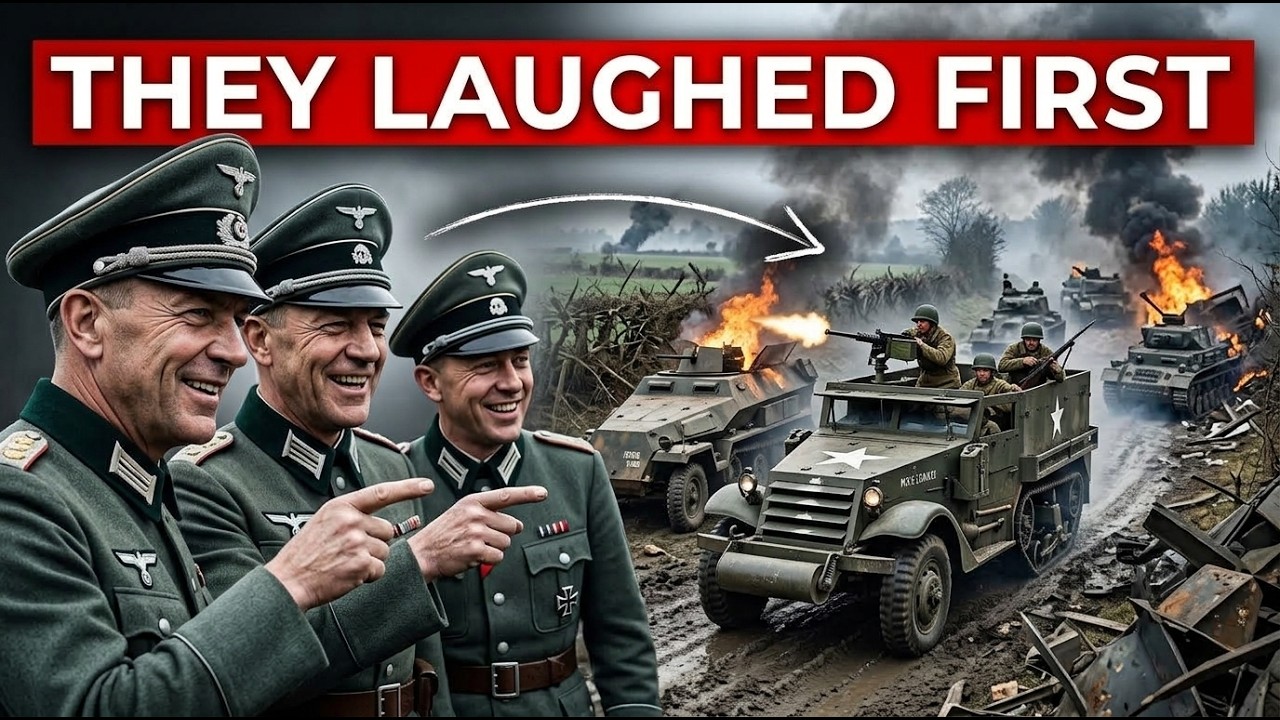
A truck cab and truck engine sat in front, a set of short rubber tracks in the rear, and a thin steel hull in the middle where men stood, exposed from the chest up. German officers had watched these machines since Tunisia and drawn the obvious conclusion. This was an armored vehicle, but it was a truck disguised as one. Its armor was so thin that an armor-piercing rifle round could punch through the sides at close range.
With no roof, a single mortar shell or an air burst above the trees would kill everyone inside. It could not lead an attack. It could not fight a tank. It could not do what a fighting vehicle was supposed to do.
The Americans agreed. The men who rode in it had already given the M3 half-track a permanent nickname, and it was not affectionate. They called it the “Purple Heart Box. ”
Over the next five days, an American infantry division and its attachments, supported by artillery and later by aircraft once the fog lifted, stopped four German Panzer divisions on that ground.
The German counteroffensive meant to split the American army in Normandy turned into a trap that destroyed a German army in France. When the fighting is examined hour by hour, the vehicle that appears again and again in American accounts is the one the Germans had spent two years mocking. Not because it fought well. Because that was never its purpose.
The German mockery was fair. The M3 was a vehicle built on compromise, and everyone involved knew it. Armor was about a quarter of an inch thick on the sides, enough to stop rifle fire and shell fragments and little else. The crew compartment was open from above.
It had no turret. In its basic form, its only offensive firepower was a machine gun on a mount or ring. Set against a true armored personnel carrier, it looked worse still. The German Sd.
Kfz. 251, the “Hanomag” seen in every Panzergrenadier photograph, was better designed in several specific ways. Its armor was sloped, which counted for more than the same thickness of vertical plate. Its track system was an elaborate interleaved German suspension, advanced and superior off-road.
It looked like what it was: a purpose-built armored vehicle designed by people who wanted it to attack. The American vehicle was designed for the opposite. It began as a truck. It used commercial truck engines and commercial truck fronts, with suspension and tracks bolted on the rear.
That is not an insult; it is literally the design philosophy. Take something the nation’s truck plants could build ten thousand of, and add tracks. The German assessment that it was a truck pretending to be a tank was a fair comment on the metal. But it was also completely beside the point, because it missed what the army believed the vehicle was for.
No one ever intended the M3 to fight. It was not built to win battles. It was built to move things, to serve as a platform for anything the army could mount on it, and to exist in numbers that made those two facts strategically decisive. The numbers are the core of the argument.
American industry produced M2 and M3 half-tracks and their variants in quantities exceeding 40,000 vehicles during the war. They were built by many companies, including White Motor, Autocar, Diamond T, and International Harvester, to a unified standard so parts were interchangeable regardless of factory. The Germans produced their superior half-track in numbers approaching 15,000 across a full family of variants, from a manufacturing base under constant bombing. Now consider what that gap meant on the ground.
The famous image of the German army is Panzergrenadiers riding in the back of a Hanomag. But the reality of the German army in 1944 is that only a small fraction of its Panzergrenadier forces were equipped with half-tracks. In a typical Panzer division, perhaps one battalion had them, if the division was lucky and recently re-equipped. The rest rode in unprotected trucks, on top of tanks, or on foot.
Behind them, divisional artillery was largely horse-drawn. The Americans made everything mobile. Their armored infantry moved by vehicle. Their mortars moved by vehicle; even the 81mm mortar fired from inside the carrier.
Their anti-aircraft guns moved by vehicle, their anti-tank guns were towed by half-tracks, and their ammunition arrived in half-tracks. Battalion aid stations moved inside them. Radios rode in them. Forward observers traveled in them.
That last item encapsulates the entire story. The half-track was not one vehicle. It was a chassis onto which the American army mounted its entire suite of support equipment, allowing that equipment to move at the same speed as the tanks. Two of those mounted variants played enormous roles in the fog west of Mortain.
The first was the multiple gun motor carriage, a half-track carrying a powered turret with four . 50-caliber machine guns. It had been designed originally to shoot down aircraft. American units in Normandy discovered that four heavy machine guns on a powered rotating mount, fired at a hedgerow or down a road, were among the most terrifying anti-personnel weapons on the battlefield.
The men who used it named it for what it did to infantry in the open, and the name does not need repeating here. Crews called it the “meat chopper,” and they meant it literally. The second was less dramatic but more important. The tank destroyer battalions supporting infantry divisions in Normandy included towed battalions, units whose weapon was a 3-inch anti-tank gun towed by an M3 half-track that also carried the crew and ammunition.
The towed gun is also a compromise. It cannot fire on the move. It takes minutes to unlimber and dig in. Once in position, it is very hard to move quickly again.
Nearly everyone in the American anti-tank community argued over whether towed battalions were a mistake, and after the war the consensus was largely that they were. But the towed gun has one property that matters more than anything else in a defensive night battle in confined terrain. You can put it anywhere a half-track can reach, in darkness, in fog, in a hedgerow gap, at a farm gate, at a crossroads, and you can move it to a different gap two hours later once you know where the enemy is actually coming. That ability, repositioning anti-tank weight laterally at night without lights, decided the Battle of Mortain.
The German operation was called Lüttich. The intention came from Hitler personally, and the strategic stakes were immense. A heavily armored thrust was launched westward out of the Mortain area to reach Avranches and cut the corridor through which the American breakout was flowing south, isolating Patton’s Third Army from its supplies. Four Panzer divisions were committed or directed to the task.
The attack began before dawn on August 7, deliberately using darkness and fog, because by that point every German commander in Normandy knew that daylight belonged to Allied air power. Facing them was the 30th Infantry Division, “Old Hickory,” which had moved into the Mortain sector only hours earlier and had not had time to learn the terrain. What happened over the next five days is among the most studied defensive battles in American history. The Germans achieved surprise and made real progress under cover of darkness.
They pushed into and through the village of Saint-Barthélemy, where a mixed force of American infantry and anti-tank guns fought at ranges measured in tens of meters in the fog, and was almost entirely destroyed in the process. But they held long enough to disrupt the attack’s timetable. On Hill 314 east of Mortain, a group of division infantrymen found themselves surrounded. They remained there for five days without food, with ammunition running low, and with wounded men they could not evacuate.
What made these men more dangerous than their numbers suggested was the presence of forward artillery observers, who could see the entire axis of the German advance. From the top of that hill, for five days, they directed American artillery fire onto German columns that did not know who was watching them. The Germans understood the hill’s importance and attacked it repeatedly, but failed to seize it. Eventually, the men on that hill received supplies by artillery.
Medical supplies were packed into empty smoke shells and fired to their position, because no wheeled or tracked vehicle could reach them. Meanwhile, in the corridors below, the fight was supported by mobile vehicles. Anti-tank guns placed to cover one road at midnight were moved and reoriented to cover another by 2 a. m.
, because the critical intersections kept changing. Ammunition stacked at one farm was moved to another. Reserve platoons that would have taken three hours to reach the fight on foot arrived in minutes, carrying full ammunition with machine guns mounted and crews rested enough to fight immediately. Between the fields and lanes, the fighting was a series of brutal, close-quarter engagements at hedgerow gaps and farm entrances.
That was exactly the kind of fight for which the towed anti-tank guns and half-tracks had been designed, and in which they could be redirected all night. Then, around midday on the 7th, the fog lifted. Royal Air Force Typhoons and American fighter-bombers arrived. The German columns stuck in the lanes below, unable to disperse because of Normandy’s dense hedgerows, were bombed so heavily that the attack ceased to be a serious operation within a day of its start.
The German offensive stalled, was reinforced, and stalled again, only to discover that in pushing west it had shoved itself into a sack whose drawstring was tightening behind it. The Falaise Pocket followed, and with it the destruction of the German army’s strength in Normandy. Men like the crews of the towed 3-inch guns at Saint-Barthélemy, positioned in darkness and fog in front of Panzer divisions, knowing a towed gun cannot flee, do not have their names recorded in history books. It is easy, and wrong, to say the half-track won the Battle of Mortain.
It did not. Artillery, air power, and infantry holding the hill won Mortain. What the half-track did was make all of that possible at the required speed. Review the battle and count the moments that depended on moving something quickly in the dark.
Anti-tank guns moved from one hedgerow gap to another as the situation changed. Ammunition moved to guns firing faster than anyone had planned. Wounded were evacuated from positions trucks could not reach. Machine gun bases moved into lanes and began fighting within seconds of arrival.
Command posts changed position. Observers moved to new ground. Reserve companies rode instead of walking, arriving ready to fight rather than exhausted. All of this was a vehicle problem, and the American army solved it by building an ugly compromise in enormous numbers and mounting everything on it.
Now look at the battle from the German side. The attacking Panzer divisions at Mortain had excellent tanks and excellent half-tracks in their vanguard. What they did not have was enough of those vehicles, or the fuel to run them, or the freedom to move by day, or a usable road network once the clouds cleared. They were the spearhead, a very powerful armored fist attached to an army that largely marched and towed its guns by horse.
The deeper structural problem appears in every honest account of German mechanization. The German army designed individual vehicles of superb quality, but never managed to build them in the numbers its own doctrine required. The Hanomag was better than the M3 in nearly every technical respect that designers cared about, but that did not matter, because the question that decided battles was not which vehicle was better. It was what percentage of your army moved by vehicle.
One more comparison is worth noting, and it is the least flattering of all. The Germans were forced to launch their counterattack at Mortain at night and in fog, without a preparatory bombardment, with limited fuel, toward a sector they had not thoroughly reconnoitered, because that was the only window in which they could move. The American defense ran around the clock, day and night, with vehicles moving constantly on roads not threatened by German air power, with supplies flowing from a beachhead pumping thousands of tons a day. One side had to fight in the gaps left by enemy air superiority.
The other side never stopped moving. The verdict on the M3 carrier is that it was a poor armored vehicle, and at the same time one of the most important machines on the Western Front. Both statements are true at once, and the contradiction between them is the heart of the lesson. The Germans judged it as a fighting vehicle.
As a fighting vehicle, it was poor: thin armor, open top, no turret, vulnerable to nearly everything. The soldiers who rode it named it after a medal awarded to the wounded. The American assessment never looked at it that way. It was assessed as a transport and carrier.
How many can we build? How fast can we repair it? What can we mount on it? Can every support weapon in the division keep up with the tanks?
The answers were: 40,000, easily, almost anything, and yes. That is why the same vehicle appears as an anti-aircraft platform, an anti-tank gun tractor, a mortar carrier, an ambulance, a command vehicle, a supply vehicle, and an infantry carrier. That is why an American division under attack at night could redistribute its combat power faster than an elite Panzer corps could exploit a breakthrough it had already achieved. The Battle of Mortain was not decided by which side had the better armored personnel carrier.
It was decided by which side could get anti-tank guns, ammunition, observers, and reserve forces to the right place before dawn, and which side was able to move once the sun came up. The German officer who looked at an open-topped American half-track at a crossroads in the fog and saw a truck pretending to be a tank was technically correct. What he was actually looking at was the reason his division would never reach Avranches. The officer at the crossroads is a composite figure.
The fog, the timing, and the German axis of advance are all documented. Operation Lüttich, the fight at Saint-Barthélemy, the five-day stand on Hill 314, the towed tank destroyer battalions, the arrival of Allied aircraft when the fog lifted, and the collapse of the offensive into the Falaise Pocket are all recorded on both sides.