In the late 1960s, a family-owned soda company from Detroit found itself distributed in 33 states, riding television ads during Detroit Tigers broadcasts and a jingle that generations of Michigan kids could hum decades later. It was Faygo, a regional pop maker run by the sons of two Russian immigrant bakers, and for a moment, it appeared poised to do what almost no independent regional soda ever does: go national and stay there. It didn’t. The name went national.
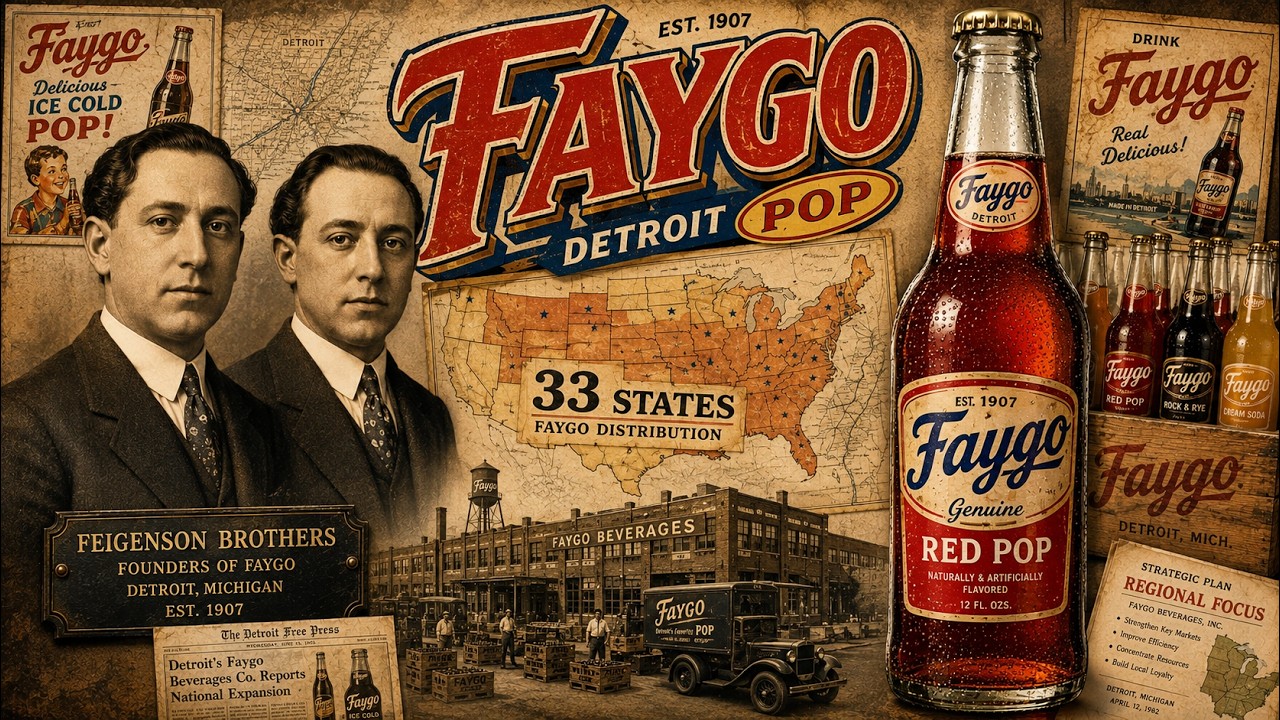
The company never did. But the real story of Faygo is not about a hometown soda losing a war against Coke and Pepsi. It is the story of a company that looked national ambition in the eye and chose deliberately to stay small. The story begins in Detroit in November 1907.
Ben and Perry Feigenson were not soda men. They were bakers. Both brothers had come from Russia as part of the great wave of immigration reshaping American cities at the turn of the century. Perry landed in Detroit first and opened a small bakery.
Ben settled in Cleveland, where he worked bottling soda pop. Perry hated the bakery hours. So he called his brother in Cleveland with an idea: get out of bread, get into bottles. The brothers didn’t have a soda recipe.
What they had was a baker’s recipe book, specifically the flavored frostings Perry used to finish cakes: fruit punch, strawberry, grape. Rather than invent flavors from scratch, they simply carbonated what they already knew how to make taste good. In November 1907, Ben and Perry Feigenson opened the Feigenson Brothers Bottling Works on Benton Street in Detroit. The timing could not have been worse.
That same year, the United States was sliding into the Panic of 1907, a financial crisis that shuttered banks and froze credit across the country. Two immigrant brothers with a wagon, a handful of frosting-based flavors, and no real capital were launching a beverage company into the teeth of a national economic collapse. They started with almost nothing: pots, pails, hoses, one horse, and one wagon. They batch brewed their drinks, then loaded the wagon and sold bottle by bottle, door by door.
Without preservatives, a bottle didn’t last long before it went flat or spoiled. What they made today, they had to sell today. There was no warehouse to hide shelf life problems. A bottle sold for 3 cents, two bottles for a nickel.
To save money, the brothers didn’t rent separate housing. They lived above the bottling plant itself, sleeping just feet from the machinery that was keeping the business alive one batch at a time. In the winter, nobody wanted cold soda pop. Sales nearly stopped.
To survive the off-season, Ben and Perry sold bread and fish on the side, patching together income until warm weather brought customers back. What the Feigensons understood was that Detroit didn’t need another national beverage brand shipped in from somewhere else. It needed something local, cheap, and made by people who lived two floors above their own product. In a city filling up fast with factory workers and immigrant families stretching every nickel, a homemade soda selling two bottles for 5 cents wasn’t competing with the big syrup companies.
It was simply there, priced for families that didn’t have room in the budget for anything else. Over the next decade, the business grew steadily. The brothers earned enough to buy their own homes. They hired their first employee.
They bought a second horse and a second wagon. They kept experimenting with flavor. Sassafras soda joined the lineup. Lithiated lemon followed, a lemon soda flavored using lithium salts, a common additive in early 20th century soft drinks.
Growth on the wagon route eventually outpaced what Benton Street could handle. The brothers built a new, larger plant on Beaubien Street. By the early 1920s, the company had a problem most growing companies would envy: their name was too big for their bottles. “Feigenson Brothers Bottling Works” took up nearly the entire label on a small glass bottle meant to be read at a glance.
In 1921, the brothers shortened it. They took the sound of Feigenson, simplified it, and stamped a new word onto their bottles: Faygo. It was a practical fix, a name that could actually fit on the glass. But practical fixes have a way of becoming identity.
Faygo was shorter, sharper, easier to say. The brothers had accidentally built themselves a brand. The following year, Faygo bought its first delivery truck. By 1923, the company had shifted from wagon routes to home delivery.
New flavors followed through the 1920s, including Rock & Rye, a cream soda-adjacent flavor that would become one of Faygo’s signature drinks for the rest of the century. But growth inside Detroit was about to run into a wall the Feigensons hadn’t built and couldn’t easily tear down: the soda itself. It was not a lack of ambition, good flavors, or loyal customers that kept Faygo a Michigan company for half a century. It was the water.
Faygo pop, made without modern preservatives and bottled using unfiltered water, had a shelf life problem baked into the product from day one. Impurities in the water caused the pop to go flat far faster than a national competitor’s product. A bottle of Faygo simply could not survive a long shipping route to a distant state and still taste the way it was supposed to. For a company dreaming of national shelves, that was close to a fatal flaw.
So Faygo stayed close to home. Through the 1920s, the Depression years, and straight through the middle of the century, its distribution stayed locked almost entirely inside Detroit and Michigan. Not because the Feigensons lacked national ambition, but because their own product wouldn’t survive the trip. In the mid-1940s, control passed from Ben and Perry to the next generation.
The sons inherited a beloved Michigan brand with a ceiling built directly into its chemistry. That ceiling would not lift on its own. It would take a discovery in a Detroit laboratory and a new filtration system to finally set Faygo free. In 1935, the Feigenson sons built a new plant on Gratiot Avenue on Detroit’s east side, a bigger, more modern facility.
It was a statement of confidence in a business that, on paper, still couldn’t ship its own product more than a few dozen miles without it going flat. That Gratiot Avenue plant is still standing today, still making Faygo pop on the same stretch of street nine decades later. In 1935, nobody knew that yet. The trap had a name: the water.
For decades, Faygo’s bottlers had assumed the flat soda problem was simply the nature of the product. It took company chemists years of trial before they landed on the real answer. It wasn’t the syrup or the bottling process. It was impurities in the water itself quietly breaking down carbonation from the inside of every bottle.
The turning invention of the Faygo story is not a flashy one. There was no viral ad campaign, no celebrity spokesman, no dramatic unveiling. It was a filtration system. In the 1950s, Faygo installed a new water filtration process at the Gratiot Avenue plant, engineered specifically to strip out the impurities that had been sabotaging shelf life since 1907.
The results were transformational. A bottle of Faygo that had once gone flat within weeks could now hold its carbonation for more than a year. It wasn’t a new flavor, ad campaign, or new leadership that broke Faygo out of Michigan. It was a filter, a piece of industrial plumbing most customers would never see, quietly solving the one problem that had kept a 50-year-old Detroit institution boxed inside a single state’s borders.
With shelf life finally fixed, Faygo could ship farther than the neighborhood, the city, or Michigan itself. For the first time in company history, the company moved fast to build a public identity to match its new geographic reach. In 1956, it began running its first television and radio advertising. Animated commercials followed through the late 1950s.
By the late 1960s, Faygo had taken the biggest swing of its history: national distribution. Faygo advertising ran during televised Detroit Tigers games, appointment viewing across Michigan and well beyond. It introduced characters like the Faygo Kid alongside jingles built to lodge themselves in viewers’ memories. One line from that era stuck for generations: “Remember when you were a kid?
Well, part of you still is, and that’s why we make Faygo. ”
By the 1980s, Faygo’s flavor lineup had grown past 50 varieties. Its distribution network stretched into more than 30 states. A company that had once needed to win only a two-mile delivery radius around Detroit was now shipping product across a meaningful share of the continental United States.
The filtration system installed quietly in the 1950s had rewritten what Faygo was allowed to become. The cultural embedding went deep. Long before Faygo existed, Americans already used the word “pop” for carbonated soft drinks. Faygo didn’t invent it, but no company leaned into it harder or for longer.
While national brands built their advertising around the word “soda,” Faygo built its identity around “pop,” printing it on labels and repeating it in commercials until, across Michigan, pop simply became the default word for a carbonated drink. In 1970, Faygo’s original strawberry soda, the very first flavor Ben and Perry Feigenson had adapted from a cake frosting recipe in 1907, was officially renamed Red Pop. It remains to this day the company’s best-selling flavor, a direct unbroken thread running from a Russian immigrant baker’s frosting recipe to the most popular product on Faygo’s shelf more than a century later. Underneath the jingles and ballgame ads sat something more structural: price.
Faygo positioned itself deliberately below the price point of the national giants. In an era when a Detroit auto worker was counting nickels between paychecks, a case of Faygo cost less than a case of Coca-Cola or Pepsi. This wasn’t an accident of scale. It was a strategy.
Faygo could never out-advertise Coca-Cola nationally. What it could do was win the arithmetic at the corner store: more pop, more flavors, for less money. That price positioning connected Faygo directly to Detroit’s industrial rhythm. The city that built Faygo was also the city that built the American automobile, a place organized around shift work and factory floors.
By the late 1970s, Faygo had become something more than a beverage company to its hometown. It had become a piece of regional shorthand. The next test didn’t come from Coca-Cola or Pepsi. It came from the Michigan State Legislature.
In 1978, Michigan passed a container deposit law, a bottle bill requiring a refundable deposit on beverage containers to cut litter. On paper, it was an environmental policy. In practice, it was a direct hit to the packaging strategy Faygo had built its business around. Faygo had spent years shifting toward cans, lighter and cheaper to ship.
The new law changed the math overnight. Returnable containers meant returnable bottles, not aluminum cans. Faygo chose to adapt, shifting back toward returnable bottles. It did not go smoothly.
The financial strain lasted for years. Faygo survived the bottle law. It did not collapse, and it did not shut down a single plant because of it. But it emerged from the crisis financially weaker at the exact moment it most needed strength, because a bigger reckoning was forming behind the scenes inside the Feigenson family itself.
The bottle law didn’t break Faygo, but it cracked the foundation just enough to make the next decision, whether to keep fighting alone or sell, impossible to put off any longer. By the early 1980s, Faygo stood at the highest point it would ever reach as a family-owned company. It was trying to sit next to every national brand on the shelf at a lower price, in more flavors, and let the customers’ own arithmetic do the rest. But peaks in this industry rarely arrive without a cost attached.
Competing in 30-plus states against Coca-Cola and Pepsi required constant reinvestment in production, distribution, and advertising, all while Faygo was still absorbing the strain of the bottle law. By the mid-1980s, the third generation of Feigensons was facing a question none of their predecessors had ever had to answer: whether the very expansion that had made Faygo a household name across a third of the country was now threatening to outgrow the family’s ability to fund it. The slow structural math of a family company had grown too large, too fast, on too thin a capital base to keep growing without help. In 1986, that help arrived.
After nearly 80 years under Feigenson family control, Faygo was sold. The buyer was TreeSweet Products Corporation, a Texas-based juice and beverage company. The price was $105 million. This was not a distress sale.
Faygo was sold at the peak of its national reach by a family that had taken it as far as three generations of independent ownership could carry it. It did not take long for the pattern to repeat. Just one year later, in 1987, TreeSweet sold Faygo again. This time to National Beverage Corporation, a Florida-based beverage company that also owned Shasta, a West Coast soda brand built on a strategy remarkably similar to Faygo’s own: undercutting the national giants on price, competing flavor for flavor, rather than head-to-head on advertising budget.
In barely 12 months, Faygo had changed hands twice. This is the point in the story where, in almost every other brand story of this kind, the next sentence describes a factory closing, production relocating, and a hometown watching its industry disappear into a distant headquarters. With Faygo, that pattern broke entirely. The Gratiot Avenue plant did not close.
Production did not move to Florida or Texas or anywhere else. Every bottle and can of Faygo sold today is still made at the same Detroit facility the Feigenson family built in 1935, now approaching its ninth decade of continuous operation under three different owners through two separate acquisitions. National Beverage kept the Gratiot Avenue plant running not out of sentiment, but because it made business sense: a functioning established Detroit facility with decades of institutional knowledge. So the Faygo ownership chain tells two stories at once.
On paper, it looks like every other brand story: family control, sold once, sold again within a year, absorbed into a larger conglomerate with headquarters a thousand miles from where the product was born. But underneath that paperwork sits a decision almost no other acquired brand gets to make: the new owners let Detroit keep making Faygo. Under National Beverage ownership, Faygo did not disappear. But it also did not keep pushing outward the way it had in the 1970s and early 1980s.
Instead, its footprint settled into something narrower and steadier, concentrated distribution across the Midwest, the Mid-Atlantic, and parts of the South, with additional reach into Southern and Western Canada. This was not collapse. It was contraction by design. National Beverage already had Shasta covering West Coast territory with a nearly identical low-price, flavor-forward strategy.
There was no need to force Faygo into a national fight it had already strained itself to sustain. The smarter move was to let Faygo do what it had always done best: dominate the region that actually knew and loved it. The company that once bought advertising time to reach 33 states pulled back into the territory where its name actually meant something. The plant on Gratiot Avenue kept running exactly as it had for decades.
Faygo remains today the last soda pop bottler still operating within the city of Detroit. Every other bottling company that once shared Pop Alley, the informal nickname for Detroit’s cluster of soda manufacturers in the early 20th century, has long since closed or relocated. Out of more than 40 bottlers that once operated in that stretch of the city, Faygo is the one still standing. In 2007, Faygo marked its 100th anniversary with a limited edition centennial soda, a blueberry cream flavor created specifically for the milestone, alongside a label design contest.
Fifteen years later in 2022, the company celebrated its 115th anniversary. In 2018, journalist Joe Grimm published The Faygo Book, a photograph and oral history collection built entirely around the company’s relationship with Detroit. The Detroit Historical Society formally recognized Faygo’s place in the city’s history. The real story of Faygo was never about a hometown soda that lost a war against Coca-Cola and Pepsi.
It was about a company that got close enough to that national fight to feel its full weight, and then, under new ownership, chose to step back into the region that had made it in the first place. Not because it had to, but because staying enormous everywhere was never actually the point. The industry rewards scale almost without exception. Most regional brands that get pulled into that gravity either grow past what they can sustain and collapse, or get bought and hollowed out by someone chasing scale on the new owner’s terms alone.
Faygo did neither. It got bought twice within 13 months, and its own factory kept running exactly where it always had. Because for once, staying regional wasn’t a failure to escape.
It was the strategy that worked.