In the winter of 1941, in a blacked-out London where bombs fell most nights, a 21-year-old woman sat across a dinner table from the richest and most important American in Britain. Her husband was 3,000 miles away in the desert. Her father-in-law was the prime minister. The man holding her gaze controlled the flow of guns, ships, and food that were keeping Britain alive.
Within weeks, she was his lover. The affair was conducted so openly that the whole of Downing Street knew and chose to say nothing.
She had no fortune of her own. She was not, by the standards of her age, a beauty. What she had was a single gift. Over the next 50 years, she would use it to bury three husbands, outlast every rival, and end her life as the ambassador of the most powerful country on Earth.
Pamela Beryl Digby was born on March 20, 1920, at Farnborough in Hampshire. She was the eldest daughter of a family whose blood was old and whose money was thin. Her father, Edward Kenelm Digby, was the 11th Baron Digby, master of Minterne, a handsome house set in the green folds of Dorset. The acres had belonged to the Digbys for centuries.
It was the very picture of English landed permanence. It was also, like a great many old county families between the wars, far grander in name than in funds. That gap between the title on the gate and the figures in the ledger shaped Pamela from the beginning.
She grew up in the conventional rhythm of the interwar rural gentry. She learned to ride almost before she could read. She was sent abroad to be finished, to Paris and to Munich, and came home speaking good French and carrying the polish that her class expected of its daughters.
In 1938, she was presented at the court of King George VI, a debutante in white among the other debutantes. There was, however, a problem. She was not beautiful. The great beauties of her generation were slim and sculpted and luminous, and she was none of those things.
She was auburn-haired and fair-skinned, round of face, inclined to plumpness, pretty in a healthy English way, but never the woman who stopped a room when she entered it. In a world where a girl of small fortune was expected to trade on her looks to marry well, she had been handed a modest hand of cards.
Pamela did something far more interesting. She found the one card she did hold, and she learned to play it better than anyone alive. From her earliest years in society, the people who met her noticed the same thing again and again across 60 years and three countries.
She made every man believe he was the only one. She listened as though the man in front of her were the single most fascinating person who had ever spoken. She remembered the details of his work, his worries, and his small vanities, and fed them back to him with a warmth that felt entirely genuine.
She did not dazzle a room. She captured one person in it completely and made him feel larger and cleverer and more important than he had ever felt before. In a world run entirely by men, the woman who could command a powerful man's attention held a sliver of his power in her own hand.
She had no money to bring to a marriage. She had no exceptional beauty. So, she made herself instead into the most attentive, most flattering, most necessary companion a great man could find. And she set out to attach herself to the greatest men she could reach.
The summer of 1939, when she came out fully into the adult world, was the last summer of the old order. The parties went on, the dances, the country weekends. But the shadow of the coming war lay over all of it.
Pamela, 19 years old and impatient with Dorset, came up to London hungry for a life larger than the one she had been born to. She did not yet know how she would get it. She only knew that she would.
Then, in the first week of September, with the country sliding into war, she sat down to dinner beside a man whose surname was the most famous in Britain.
She met Randolph Churchill at a dinner table a fortnight after Britain declared war, and she was engaged to him before the week was out. Randolph was the only son of Winston Churchill, then First Lord of the Admiralty and soon to be Prime Minister.
He was 28, handsome in a heavy way, brilliant in flashes, and already marked by the drinking and the recklessness that would ruin him. He was a serving officer now, and like many young men in uniform that autumn, he was seized by a single urgent thought that he might be killed, and that he ought to father a son to carry the Churchill line before he went.
Into that urgent sea walked Pamela, 19 and fresh from Dorset, attentive and warm and flattering in exactly the way that a vain, insecure, much criticized young man found irresistible. Randolph had proposed to a string of women that autumn, by some accounts as many as eight. Pamela said yes.
She was not in love with him in any deep sense, but she understood with great clarity what the marriage offered. It offered the name. It offered entry into the most famous and most powerful family in the country at the very moment that family was about to lead the nation through its greatest trial.
They were married on October 4, 1939, at the Church of St. John in Smith Square, Westminster, one month and one day after Britain had gone to war. She was 19. He was 28. The name on the register changed everything about her position in the world.
The plain Baron's daughter from Minterne was now Pamela Churchill, daughter-in-law of the man who would within seven months be Prime Minister of Great Britain. Whatever else the marriage was, it was the single most effective social maneuver of her early life, and she had executed it in a matter of days.
The marriage itself began to disappoint almost at once. Randolph drank heavily. He gambled with a recklessness that bordered on the pathological. He was loud, quarrelsome, and given to picking fights with the very people his father needed as allies.
Pamela, who had married the name rather than the man, found herself yoked to a personality that even his adoring father struggled to manage. But the name was doing its work. As Randolph went off to his regiment, Pamela was drawn into the heart of the Churchill family at the precise moment it became the heart of the nation.
When Winston Churchill became Prime Minister in May of 1940, his daughter-in-law was already installed within his orbit. She was a young woman the great man found pleasant and easy and undemanding company at a time when almost everyone else in his life brought him problems.
A year before, she had been one of hundreds of debutantes, a girl with a good name and no money and no particular prospects. Now she dined at Downing Street. She spent weekends at Chequers, the Prime Minister's country house, while the fate of the war was decided in the rooms around her.
For a young woman whose only asset was her ability to attach herself to power, she had attached herself at 19 to the most concentrated source of power in the country. She was about to put that closeness to the most audacious use imaginable.
On October 10, 1940, almost exactly a year after the wedding, she gave birth to a son. They named him Winston after his grandfather. The birth of a male Churchill heir secured Pamela's place in the family beyond any question.
She had done the one thing Randolph had married her to do. She had produced the son. Whatever happened to the marriage now, she was the mother of the Prime Minister's grandson, and that was a position no divorce could take from her.
The early war years saw her living a curious double life. On the surface, she was the dutiful young wife and mother. Underneath, the marriage to Randolph was disintegrating with remarkable speed.
The trouble, as it so often was with Randolph, came down to money. Sent abroad on service, he ran up gambling debts on the very voyage out, losing heavily at cards to his fellow officers, and then writing home to instruct Pamela to settle the accounts.
One such demand was for a sum of around $12,000, a fortune in those years. Pamela had no means of paying it. What she did next reveals the steel beneath the soft manner.
Rather than go to the Churchills and expose her husband's recklessness, she protected the family name and shouldered the problem herself. She took a paid job at the Ministry of Supply, earning around 12 pounds a week. She quietly sold the wedding presents. She sold a good deal of her jewelry.
She moved the baby out of London to the countryside for safety and economized wherever she could, all while keeping the scale of Randolph's debts a secret from his parents. The girl who had married for the name now found herself working to defend it.
London in the winter of 1940 and 41 was a city under siege from the air. The Blitz battered the capital night after night. Pamela, like everyone else, lived with the sound of the sirens and the bombs and the long uncertain nights in the shelters.
She was a young mother, effectively without a husband, carrying her family's debts in a city that might be destroyed around her at any moment. The pressures of that period would have broken many women of her background. Instead, they seem to have concentrated her.
For all the strain, her position at the center of things was extraordinary. She made herself useful to her father-in-law in small, constant ways, the kind of attentive companionship that a man under enormous pressure comes to rely on.
She was good with him in a way few people were, undemanding, cheerful, easy to have at the table at the end of a terrible day. Clementine Churchill, Winston's formidable wife, kept a cooler eye on her daughter-in-law, but even she found Pamela hard to dislike.
The contrast at the center of her life by early 1941 was stark. Here was a marriage that existed now mostly on paper to a husband who was absent, unreliable, and sinking under his own failings. And here, all around her, was the most concentrated power in the nation.
In March of 1941, a tall, grave, immensely rich American stepped off a plane into wartime London carrying the power to keep Britain in the war. His name was William Averell Harriman, and he had arrived as the personal envoy of President Franklin Roosevelt.
He was charged with overseeing the program that the Americans called Lend-Lease, the vast flow of weapons, ships, aircraft, food, and raw materials that the United States was sending to a Britain that could no longer pay for them. He was in that single role the most important American in the country.
Harriman was 49 years old, the son of one of the great fortunes of American history. His father, Edward Henry Harriman, had been a railroad baron who built one of the largest transport empires the United States had ever seen.
He was reserved, serious, a touch cold, a man of duty rather than charm. He was also married to his second wife, Marie Norton Whitney, and he had a grown daughter close to Pamela's own age.
The position he held in London made him, for Churchill, a man to be courted with everything the British had. The whole strategy of British survival rested on binding the United States ever closer. Churchill flattered him, dined him, took him to Chequers, and brought him inside the family circle.
It was in exactly this atmosphere of careful, deliberate hospitality that Averell Harriman was introduced to Pamela Churchill. The introduction came, by most accounts, at the Dorchester Hotel during an air raid in the early days after his arrival.
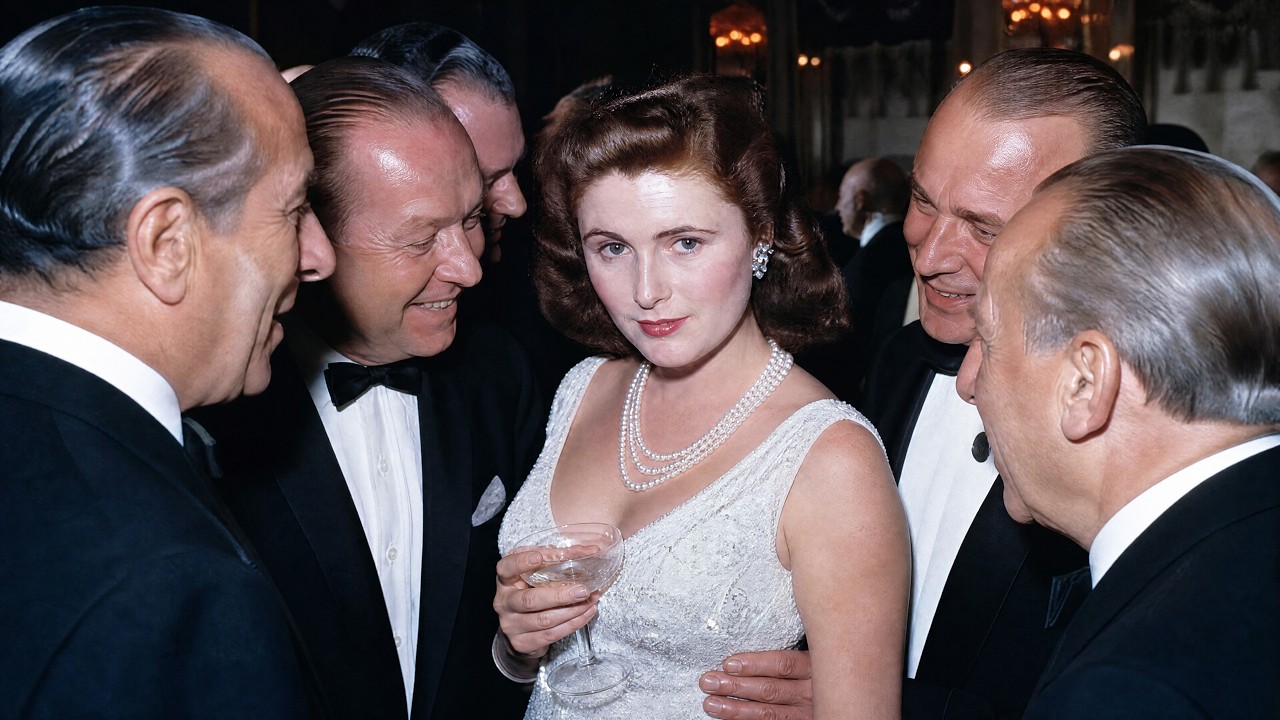
Here was the most attentive young woman in London, schooled in the art of making a great man feel he was the only one, seated beside the most important American in the country. He was a serious and rather lonely man far from home, carrying the heaviest responsibility of his life.
The chemistry was almost inevitable, and it was almost instantaneous. Harriman was lonely, powerful, and far from his wife. Pamela was trapped in a failing marriage to an absent and unreliable husband, hungry for a connection to real power.
The Churchill household, watching it all, had every reason in the world to want the great American envoy to feel happy, welcome, and emotionally tied to Britain. It is hard to imagine a set of circumstances more likely to produce exactly what it produced.
He commanded a program that would, across the war, channel goods worth more than $30 billion to Britain alone. He came from a family fortune built on tens of thousands of miles of railroad track.
The girl from Minterne, who had sold her wedding presents to cover her husband's card debts, was about to attach herself to one of the largest concentrations of private wealth and public power in the Western world. She was 21 years old.
There was something in Harriman that made him unusually vulnerable to a woman of Pamela's gifts. For all his wealth and his power, he was not a man of easy warmth. He was far from his wife, isolated by the secrecy of his work.
What he lacked was someone who simply made him feel at ease, who listened without wanting, who made the weight of his position seem lighter for an evening. Pamela gave him precisely that.
Within weeks of their meeting, Pamela Churchill and Averell Harriman were lovers. The affair would become one of the worst-kept secrets of wartime London, and one of the most quietly consequential.
It was conducted not in spite of the Churchills, but in a strange and unspoken way, with their tolerance. The question of why a prime minister would permit his daughter-in-law to take the American envoy as her lover leads into the strangest part of the whole story.
She was 21, he was 49 and married. And within weeks of their first meeting, the whole of Downing Street knew what was happening between them. The affair was extraordinary, not because it was secret but because it was not.
They were seen together. They were known to be together. And the family at the center of British power, the Churchills themselves, said nothing, did nothing, and allowed it to continue.
Pamela was the wife of Winston Churchill's only son. She was the mother of his infant grandson and namesake. By every ordinary standard of the time, her taking a lover while her husband fought abroad was a scandal that should have brought the full weight of family disapproval down upon her.
Yet Winston and Clementine Churchill, who missed very little, chose to look away. There is no record of Winston confronting Pamela, no record of Clementine casting her out, no record of any attempt to end the relationship.
The silence was deliberate, and it was in its way a calculation. The Prime Minister of a country fighting for its survival had decided that the comfort and goodwill of the American envoy mattered more than the propriety of his daughter-in-law's behavior.
Pamela herself navigated the situation with a poise that belied her age. She did not flaunt the affair to wound her husband, nor did she pretend it was not happening. She simply carried on conducting the relationship with discretion enough to preserve appearances and openness enough that everyone who mattered understood the truth.
She had grasped something that would serve her for the rest of her life, that a powerful family will tolerate a great deal from a person who makes their lives easier and asks nothing awkward in return.
The relationship deepened through 1941. Harriman, grave and reserved in public, was by all accounts deeply taken with the young woman who listened to him so completely and asked for so little.
For Pamela, the affair was both a genuine attachment and a profound education. Through Harriman, she came to understand the inner workings of the Anglo-American alliance. She was no longer merely close to power through her marriage. She was now intimate with one of the men who held the lifeline of the war in his hands.
There is a striking detail in the geography of the affair. For a time, Harriman's own grown daughter, Kathleen, came to London and became Pamela's close friend and flatmate. The two young women shared quarters even as Pamela carried on her relationship with Kathleen's father.
The society around them watched and gossiped and marveled. London in the war was a small world at the top. The Dorchester and the Savoy, where the powerful sheltered from the bombing in their grand basements, hummed with the knowledge of it.
Pamela moved through it all with an unbothered grace that some found admirable and others found chilling. She had decided very early that the judgments of society were a price worth paying for the things society could not give her.
Some who knew her well came to believe that Pamela was not only Harriman's lover, but Churchill's most useful private channel to the Americans. The argument runs like this.
Pamela spent her nights with the man who controlled the flow of American supply and who knew the mind of the Roosevelt administration as few others in London did. She spent her days inside the Churchill family, dining with the Prime Minister, weekending at Chequers.
She was, in other words, perfectly positioned to carry what she learned from the American at night to the Englishman at breakfast. Several of her biographers have concluded that this is exactly what she did.
That Pamela had the affair is beyond dispute. That she was close to Churchill is beyond dispute. That she moved between the two worlds is beyond dispute. What cannot be proven is the precise content of what passed between them.
The idea that she was a deliberate conduit, a kind of willing listening post between Number 10 and the White House, sits on the interpretation side of the line. It is what some serious students of her life believe, argued from the circumstances.
But the circumstances are suggestive. Pamela was an extraordinary listener, the kind of woman to whom men talked freely. Harriman was a man under immense pressure, far from home, and she was the person he relaxed with.
Whether or not Churchill formally directed it, the simple flow of a clever, attentive woman between two centers of power could not help but carry information with it.
Pamela was learning in the most direct way possible that intimacy with powerful men was itself a form of power. She was discovering that the woman who holds a great man's confidence holds something that other people want.
She was not a spy in any formal sense. She was something subtler and in the long run more durable. A woman who understood that proximity to power, patiently cultivated, was a currency she could spend for the rest of her life.
The arrangement also taught her the value of being underestimated. To the men around her, Pamela was a pretty, agreeable young woman, the sort one talked freely in front of precisely because one did not take her entirely seriously.
That underestimation was her great advantage. She could sit at a table of powerful men, absorbing everything, weighing everyone, and they would think of her only as a delightful presence, never as a player in her own right.
She was 21 years old. The man she shared her nights with controlled a supply program that kept an entire nation fighting. The man she dined with by day directed the war effort of the British Empire.
Between those two men passed decisions that would shape the fate of the world. And in the narrow, intimate space between them moved a baron's daughter from Dorset, plain and penniless three years before, now woven into the private fabric of the alliance that would win the war.
By the time Harriman's duties carried him away from London later in the war, Pamela had been transformed. She had entered the war a 19-year-old bride of a difficult man. She was emerging as something entirely new.
When Harriman sailed home to other duties, the war brought a steady parade of powerful Americans to London and to Pamela, and she received them. The years between 1941 and the war's end saw the British capital fill with the most important men of the United States.
Many of them found in Pamela Churchill exactly the warmth and attention they craved. She became, in the words that would later cling to her, the great hostess of the Anglo-American alliance and a good deal more, besides.
The most famous of these attachments was to Edward Murrow, the celebrated American broadcaster whose nightly reports from London, opening with the words "This is London," brought the courage of the bombed city into millions of American homes.
Murrow was the voice of Britain's suffering to the United States, a man of enormous prestige and moral weight. His relationship with Pamela was serious enough that it shook his marriage to its foundations. By some accounts, he came close to leaving his wife for her.
Then there was William Paley, the founder and chairman of the Columbia Broadcasting System, the network that Murrow worked for. Paley was in London during the war on government service, and he, too, fell within Pamela's circle.
And there was John Hay Whitney, known as Jock, heir to one of the largest fortunes in the United States, descended from the Whitney and Payne families. A man who would later serve as the American ambassador to the court of St. James.
These three men, Harriman, Paley, and Whitney, are the figures the story gathers under the dramatic banner of the three American billionaires. In the money of the 1940s, they were not billionaires in the literal sense, but ultra-rich men of the first rank.
What is true, and what matters, is that Pamela attached herself in a single span of wartime years to three of the richest and most powerful Americans alive. The master of the Anglo-American supply line, the founder of a broadcasting empire, and the heir to one of the great Gilded Age fortunes.
Around these three moved others, lesser in fame, but considerable in their own right. There was Major General Frederick Anderson of the United States 8th Air Force. There was the broadcaster and writer Quentin Reynolds.

Through them all, Pamela built something no money could have bought her. An address book of the American establishment, a web of personal connections to the men who were rising to run the most powerful country on Earth.
Set the three great names side by side, and the scale of what she had gathered becomes clear. Averell Harriman commanded a flow of supplies worth more than $30 billion across the war to Britain alone. William Paley had built the Columbia Broadcasting System into one of the two networks that would dominate American broadcasting for half a century. Jock Whitney sat atop a Gilded Age fortune reckoned among the largest in the United States.
Three men, three empires of money and influence, and a single Englishwoman of 24 with no fortune of her own who had drawn all three into her orbit within the space of a few wartime years.
It was not simple seduction, not mere beauty, for she had already been told often enough that she was not a beauty. It was the rarer thing she had cultivated since girlhood, the total, flattering, unhurried attention that made each of these formidable men feel for the hours he spent with her that he was the most interesting and important man alive.
The cost of all this was her marriage, and by the war's later years, there was almost nothing left of it to lose. Randolph, returning periodically from his service, learned of his wife's affairs, and the discovery enraged and humiliated him.
There were furious scenes and bitter recriminations. The union that had given Pamela the Churchill name was finished in all but the legal sense, held together only by the child and by the awkwardness of a divorce within the Prime Minister's family during a war.
By the time the guns fell silent in 1945, Pamela Churchill stood at a strange crossroads. She was 25 years old. She had a son, a famous name, and a collection of powerful friends and former lovers scattered across the most important country in the post-war world.
She had no husband worth keeping, no fortune of her own, and a reputation that hovered between glamorous and scandalous. The war that had made her had also burned away the marriage that gave her the name.
The divorce from Randolph Churchill came in 1945 and was finalized in the months that followed. Pamela kept two things from it that would matter for the rest of her life. She kept her son, young Winston. And she kept the name Churchill.
Randolph's own story moved swiftly toward tragedy. Freed of the marriage, he did not recover. The drinking deepened. The quarrels multiplied. He died in 1968 at the age of 57, a disappointed and diminished man.
Pamela, by contrast, was only beginning. In the late 1940s, she made a decision that would define the middle of her life. She left England with its rationing and its gray austerity and its memory of her wartime reputation, and she moved to Paris.
Post-war Paris was reviving as the capital of European pleasure and style. A city where a beautiful manner mattered more than a fat inheritance. And where a woman with charm and connections could remake herself entirely.
In London, she was Randolph's discarded wife, the girl with a past. In Paris, she could be whoever she chose to be. She arrived with very little money and a great deal of nerve.
Paris in those years was a gathering place for the surviving aristocracy of Europe, for industrialists and bankers and heirs. Pamela set herself up, modestly at first, and began to do what she did better than anyone, to attach herself to the very richest men she could find.
She refined her taste. She learned about art, about wine, about furniture and food, and all the small expensive languages of the very rich. She converted, in time, to the Roman Catholic faith.
Paris in those years ran on a particular economy that suited Pamela perfectly, an economy of the kept woman raised to an art form. It was understood among a certain stratum of the very rich that a beautiful and amusing companion was a thing a great man maintained as he maintained his houses and his horses.
Pamela did it superbly. She understood the unspoken terms of the arrangement, the need to be charming without being grasping, present without being possessive, devoted without being a burden.
The first of the great men she attached herself to, the one she would later call the great love of her life, was the dashing young heir to one of the largest industrial fortunes on the continent.
His name was Gianni Agnelli, and in the Italy of the early 1950s, he was the most glamorous man alive. He was the grandson and heir of the founder of Fiat, the car company that was rebuilding industrial Italy.
He was handsome, charming, fabulously rich, and recklessly alive. When Pamela met him, she was a divorced Englishwoman in her late 20s with a famous name and little money. He was a few years younger, an heir to one of the great fortunes of Europe.
For roughly five years, through the early 1950s, Pamela was Agnelli's companion, installed in style, moving with him between Paris and the Riviera and the great houses of Italy. They were, for a time, one of the golden couples of the continent.
Pamela seems to have allowed herself, in those years, to love as well as to calculate. The world she now inhabited was the glittering high society of the post-war Mediterranean.
But beneath the glamour ran the old familiar problem. Pamela wanted to marry him. She wanted the security, the title, the permanence that marriage to Agnelli would bring. And Agnelli, for all his devotion, would not marry her.
In 1953, Gianni Agnelli married Marella Caracciolo, a beautiful Italian princess of impeccable lineage. Pamela was left with nothing but the memory of the happiest years she would ever name.
She had made herself the perfect companion to a great man, indispensable in every respect but one. She could give him everything except the bloodline and the social fitness that his family demanded in a wife.
The years with Agnelli completed her European education. She emerged from them with flawless taste, deep knowledge of art and food and wine, and a polish that no finishing school could have given her.
After Agnelli came a Rothschild. Baron Elie de Rothschild was a member of the French branch of the most famous banking family in the world, a partner in the family bank, and a master of the great vineyard of Chateau Lafite.
He was cultivated, worldly, immensely rich, and crucially, married. When Pamela became his companion in the years after Agnelli, she entered a relationship with a man whose wealth and sophistication matched anything she had known.
The relationship was, in its way, another stage of her education. A de Rothschild schooled her further in the connoisseurship of the European elite, deepening her knowledge of wine, of art, of the refined pleasures that the very rich made into a way of life.
But the heart of the matter was, once again, marriage. And once again, it was denied her. Rothschild was married, and a Rothschild did not divorce his wife to marry a divorced and somewhat notorious Englishwoman.
Pamela, by several accounts, pressed the point. She is said to have issued something close to an ultimatum. The answer was the one she had heard before. He would not leave his wife.
The House of Rothschild was a name to conjure with, one of the great financial dynasties of the modern world. To be the companion of a Rothschild baron was to stand at yet another summit of European wealth and prestige.
And yet the very grandeur of the name was part of what doomed Pamela's hopes. For a family so conscious of its lineage and its position was the last family on earth to absorb a divorced Englishwoman with a colorful past.
It was the repetition that taught the lesson. Once might have been bad luck. Twice was a pattern. She had now given years of her life to two of the richest men in Europe, and both had been content to keep her and unwilling to wed her.
The conclusion was inescapable and bitter. As long as she pursued men who were already attached, men whose families and positions made her unmarriageable, she would remain forever the companion and never the wife.
She had been refused twice. She resolved in effect never to be refused a third time. She treated her two great romantic failures not as heartbreaks to be mourned, but as data to be analyzed.
Pamela stopped chasing the unattainable married princes of Europe, and began instead to look for a man she could actually marry, a man whose situation made marriage possible, and whose wealth and standing made it worthwhile.
In New York, she found at last a man who would marry her, a Broadway producer who left his own wife to make Pamela his bride. His name was Leland Hayward.
He was one of the most successful theatrical and film producers of his era, the man behind a string of celebrated Broadway shows and Hollywood pictures. When Pamela met him at the end of the 1950s, he was married to his wife Slim, a famous beauty in her own right.
This time the campaign succeeded where the others had failed. Pamela set her sights on Hayward and did not let go. He divorced Slim, an episode that earned Pamela a fresh wave of hostility, and in 1960, he married her.
After two great refusals, after all the years of being the companion who was never quite the wife, Pamela Churchill had finally won the thing she had wanted since Agnelli. She had a husband, a real and legal one.
She was now Pamela Hayward, and she had crossed the Atlantic to become an American wife. She reinvented herself once more, this time as the devoted wife of a leading American producer, and as a hostess at the heart of New York's theatrical and social world.
She made their homes beautiful. She entertained brilliantly. She cared for Hayward and his interests with the same flattering attention she had once given to wartime envoys and Italian heirs.
It was not without its frictions. Pamela's arrival in Hayward's life had broken a marriage and disrupted a family, and his children from the previous marriage did not welcome the woman who had displaced their mother.

For 11 years, she was Leland Hayward's wife. And by the accounts of the period, it was, in its way, a successful and even happy marriage. She had stopped chasing the impossible and settled into the achievable.
And then, in 1971, Leland Hayward died. And Pamela, at the age of 51, found herself a widow in a foreign country.
Within months of burying Leland Hayward, she would marry again. And the man she married would be the very first of her great lovers, the American envoy from the blacked-out London of 30 years before, now a widower himself, and richer and more powerful than ever.
Six months after she buried one husband, she married the man she had taken as a lover 30 years before. Harriman had gone on to a towering public career.
He had served as ambassador to the Soviet Union and to Britain, as secretary of commerce, as governor of New York, as a negotiator and elder statesman of the Democratic Party. His wife, Marie, had died. And in 1971, he was a widower in his late 70s.
They met again at a dinner in Washington, the old lovers, both now free, 30 years after the blacked-out nights of the Blitz. The attraction that had drawn them together in wartime reasserted itself with remarkable speed.
The wedding took place in 1971, only about six months after Leland Hayward's death. She was marrying not a stranger, but the first of her great men.
Through Averell Harriman, Pamela gained two things she had pursued her whole life and never fully possessed. She gained American citizenship. And she gained access to one of the great American fortunes, the Harriman railroad money.
She became the wife of a revered elder statesman, the chatelaine of his estates, the partner of a man at the very center of the Democratic establishment. The baron's daughter, who had sold her jewelry in the Blitz, was now one of the wealthiest and most connected women in the United States.
She devoted herself to Averell with the same completeness she had brought to every important man in her life. He was an old man now, and Pamela nursed him, managed his life, and kept him at the center of things.
Through him, she was drawn ever deeper into the world of Democratic politics, the fundraising, the strategizing, the network of powerful figures who ran the party. She was becoming, in her own right, a figure in American political life.
Averell Harriman died in 1986 at the age of 94. His death left Pamela a very rich widow and plunged her into one of the bitterest battles of her life.
The Harriman fortune and the trusts through which much of it flowed became the object of a long and savage legal war between Pamela and Averell's children and grandchildren from his earlier marriages.
They accused her, in essence, of mismanaging and draining the family money that should have passed to them. The litigation dragged on for years, costly, public, and damaging to her reputation.
The Harriman children and grandchildren had watched their father's vast fortune pass, in large part, into the hands of a woman who had married him late in his life and who had first come into the family 30 years before as the lover who broke their parents' world.
The lawsuits ran for years and reached into the tens of millions of dollars. It was the price of her method laid bare.
Yet, even as the inheritance battle raged, Pamela was building something the Harriman heirs could never take from her, a position of real and independent power in the politics of the United States.
By the start of the 1980s, the Democratic Party was in disarray, beaten and demoralized, locked out of the presidency and short of money and direction. Pamela decided to do something about it.
In 1981, she founded a political action committee, formally called Democrats for the '80s, and known to everyone with affection and a little awe as Pam PAC. From her estate at Middleburg, Virginia, she set out to raise money and rebuild the party's fortunes.
She turned out to be magnificent at it. The same gifts that had drawn wartime envoys and Italian heirs now drew donors, politicians, and operatives to her dinners and her gatherings.
She made every guest feel important, every donor feel valued, every rising politician feel that she believed in him personally. In its first 20 months alone, her committee raised more than a million dollars.
Over its life, it is credited with raising on the order of $10 million, a vast sum channeled into the rebuilding of Democratic campaigns and the support of more than a hundred candidates for office.
The crowning achievement of this final career came with the rise of Bill Clinton. Pamela was an early and important backer of the young governor of Arkansas.
A single fundraiser at her Middleburg estate in 1992 is said to have gathered more than $3 million for his campaign in one day. She helped bring the party's money and its grandees behind him.
When Clinton won the presidency in 1992, Pamela Harriman had backed the winner. And winners remember their friends.
In 1993, President Clinton appointed Pamela Harriman the United States Ambassador to France. The Baron's daughter from Dorset returned to the city of her great love affairs, not as a kept companion, but as the official representative of the most powerful nation on Earth.
She took up residence in the magnificent Ambassador's house in Paris. And she filled the role with distinction, working hard at the substance of diplomacy, and bringing to it all the charm and connection she had spent a lifetime perfecting.
What she brought to American politics was, in the end, the same thing she had brought to every man and every room across her whole life. Only now turned to a public purpose.
She made people feel seen. She made the nervous donor feel important. The ambitious young politician feel believed in. She remembered names and worries and small particulars.
She had spent 50 years learning how to make the powerful adore her. Now she spent that knowledge in the service of a cause, and it made her one of the most effective political operators of her age.
She had begun as the penniless daughter of an obscure English barony. She had married the son of a prime minister, taken the most powerful American in wartime Britain as her lover, been kept by the heir to Fiat and a baron of the Rothschilds, married a Broadway producer, and then the railroad heir she had first loved in the Blitz.
Finally, at an age when most lives are winding down, she made herself a maker of presidents and an ambassador of the United States. Few human beings of any birth and almost no woman of her era ever climbed so far on so little.
She had risen entirely through the one avenue open to a clever woman in a world run by men, the cultivation of those men, patiently, brilliantly, across 50 years and three countries.
On a day in early February of 1997, Pamela Harriman, then 76 years old and serving as the American ambassador, went as she often did to swim her laps in the indoor pool of the Hotel Ritz.
It was there, in the water, that she suffered a sudden cerebral hemorrhage. She was pulled from the pool and rushed to the American Hospital at Neuilly, on the edge of Paris. And there, the following day, she died.
The president of France, Jacques Chirac, came in person to honor her and laid upon her flag-draped coffin the Grand Cross of the Legion of Honor, the highest order France can bestow. An honor, it was said, never before given to a woman serving as a foreign diplomat.
President Bill Clinton, whom she had helped to power, sent the presidential aircraft, Air Force One itself, across the Atlantic to bring her body home to the United States.
Her funeral was held in February of 1997 at the National Cathedral in Washington, and the powerful of American public life gathered to mourn her. Clinton himself spoke in her praise.
The argument over who she had really been began at once, and it has never entirely been settled. To her detractors, Pamela Harriman was the courtesan of the century, a woman who had slept her way from a Dorset barony to a Washington Cathedral.
To her admirers, she was something far more impressive, the cleverest political operator of her generation, a self-made woman who had risen through the only door history left open to her.
Perhaps the truth lives in that very gap, in the refusal of her life to resolve into either story. She had been denied the fortune her name implied. She had been refused twice by the men she most wanted to marry.
And she had answered every denial and every refusal and every insult not with protest but with relentless, patient, brilliant advance until the country that had nothing to offer the plain girl at Minterne was sending its president's plane to carry her home.
She had made every man believe he was the only one. And in the end, she had made an entire establishment believe she belonged at its center, which she had never been born to do.
Picture once more the young woman of 21 at the wartime dinner table, plain and penniless and unremarkable, fixing her whole attention on the most important man in the room and making him feel he was the only one alive.
Everything that followed, the husbands and the lovers and the fortunes and the honors, flowed from that single gift exercised without rest for more than 50 years. She had no money, no great beauty, and no power the world would recognize.
She had only attention and the will to spend it. And with those two things alone, she rewrote the whole of her own ending.