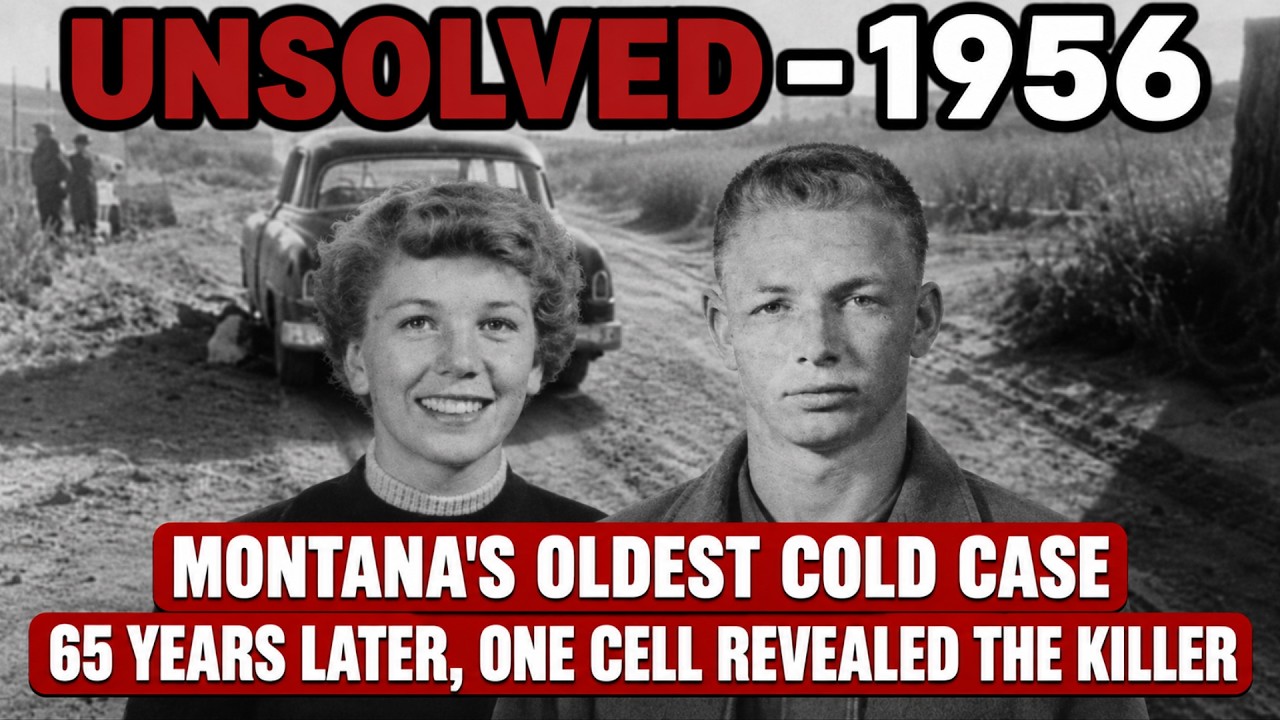
On the night of January 2, 1956, 18-year-old Lloyd Duane Bogle, an airman stationed at Malmstrom Air Force Base, drove his girlfriend, 16-year-old Patricia Kalitzke, to a secluded road near Wadsworth Park along the Sun River in Great Falls, Montana. The two had just left a drive-in restaurant after 9 p.m. They were young, in love, and talking about marriage. Bogle never made it home.
The next morning, three boys walking along the Sun River found Bogle lying face down next to his car. His hands were tied behind his back with his own belt. He had been shot twice in the head. The car was still running, still in gear, with the parking brake engaged. His money and personal belongings were untouched. This was not a robbery. It was an execution.
Kalitzke was missing. The following afternoon, a county road worker found her body at the bottom of a 6-meter embankment on Vineyard Road, about five miles north of where Bogle was killed. She had been raped and shot in the head. She was 16 years old.
Investigators followed every lead. They interviewed dozens of people. Over the years, they considered about 35 suspects, including notorious crime boss Whitey Bulger, who was in the area at the time and had previously been arrested for rape in Great Falls. All of them were cleared. There was no motive, no connection, no arrest. The case went cold for decades.
It took 65 years, generations of investigators who refused to give up, a sperm cell preserved on a microscope slide since 1956, and a technological breakthrough that did not exist in anyone’s imagination at the time of the murders. This is the story of the oldest cold case in American history to be solved through forensic genealogy.
Lloyd Bogle grew up in Waco, Texas, a small town where young men faced two clear paths: stay and work the farms and factories, or join the military and leave. Bogle chose the second path. He joined the U.S. Air Force and was assigned to Malmstrom Air Force Base in Great Falls, Montana, more than 2,000 miles north of Waco. He was 18 years old.
Patricia Kalitzke was born and raised in Great Falls. She was a junior at Great Falls High School when she met Bogle. According to investigator John Kadner, who would later dedicate nearly a decade of his life to the case, Bogle was immediately captivated by her. Friends said he spoke about her with a certainty rare for an 18-year-old. The two began dating and soon started talking about marriage.
Great Falls in 1956 was a quiet town of about 40,000 people. The lovers’ lanes along the Sun River and near Wadsworth Park were a natural part of teenage life in 1950s America. Malmstrom Air Force Base brought a steady flow of young soldiers to the area, and Bogle was one of them. He was not the type to cause trouble. He was the type to build a life.
On the evening of January 2, 1956, Bogle took Kalitzke to a drive-in restaurant in Great Falls. They were last seen there shortly after 9 p.m. From the restaurant, they drove to a deserted road west of Great Falls, near Wadsworth Park along the Sun River. Neither family worried immediately when they did not come home that night. Some sources say the families even assumed the couple had eloped. They had not.
On the morning of January 3, three boys walking along the Sun River found Bogle’s car. Next to it, they found him. His hands were tied behind his back with his own belt. He had been shot twice in the head. The engine was still running. The transmission was still in gear. The parking brake was engaged. His money was still in his pockets. Nothing had been stolen.
The boys alerted police immediately. Officers arrived and realized that Patricia Kalitzke, the girl Bogle had been out with the night before, was not there. She had disappeared. A search began at once. The next evening, a county road worker found her body at the bottom of a steep embankment on Vineyard Road, near an area known as Hill 57, about five miles north of where Bogle was found. She had been raped and shot in the head.
Investigators reconstructed the sequence of events. Bogle was killed first. The killer bound his hands, shot him, then took Kalitzke from the scene. He drove or forced her to travel five miles north, raped her, shot her in the head, and threw her body down the embankment. Then he disappeared. No one saw him. No one heard the gunshots. No piece of evidence led to any specific person.
The community was shocked. Two beloved young people, an airman and a high school student, had been brutally murdered. The initial investigation did not lack resources or determination. Law enforcement in Cascade County spent weeks, then months, then years chasing the killer. They examined every soldier at Malmstrom Air Force Base who had contact with Bogle. They interviewed people living near the lovers’ lane along the Sun River. They tracked every vehicle seen near Wadsworth Park in the days around the crime. They searched for a motive: jealousy, hatred, money, personal conflict. There was nothing.
Bogle was a young serviceman new to town. Kalitzke was a high school student living an ordinary life. No one had an obvious reason to want them dead. That was what made the case more terrifying than any explanation. If the killer had a motive, police could work backward from it to find him. But when there is no motive, and when the victims are two young people chosen at random on a deserted road at night, anyone could be the killer. And anyone could be the next victim.
Parents began forbidding their children from going to lovers’ lanes. Young people no longer drove to the outskirts at night with the same carelessness as before. The fear did not come from a specific threat. It came from not knowing, from the fact that the killer was still out there somewhere, and no one knew who he was.
Over the years, approximately 35 suspects came under investigators’ scrutiny. That number is not an exaggeration. Thirty-five men, each with a different reason, were examined, interviewed, investigated, and cleared. Among them was James Joseph “Whitey” Bulger Jr., the notorious Boston crime boss who would later spend more than a decade on the FBI’s Most Wanted list. Bulger was in the Great Falls area around that time. He had been arrested for rape in Great Falls in 1951. In theory, he could have been a suspect. But when the evidence was compared, Bulger was cleared like everyone else.
Thirty-five suspects. Thirty-five dead ends. No weapon was found. No witness came forward. No one close to the victims behaved suspiciously. The case was not a puzzle missing a few pieces. It was a puzzle where no one knew what the completed picture looked like. Gradually, like every unsolved case, it sank into silence. Not because police gave up, but because there was nothing left to chase.
The Kalitzke-Bogle file was placed in the evidence room at the Cascade County Sheriff’s Office, sitting there among hundreds of other files, waiting for something no one could name. Years passed. Decades passed. The original investigators retired and died. Great Falls changed, grew, built new roads and neighborhoods, but the file remained in the evidence room, and the question remained unanswered.
In 1988, more than three decades after the murders, an investigator named Phil Matteson began working in the evidence room at the Cascade County Sheriff’s Office. Matteson was not assigned to the case. He was just someone working where the evidence was stored. But the Kalitzke-Bogle file was still there, complete, waiting. Matteson began reading it. He read the investigative reports. He read the interview transcripts. He read the list of 35 cleared suspects and began to believe that with advancing technology, the case might not be dead.
In 1989, Matteson extracted bullets from a cottonwood tree at the site where Bogle’s body was found. Those bullets had been embedded in the tree trunk for 33 years. It was the act of a man who believed physical evidence still had value, even if no one yet knew what to do with it.
Then, in 2001, Matteson took the most important step in the entire history of the case. During Patricia Kalitzke’s autopsy in 1956, the medical examiner had taken a vaginal swab, a standard procedure at the time. That swab had been preserved on a microscope slide and placed in the evidence room for 45 years. Matteson sent that slide to the Montana State Crime Lab for analysis. The lab found a sperm cell on the slide. It did not belong to Lloyd Duane Bogle. For the first time in 45 years, investigators had direct biological evidence from the killer.
But having DNA evidence and being able to use it are two very different things. In the years that followed, authorities compared the DNA sample from that sperm cell to about 35 men, including again Whitey Bulger and all the previous suspects. One by one, they were cleared. The DNA sample was also entered into CODIS, the FBI’s national DNA database containing records of millions of convicted offenders. There was no match. The killer, whoever he was, had never been arrested for any other crime. He was not in the system. He was a ghost.
Matteson continued working the case until he retired. When he left, he said something that anyone who has spent years on an unsolved case understands: “A lot of people tried, but we just couldn’t come up with the answer.” That was the voice of a man who had struggled with everything he had and finally accepted that his effort was not enough. He did not think the case would ever be solved. He was wrong, but he could not have known it, because the tool that would solve the case did not exist when he retired.
In 2012, the Kalitzke-Bogle file had been in the evidence room at the Cascade County Sheriff’s Office for 56 years. Matteson had retired. The sperm on the microscope slide had been identified, but it matched no one in the system. Every tool available to the American criminal justice system had been used and had failed. The case, by all practical measures, was dead.
Then a new investigator took over the file. John Kadner, a detective sergeant at the Cascade County Sheriff’s Office, took the Kalitzke-Bogle case in 2012. Kadner was 40 years old. He had grown up in a small town in Iowa, more than 1,000 miles east of Great Falls. He was born in 1979, more than two decades after Bogle and Kalitzke were killed. When he first opened the case file, it was also the first time he had heard the victims’ names. He knew nothing about the night of January 2, 1956, or the car still running near the Sun River, or the 16-year-old girl found at the bottom of the embankment on Vineyard Road.
But when he finished reading the file, when he had gone through decades of investigative notes, the list of 35 cleared suspects, the 2001 DNA report, and the empty CODIS results, he realized one thing immediately. Kadner later said: “There were years of documents and dozens of suspects that were looked at. But I knew the key would be DNA.” That was not just a hunch. It was logic. Every traditional investigative method had failed. There were no witnesses. The motive was unclear. Physical leads had gone nowhere. The only thing of real value in the entire file was the sperm on the microscope slide, the killer’s DNA sample, the most direct biological evidence that could exist.
The problem was that the DNA had been compared to dozens of people and matched no one. It had been entered into CODIS with no results. Kadner had perfect evidence with no way to use it. He needed a tool that did not yet exist. Then that tool appeared.
In April 2018, California police announced they had arrested Joseph James DeAngelo Jr., known as the Golden State Killer, responsible for at least 13 murders, more than 50 rapes, and hundreds of burglaries across California from the mid-1970s to the mid-1980s. The case had remained unsolved for more than 30 years. Police did not catch DeAngelo with a new witness or a confession. They caught him with a method most law enforcement agencies had never heard of: forensic genetic genealogy.
The method works on a simple but powerful principle. Instead of comparing a suspect’s DNA to a criminal database like CODIS, which only contains records of people who have been arrested, scientists upload the DNA sample to voluntary genealogy databases. These are platforms where millions of ordinary people have submitted their DNA to learn about their ancestry or find relatives. If the killer’s DNA partially matches anyone in the database, it means that person is related by blood to the killer. It could be a cousin, a nephew, a niece, or some other family connection. From that partial match, forensic genealogists build a family tree backward, eliminating branch after branch, narrowing the range generation by generation, until only one person remains.
This method does not require the killer to be registered in any criminal system. All it requires is that one of his distant relatives, perhaps someone he never met, has submitted their DNA to a genealogy database. That is exactly what happened with the Golden State Killer. The arrest of DeAngelo shook the criminal justice system. It opened a door no one thought could be opened. If this method could catch a serial killer after more than 30 years, it could catch anyone in any case, no matter how much time had passed.
Kadner read the news about the Golden State Killer and knew immediately that this was the tool he needed. In 2019, Kadner partnered with Bode Technology, a Virginia-based forensic technology company specializing in DNA analysis and forensic genealogy in criminal cases. Bode Technology had helped solve dozens of cold cases across the United States using FIGG, forensic investigative genetic genealogy. Kadner sent them the only DNA sample in the case: a sperm cell from a 1956 microscope slide, a single cell preserved for 63 years on a piece of glass in an evidence room in Great Falls, Montana.
Bode Technology conducted additional DNA testing on that sample, creating a more complete DNA profile than the 2001 technology could provide. That DNA profile was uploaded to voluntary genealogy databases, platforms where millions of Americans had submitted their DNA to learn about their ancestors or search for missing relatives. Among those millions of profiles, the system found a result: a possible family connection. Not an exact match, not the killer himself, but a person related by blood to the killer. From that result, forensic genealogists began building a family tree. They traced branch after branch, generation after generation, every marriage, every child born. They eliminated people who did not fit by age, sex, or geographic location. The family tree led to a name: Kenneth Gould.

When Kadner received that name, he did the first thing any investigator would do. He checked the case file. He turned over every page, every report, every list of suspects considered over six decades of investigation. The name Kenneth Gould appeared nowhere. Not once. Over 65 years, across generations of investigators, through dozens of interviews and hundreds of pages of documents, the name Kenneth Gould had never been written, never been mentioned, never been suspected. He was a ghost in the most literal sense.
Kadner began searching. He checked public records, old articles in the Great Falls Tribune, city directories from the 1950s. What he found made every piece begin to fall into place. Kenneth Gould had lived in Great Falls at the time of the murders. He lived about one mile from Patricia Kalitzke’s home. He worked as a horse trainer just a few blocks from her house in the southwestern part of the city. He was right there, next to her, and no one knew.
Kenneth Gould was born on August 23, 1927, in Great Falls, Montana. He grew up there, married there, had children there, and lived the life of a man no one had any reason to look at twice. In January 1956, when Lloyd Duane Bogle and Patricia Kalitzke were killed, Gould was 29 years old. He was a husband. He was a father. He lived in southwest Great Falls, the same area as the Kalitzke family, just one mile from their home. He worked as a horse trainer, and people often saw him riding a horse through the neighborhood where Kalitzke lived. He was not a stranger in the area. He was part of the daily scenery, the kind of person you see every day but never really notice. A man on a horse passing down the road you walk to school.
Patricia Kalitzke, 16 years old, walked to school every day along roads where Kenneth Gould rode his horse. She may have seen him dozens of times without knowing his face. And he may have seen her dozens of times without anyone noticing. On the night of January 2, 1956, on a deserted road by the Sun River, her life ended at the hands of a man who lived less than a 20-minute walk from her home.
Investigators found no link between Gould and the victims. There was no evidence he knew Bogle. There was no evidence of any personal interaction between him and Kalitzke other than living in the same neighborhood. There was no clear motive: no hatred, no jealousy, no financial dispute, no secret relationship. That is what made the case more horrifying than any scenario a novelist could write. If Gould had no connection to the victims, and if he had no personal reason to kill them, then these two young people died because they happened to be in the wrong place, at the wrong time, in front of the wrong person. They did not die because of who they were. They died because they were there.
Kenneth Gould, the ordinary man living a mile away, decided to kill them. No one knows why. Perhaps no one will ever know why. Gould took that secret with him to his grave. But what he did after the murders was more telling than any confession. More than a month after Bogle and Kalitzke were killed, Kenneth Gould sold the family property near the town of Tracy, on the outskirts of Great Falls. By July 1956, he and his family had moved to Geraldine, a small town about 60 miles east of Great Falls. From Geraldine, the family moved to Hamilton in western Montana. Then, in 1967, 11 years after the murders, the Gould family left Montana entirely and moved to Missouri. They never returned to Montana. Not for family visits, not to come home, not for any reason.
A man born and raised in Great Falls, with family and work there, suddenly sold everything and left, and never set foot in the place where he had lived his entire life again. That behavior by itself is not proof of guilt in any court. But for an investigator building the full picture, it was a piece that could not be ignored. People do not flee their hometown without a reason.
Kenneth Gould had no criminal record. There were no arrests in his file. There was no connection to any other crime. He lived the rest of his life as an ordinary citizen, raising his children, working, growing old just as millions of other American men grow old. He died on May 31, 2007, in Oregon County, Missouri. He was 79 years old. After his death, his body was cremated. There was no physical body from which to take a DNA sample.
Kenneth Gould died 14 years before investigators connected him to the murders. He was never interviewed, never interrogated, never looked into an investigator’s eyes and had to explain anything. He lived 79 full years without anyone suspecting him. That was the reality John Kadner had to face. He had DNA leading to Kenneth Gould. He had evidence that Gould lived near the victims at the time of the crime. He had the behavior of fleeing Great Falls immediately after the murders. But Gould was dead, and his body had been cremated. There was no body from which to take a sample to confirm the DNA directly.
Kadner needed another way, and that way was Gould’s children. Kadner traced the Gould family from Missouri back to Montana and identified the surviving children. Then he contacted them. He later recalled that moment with the honesty of someone accustomed to difficult conversations. Kadner said: “I wasn’t sure how they would react when I came and told them their father was a suspect in this case. But they were very cooperative.”
Three of Kenneth Gould’s children agreed to provide their DNA samples. They were surprised, which was inevitable when an investigator knocks on your door and tells you that your father, the man you lived with throughout your childhood, the man you called Dad, may have killed two young people on a deserted road in Montana before you were born. But they did not refuse. They did not close the door. They allowed science to answer the question their father never answered.
Gould’s daughter said something Kadner would remember for a long time. She said: “You never know. There are people who keep secrets they don’t tell anyone.” That was the voice of someone confronting the possibility that the father she knew was not the complete person he actually was. That behind the smile, behind the family dinners, behind the ordinary life, there was a night in January 1956 he never mentioned.
The DNA of the three children was analyzed and compared to the sperm sample from the 1956 slide. The results matched. Kenneth Gould, the man who rode a horse through Patricia Kalitzke’s neighborhood, the man who sold his house and fled Great Falls immediately after the murders, the man who lived 79 full years without anyone suspecting him, was the one who left a sperm cell on the body of a 16-year-old girl shot to death in January 1956.
Kadner summarized the case with the words of an experienced investigator, with legal caution that leaves no room for ambiguity. Kadner said: “Obviously I can’t prove that he’s the one that pulled the trigger. But when you put all the evidence together, I have no doubt in my mind that he’s the suspect.” No doubt at all. After 65 years, across generations of investigators, 35 cleared suspects, Whitey Bulger, CODIS, and dozens of dead ends, the answer was a man who lived one mile from the victim, a man no one had ever looked at.
There is a strange gap between knowing who killed someone and being able to state it publicly. Kadner knew. The DNA had spoken. Gould’s children had confirmed it. Every piece, the geographic location, the fleeing behavior, the complete absence from suspect files, all pointed in the same direction. But Kenneth Gould was dead. He died in 2007, 14 years before his name was connected to the case. He could not be arrested. He could not be tried. He could not sit in an interrogation room and look into Kadner’s eyes and have to answer the question no one had asked him in 65 years. His body had been cremated, meaning there was no body from which to take a direct DNA sample, no 100% confirmation by the standards a courtroom requires.
What Kadner had was DNA from Gould’s children matching the 1956 sperm sample. Strong circumstantial evidence regarding location and behavior. And a complete absence of any innocent explanation. In a trial, that might have been enough, or it might not have been. But there was never a trial for Kenneth Gould. Death protected Kenneth from justice in the same way 65 years of silence had protected the suspect from suspicion.

Kadner was aware of those limits. He was an investigator, not a judge. His job was not to convict, but to uncover the truth. And the truth, according to all the evidence in his hands, was that Kenneth Gould killed Lloyd Duane Bogle and Patricia Kalitzke on the night of January 2, 1956. Kadner used the phrase “probable suspect” or “most likely suspect,” careful wording that those who understand legal language will recognize as very close to certainty as an investigator can speak without a court ruling. He did not say “maybe.” He did not say “one of the suspects.” He said he had no doubt. That is the language of personal certainty, the kind of certainty you only get after looking at every other possibility and eliminating them one by one.
But before announcing anything, Kadner still had one thing to do. He had to find the victims’ families. Sixty-five years is a long time. Long enough for children to become grandparents. Long enough for adults to become memories. Long enough for an entire generation to be born, live, and die without ever knowing who killed their loved ones. Most members of the Kalitzke and Bogle families had already passed away. Time had done what the killer did not need to do. It had erased the people who had the greatest right to demand justice.
Patricia Kalitzke’s sister was still alive, but she was suffering from severe dementia. She was not able to comprehend that after 65 years, her sister’s killer had finally been found. The news she had waited her whole life for came at a time when she could no longer process it. Lloyd Duane Bogle’s brother died in 2013, eight years before the case was solved. He lived his entire life without knowing who killed his brother. He carried that question with him to his grave, and the answer came too late for him to hear it.
Kadner found the rest of the family, nieces and nephews, distant relatives, people who carried the Kalitzke and Bogle names but had never met the victims when they were alive. He told them what he had found. Their reaction, according to Kadner, was relief. Not joy, not celebration, but relief. The kind of relief you feel when a question that has haunted your family for generations finally gets an answer, even if that answer came too late to change anything.
Kadner also had to face another reality. A reality few people think about when they hear that a cold case has been solved. He had devoted nearly 10 years of his life to this case. Ten years of reading files, following leads, waiting for technology, contacting labs, knocking on the doors of a dead man’s children. Ten years spent with Bogle and Kalitzke in his mind. Two young people he never met, never heard speak, never knew in life. Kadner was born in 1979. When Bogle and Kalitzke died, his parents may not have even met yet. He grew up in Iowa, more than 1,000 miles from Great Falls, in a completely different world. Yet somehow his life intersected with theirs. Two young people from 1956 and an investigator from 2012, connected by a sperm on a microscope slide and the patience of people who refused to let the case die.
The Kalitzke-Bogle case teaches you something about time. Time does not erase crime. It only erases the people who remember the crime. The victims die. The families age and die after them. The witnesses forget. The community moves on. But evidence, if preserved properly, does not forget. The sperm on the microscope slide from 1956 did not know that 65 years had passed. It did not know that the person who left it had lived, grown old, and died without punishment. It only contained information. And when someone finally knew how to read that information, it spoke the truth that no one else could tell.
Kadner prepared for the day of the announcement. He gathered the documents, organized the evidence, and prepared answers for the questions the media would certainly ask. He knew that what he was about to announce would not just be an answer to a murder in Montana. It would be proof that no case is too old, that science can reach into the past further than anyone imagined, and that the patience of people who preserved evidence, from the unknown medical examiner in 1956 to Phil Matteson in 2001, can make the difference between an eternal secret and the truth.
On June 8, 2021, Detective Sergeant John Kadner stood before the media in Great Falls, Montana, and spoke the name that no one had known for 65 years: Kenneth Gould. The Cascade County Sheriff’s Office officially announced that Gould, a Great Falls resident who died in 2007, was the most likely suspect in the rape and murder of Patricia Kalitzke, 16, and the murder of Lloyd Duane Bogle, 18, on January 2, 1956.
Kadner presented the evidence with the caution of someone aware that every word he said would be recorded, analyzed, and evaluated. He presented the DNA sample from the 1956 sperm. He presented the forensic genealogy results from Bode Technology. He presented the DNA of Gould’s children matching the sample taken from the crime scene. He presented the circumstantial evidence: Gould’s geographic location, his proximity to the victim, his behavior of selling the house and leaving Great Falls immediately after the murders, leaving Montana entirely and never returning.
He announced that this was the oldest murder case in the entire United States to be solved through forensic genealogy. Sixty-five years. No older case had ever been solved using this method. From the Golden State Killer case in 2018 to the Kalitzke-Bogle case in 2021, forensic genealogy had proven it could reach back in time further than anyone had imagined. The Kalitzke-Bogle case pushed that limit back by decades.
The news spread quickly. CNN, NBC, CBS, the New York Times, the Washington Post, and dozens of news outlets across the United States carried the story. A murder that occurred in 1956, in the Eisenhower era, before Elvis Presley was famous, before America sent its first human into space, finally had an answer. The story attracted attention not only because of its age, but because it proved something families of victims across the country needed to hear: time is not the ultimate enemy of justice.
But for the Kalitzke and Bogle families, the news came with a bitterness not everyone realized when reading the headlines. Most of the people who loved Bogle and Kalitzke the most did not live long enough to hear the answer. Bogle’s brother died in 2013. He lived 57 years after his brother’s murder without knowing who did it. Fifty-seven years of waking up every morning with an unanswered question. Fifty-seven years, and then he died, and the answer came eight years after his passing. Kalitzke’s sister was still alive but suffering from severe dementia. She could not understand the news she had waited 65 years to hear. The information she may have prayed for every night, wished for every time the phone rang, gradually given up hope for over the decades, was now in front of her, and she could not process it.
That is the cruelest thing time does to cold cases. It does not just delay justice. It steals the audience. The people with the greatest right to hear the truth are the ones who are no longer here to hear it. The remaining family members, nieces, nephews, distant relatives who carried the Kalitzke and Bogle names and knew the victims only through old photographs and family stories, expressed a feeling of relief. Not triumphant joy, but relief. Relief that the question had been answered. Relief that the killer’s name had finally been spoken. Relief that they would not have to pass that question on to the next generation.
Kadner spoke about the case with the respect of someone who knew he had not just solved a murder, but completed work begun by many generations before him. The unknown medical examiner in 1956 took a vaginal swab and preserved it on a microscope slide, not because he knew someone would find DNA on it 63 years later, but because it was the proper procedure. In 2001, Phil Matteson sent that slide for testing, not because he knew forensic genealogy existed, but because he believed evidence always has value, even if no one yet knows how to use it. In 2019, Kadner realized the tool had finally arrived.
Kadner said: “I think it opens up a whole new door for solving old cold cases. It also shows the importance of collecting evidence from the beginning in all cases.” That sentence sounds simple, but it summarizes the entire lesson of the Kalitzke-Bogle case. Collect evidence properly. Preserve it. Do not throw it away. Do not let it deteriorate. Do not treat it as worthless just because current technology cannot read it yet. Because technology changes. Science advances. And one day, someone will know how to read what you preserved.
The Kalitzke-Bogle case also left a question that no evidence could answer: why? Why did Kenneth Gould kill them? He did not know them. He bore them no hatred. He had no history of violence. He was a husband, a father, a horse trainer living one mile from the victims. On a January night, he bound the hands of an 18-year-old, shot him in the head, raped his 16-year-old girlfriend, shot her in the head, threw her body down an embankment, then returned home, sold the house, and left town. Then he lived another 51 years without ever being caught. The motive died with him. Perhaps there will never be an explanation for the question “why.” But the question “who,” the most important question, the question two families carried for more than half a century, now has an answer.
Knowing “who” does not bring Bogle and Kalitzke back to life. It does not give Bogle’s brother back the years he lived in darkness. It does not break through the fog in Kalitzke’s sister’s mind so she can know her sister finally got justice. But it rewrites the record. It places Kenneth Gould’s name next to his crime. And it tells the world that two young people who died on a deserted road by the Sun River on a winter night in 1956 were not forgotten.
On the morning of January 3, 1956, three boys walking along the Sun River found a young man lying dead next to his car. Sixty-five years later, a cell on a microscope slide spoke. The case was solved. The evidence was preserved. The investigators did not give up. Science caught up with time, and finally, two names, Lloyd Bogle and Patricia Kalitzke, were connected to a third name: justice.