The hospital room at Wilmington Medical Center was small, crowded, and suffocating with the weight of an impossible moment. On January 5th, 1973, a 30-year-old man raised his right hand beside the bed of his injured son and became the youngest United States Senator in Delaware history. The photograph of that swearing-in has been seared into the American consciousness for half a century, an image of grief so profound it transcended politics.
It is also, according to a meticulous re-examination of the historical record, an image of a campaign—the final act of a political machine built and operated by the woman who was not in the frame. Eighteen days earlier, Neilia Hunter Biden was killed in a car crash while Christmas shopping with her three small children. She was alone because her husband was in Washington, D.
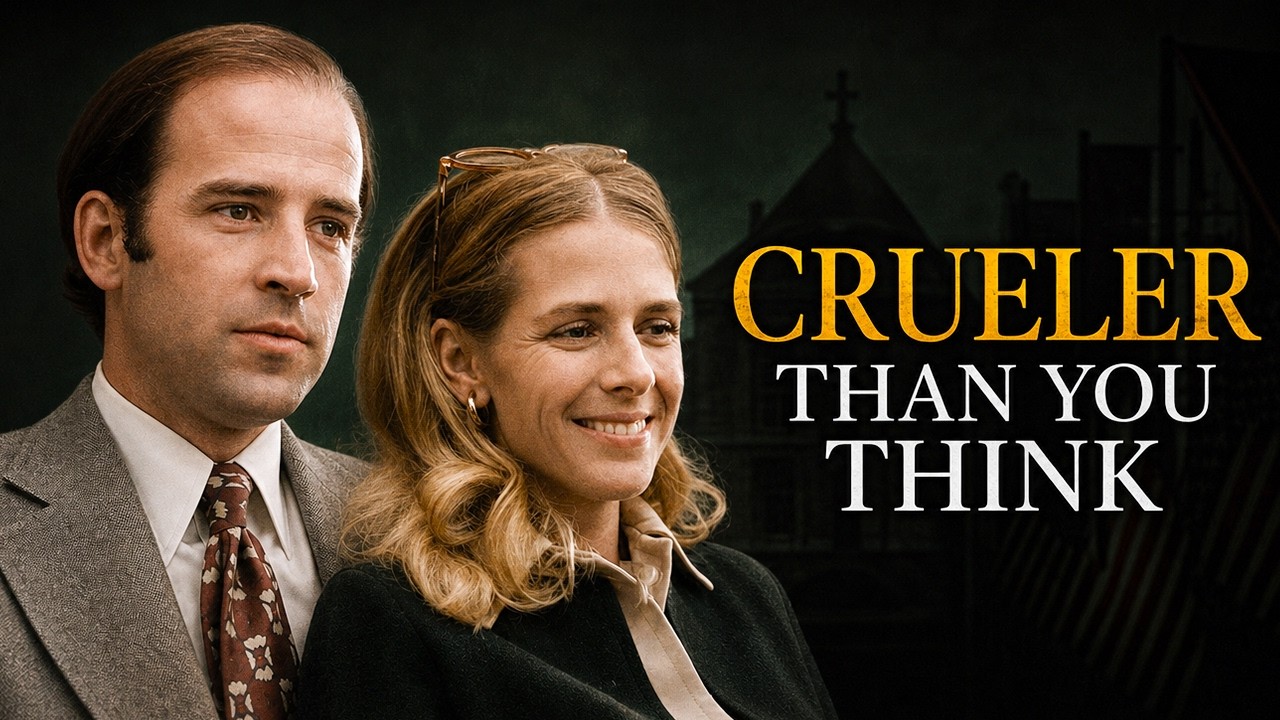 C. , hiring staff for the office she had helped him win. For 35 years, the country was told a drunk driver killed her.
The police found no alcohol. The story of what happened before that crash, and the quiet, structural cruelty that defined her marriage, is only now coming into focus.
Start with the photograph, because the photograph did more work over the next 50 years than almost any other image in American politics. A young man in a dark suit, hand raised, left hand nowhere near a Bible held by a wife because there was no wife. His son Beau is in the bed, leg in traction, broken in multiple places.
Frank Biden, his brother, is in the frame. The Senate secretary swore him in inside a hospital room because the family had decided that a man whose wife and infant daughter had just been killed should not go to Washington for the ceremony. That is true.
It is also true that this was the first press event of his Senate career. And it worked. The image of the grieving father, stoic and devoted, became the foundational myth of a political identity that would carry him through six terms in the Senate, two terms as Vice President, and ultimately to the Oval Office.
But here is what nobody says out loud about that morning: Joe Biden very nearly did not take the seat at all. He said so repeatedly afterward, and the people around him confirmed it. He wanted to resign before he was sworn in.
What stopped him was Mike Mansfield, the Senate majority leader, who by Biden’s own account called him again and again in those weeks and finally made a request that was less a request than a leash. Give me six months. Stay six months, and if you still want to leave, leave.
He stayed 36 years.
Sit with the arithmetic of that for a second. The reason he couldn’t quietly disappear into his grief was that he held an office. The office existed because a Senate race had been won by roughly 3,000 votes in a state where he was a 29-year-old county councilman nobody outside Newcastle County had heard of.
And that race had been run in large part out of a house in Wilmington by his wife, who kept the books, signed for the money, edited the literature, and did not draw a salary. So, the widower’s photograph is real. It is just not the whole caption.
The seat that made his grief a national story was the same seat that made his grief impossible to have in private. She built the thing that took her funeral away from him. Now, go back nine years before any of it, to a woman who has almost no archive.
That is the first hard problem with telling this story honestly. Neilia Hunter Biden left very little in her own hand that has been made public. No published letters, no diary in circulation.
A handful of photographs, a few quotes in Delaware newspapers from 1972, and then a long silence filled entirely by other people. Almost everything Americans think they know about her personality comes from her husband’s memoir published 35 years after her death, or from his sister’s memoir published 50 years after. Both are affectionate.
Both are also by definition interested parties writing about a woman who cannot revise them. Keep that in mind. It matters more at the end of this than anything else.
What the record does support is this: she was born July 28th, 1942, in Skaneateles, New York, a Finger Lakes town of a few thousand people with an old money summer trade and a lake that people photograph on purpose. Her father, Robert Hunter, ran a restaurant in nearby Auburn, Hunter’s Dinerant, a chrome and glass institution on Genesee Street. The kind of place where a town’s business gets done over coffee at 7:00 in the morning.
Her mother, Louise, was part of that operation, too. This is not a trivial detail. It is the single most useful fact about her.
A family restaurant is a business where the books are personal. Payroll, receipts, suppliers, the daily reconciliation of what came in against what went out, and simultaneously the performance of being pleasant to every human being who walks through the door, including the ones who owe you money. A kid who grows up in that learns two skills at the same time: accounting and charm.
She would use both professionally for a man who was not paying her. She went to Syracuse University. She trained as a teacher.
Contemporary descriptions of her, including the ones printed after her death, when Delaware papers were reaching for anyone who could describe her, are consistent and a little frustrating in their sameness. Poised, warm, capable, well-liked. That is the vocabulary 1972 used for a woman it wasn’t going to describe any other way.
In March of 1964, she was on spring break in Nassau with friends. Joe Biden was a senior at the University of Delaware, down there with a buddy on a cheap trip he has admitted he probably couldn’t afford. His version, told in Promises to Keep and in roughly 400 speeches since, is that he saw her at the Sheraton British Colonial, talked his way past the pool attendant, and introduced himself.
She had a boyfriend at the time. By the end of the trip, she didn’t. Take the romance of that at face value if you want.
It is probably close to accurate. But notice what happened next, because it is the actual beginning of the marriage, and it has nothing to do with a beach. He rearranged his life around her geography.
He went to law school at Syracuse, a school he has never pretended he chose for its faculty. He went because she was there. And in Syracuse, for the next couple of years, she was the one with the paying job.
She taught. He was a student with no income, a family in Delaware with no money to spare, and a stated ambition that most 22-year-olds would have had the decency to keep to themselves. Because here is the part that everyone repeats as charming and nobody examines as a contract: He told her early and directly what he intended to do.
Senator by 30, then the White House. He also told her father. That story has been repeated by Biden and by his sister Valerie for decades.
And there is no reason to doubt the substance of it. Men like that generally do announce themselves. But understand what he was actually proposing.
Not a marriage. A candidacy with two people in it. She said yes anyway.
And she said yes knowing the timeline, which means when we get to 1972 and she is doing the finances of a Senate campaign with three children under four in the house, that is not something that happened to her. That is something she signed up for with the schedule printed on the front. The warning signs were not hidden.
They were the pitch.
There was friction on her side, and here the record gets softer, so flag it. Several accounts, his, his family’s, and later biographies drawing on interviews, describe the Hunters as less than delighted. Part of it was money.
He had none, and her family had a business, a house, and a standing in a small town where those things are noticed. Part of it, as it is usually told, was religion. She was Protestant.
He was Irish Catholic from Scranton by way of Claymont, with a mother named Jean Finnegan and a household where the church wasn’t decorative. How much of that resistance was real, and how much of it has been smoothed into a charming obstacle in retelling, cannot be known with certainty. What is documented is how it resolved.
And the resolution is the first thing in this story that shows you who was going to bend. They married on August 27th, 1966, in Scranton, at Saint Mary of the Lake, a Catholic church, a Catholic ceremony. She came down the aisle in her own hometown into her husband’s religion.
 That is not a 𝒔𝒄𝒂𝓃𝒹𝒶𝓁. In 1966, it was ordinary. The church had rules.
Families made accommodations, and a Protestant bride marrying a Catholic groom knew roughly how that negotiation was going to end. It is the first clean example of a pattern that ran through the next six years without a single documented argument about it. When the Hunter way and the Biden way collided, the Biden way won, and Neilia made it look easy, which is a skill, and which is also how you disappear.
She was 24. He was 23, a year from a law degree he had nearly torpedoed, because there was something else in Syracuse that she almost certainly knew about, and that the American public would not learn for 21 years. In 1965, in a legal methods course, Joe Biden turned in a paper containing five pages lifted almost verbatim from a Fordham Law Review article, with one footnote.
He failed the course and repeated it. The school kept the file. That file sat in a drawer in Syracuse while she raised his children, ran his numbers, and got him elected.
It came out in September 1987, in the middle of his first presidential campaign, and helped end it. She was 15 years dead by then. She never got to be asked about it.
They married into a corporation. That is meant almost literally, and it is the part of this story that people who love the Biden mythology and people who hate it both tend to skip because it isn’t scandalous. It is structural.
The Bidens of Wilmington were not a wealthy family. They were not a political family, and in 1966, they were not anything at all. What they were was organized.
Jean Finnegan Biden ran a household with a code. You don’t quit. You don’t complain outside the family, and family is the only thing that isn’t negotiable.
Her four children absorbed it completely. Valerie, three years younger than Joe, would run every campaign he ever entered. Jimmy would raise the money.
Frank would work the phones and the streets. So, when Neilia Hunter of Skaneateles married Joe Biden, she did not marry a man and set up a household. She joined a firm that already had its senior staff in place, and the founder’s chair was taken by his sister.
Nobody in this story treated that as a problem. That is what is interesting about it. Valerie and Neilia were, by every account, including Valerie’s own, genuinely close.
They had been friends since Joe brought her home from the Bahamas, and the two of them, plus Jimmy and Frank, formed a unit that spent most of the next six years in each other’s houses. It reads as warmth, and it likely was warmth. It was also a system in which the wife had no separate jurisdiction.
There was no wing of the Biden operation that was hers alone. There was no property in her name, no career she could return to, no independent circle of people who were hers first. She had a role.
She was extremely good at it. That is a different thing from having power. They came back to Delaware after his law degree in 1968, and he did the thing young lawyers with plans do.
Worked briefly for a corporate firm, hated it, went to a defense practice, started taking public defender cases, and turned up at every Democratic function within driving distance. Then the children arrived at a pace that decided her life for her. Beau, Joseph Robinette Biden III, was born in February 1969.
Hunter, Robert Hunter Biden, named for her father, was born in February 1970, one year and one day later. Naomi Christina, called Amy and Caspy in the family, was born in November 1971. Three children in 33 months.
She was 29. The teaching career ended. Not dramatically, not in a fight.
It ended the way careers ended for women in 1969, by simply not being scheduled anymore.
And here is what replaced it. In the spring of 1970, with a one-year-old and a newborn in the house, her husband decided to run for the New Castle County Council in a district Republicans had been winning comfortably. He won it.
It is a small office. It is the reason any of the rest happened. Look at the campaign material from that period, and from what followed, because the visual grammar is worth naming.
The photographs are family photographs. Joe with the kids, Joe and Neilia, the young couple, the babies, the whole package. An implicit promise about stability and decency being sold door-to-door in Delaware.
That was the product. And the woman photographed as the product was, at the same time, the person doing the bookkeeping behind the camera. Both of those things were her job.
Only one of them was visible. Then in 1971 they made the decision that ended her life. And it is worth being precise about how insane it was.
J. Caleb Boggs was a Delaware institution. Two-term governor, two-term senator, congressman before that.
A man who had never lost a statewide race in a state small enough that a large portion of voters had met him personally. He was 62. He was liked.
He wasn’t even sure he wanted to run again, which was the only opening that existed. The state Democratic Party had no serious candidate, and more to the point, no serious money. What they had was a 29-year-old county councilman who would not be 30, the constitutional minimum age for the Senate, until 19 days after the election.
The campaign that resulted has been mythologized to death. Strip it to the mechanics. It was run out of the family.
Valerie was campaign manager. Jimmy handled fundraising, such as it was. The candidate’s mother and siblings worked it like a family business in a bad quarter, which is to say all hours, no salaries, no separation between the office and the kitchen table.
Money was raised in small amounts from Delaware people, and according to multiple accounts, supplemented by family loans and by Neilia’s father, the restaurant man from Auburn. The specific Hunter contributions are described mostly in later recollections rather than in surviving filings, but that the Hunter family put money and credit behind their son-in-law’s impossible campaign is well attested and entirely in character with everything else they had done since 1966. Her father helped pay for the campaign.
Her name was on the bank paperwork. Her handwriting was in the ledgers. And the single most effective piece of material that campaign produced was a newspaper.
Not an ad in a newspaper. An actual tabloid-format newspaper printed and mailed to Delaware households laying out Biden positions in the format of news. It was cheap.
It looked substantial. And in a state where everyone gets their mail from the same handful of routes, it hit. The Biden campaign’s own account and Valerie’s credits Neilia directly with the concept and the editing of that literature.
 So here is the woman on December 1st, 1972, three weeks after the election, as an organizational chart. Campaign treasurer. Principal bookkeeper.
Editor of the campaign’s flagship communication. Primary caregiver to a three-year-old, a two-year-old, and a 13-month-old. And the public face of the family values photography.
Compensation: none. That is the cruelty in this marriage. And it doesn’t require a mistress.
There is no credible evidence Joe Biden was unfaithful to Neilia Hunter, and none is manufactured here. The harm is quieter and more common. A woman with a professional skill set who spent six years applying it full-time to another person’s ambition inside a family that genuinely loved her but never once considered that her labor was labor.
On November 7th, 1972, they won by roughly 3,100 votes. That is a margin you can name the reasons for. Boggs ran a lazy campaign.
Nixon’s landslide didn’t pull down the Democratic ticket in Delaware the way it should have. But you cannot look at that number and tell me the newspaper mailer and the balanced books didn’t cover it. She won that seat as much as he did.
Thirteen days later he turned 30 and became constitutionally eligible for the job he had already been given.
Now watch the next six weeks, because this is the only stretch in the entire story where the deal she made appears to be paying off, and it lasts about a month and a half. Everything opens up. The national press finds the youngest man elected to the Senate in decades and his photogenic family.
They start looking at houses. There is the question of where to live, Washington or Delaware, and how the children fit and what her role would be in a Senate office where, unlike a scrappy county campaign, there would be actual paid staff. She had been asked in that period by Delaware reporters about being a Senate wife.
The surviving quotes are brief and cheerful and give you nothing. She was 30, he was 30. They had six years of unpaid work behind them and on paper the entire structure of American public life in front.
In mid-December he went to Washington with Valerie to interview staff. That is the transition. You hire your chief of staff, your legislative director, you find office space, you do the thousand small hires that make a Senate operation exist.
It was necessary work. It was also, again, the two of them, brother and sister, the founding partners, doing the firm’s business in the capital. Neilia stayed in Wilmington with the children.
On Monday, December 18th, 1972, one week before Christmas, she put the three of them in the family station wagon and went out to buy a Christmas tree and finish the shopping. Beau was three. Hunter was two.
Naomi was 13 months old and in the car with them. At an intersection near Hockessin in northern Delaware, the station wagon was struck by a tractor trailer. Neilia Hunter Biden and Naomi Christina Biden were killed.
Beau and Hunter were badly injured and hospitalized. Beau’s leg was broken in multiple places, which is why he was in traction three weeks later in the photograph everyone remembers. Joe Biden learned about it by telephone in Washington from Valerie.
He got the news in an office he had gone to fill with employees, about a car she was driving because he was there and she was not. The story the country was given about that crash, and repeated back to it by a United States Senator for the next three and a half decades, was that the truck driver had been drinking. That story was not true.
Curtis C. Dunn was 47, from Avondale, Pennsylvania, driving a tractor trailer north on Limestone Road with a load of corn. He had seven children.
When the station wagon came out of Valley Road in front of him, he swerved hard enough to overturn his rig, then climbed out and ran to the wreck. He was the first person to reach them. He was not charged with drunk driving.
He was not charged with anything.
The investigation was overseen by Jerome O. Herlihy, then Chief Deputy Attorney General in Delaware and later a Superior Court Judge, and his account has never wavered. There was no evidence alcohol played any role on either side.
Police concluded that Neilia’s car had entered the intersection into the truck’s right of way. She had a stop sign. Dunn did not.
Possibly because her head was turned, possibly because she was distracted by three small children, one of whom she had been holding. The file itself no longer exists. Delaware lost it decades ago, which is its own small obscenity given what got built on top of it.
Here is what Joe Biden told audiences for something close to 35 years: that the man who hit his wife had been drinking. In 2007, on the record, he described a guy who drank his lunch. He said versions of it in speeches, in interviews, to crowds who had come to hear him.
It was not a slip. It was a fixture. Dunn died in 1999 without ever getting a correction.
His daughter, Pamela Hamel, finally went to the Delaware News Journal in 2008 after Barack Obama put Biden on the ticket and the story started circulating again nationally. Her father hadn’t been drinking, she said. He grieved over the crash.
He was tormented by it for years. She wasn’t asking for money or an investigation. She wanted a sitting United States Senator to stop calling her dead father a drunk.
He called her to apologize in 2009.
Be careful here, because this is the point where the story gets misused by people with an agenda. There is no evidence Joe Biden invented the alcohol claim as a deliberate lie. Rumors circulated in Delaware in 1972.
Everybody in a small state has a theory. And blood alcohol testing wasn’t mandatory then. So nothing was ever formally ruled in or out at the hospital.
A grieving 29-year-old may well have been told something and believed it for the rest of his life. But notice the shape of it. The official finding pointed gently and without charges toward Neilia.
The version he carried into public life pointed at a stranger. And for three and a half decades, the only nationally amplified account of how she died came from the one person in the marriage still able to speak. Until a truck driver’s daughter in Newark, Delaware, went to a local paper and made him take it back.
That is the whole mechanism of the story in one incident. She stopped being a person with a record and became a passage in someone else’s speech. What happened to him next is well documented and genuinely brutal.
 He has spoken openly, including to Politico in 2008, about thinking of suicide in that period. He drank. He drove around Wilmington at night.
He took the oath in the hospital room because his sons were there, and then he did the thing that turned into his brand. He commuted. Ninety minutes down on Amtrak in the morning, ninety minutes back at night, every day for 36 years, because he had two hospitalized little boys in Delaware and had decided they would not lose a second parent to Washington.
That is a real decision and it cost him real things: influence, dinners, the social machinery of the Senate. It also became one of the most effective pieces of political branding in modern American history. Amtrak Joe.
The conductors who knew his name. The story told in every profile from 1974 to 2020. A private grief that functioned year after year as a credential.
Meanwhile, the house in Wilmington filled up with Bidens. Valerie moved in with her husband and effectively raised Beau and Hunter for the next several years. Jimmy and Frank were constants.
Jean Finnegan Biden’s system absorbed the crisis exactly as it had absorbed everything else. Which is the reason the family survived it. And also the reason there was from that point forward no adult in that house who remembered Neilia as a Hunter.
Her parents were in Skaneateles. Her brothers were in New York. And they said publicly essentially nothing for 50 years.
Then in June 1974, 18 months after the crash, the freshman senator sat down with a reporter named Kitty Kelley for a piece in the Washingtonian titled “Death and the All-American Boy.” That article is the single most important surviving document about how Joe Biden talked about his wife when nobody was managing him yet. It is not a hit piece, since Kelley wasn’t yet the Kitty Kelley of the later celebrity biographies.
And much of the profile is admiring. It is just uncomfortably close to the man. He talks about ambition.
He talks about the presidency. And when he talks about Neilia, he reaches for a photograph and describes her body. He compares her favorably to a Playboy centerfold.
He was 31 and destroyed. Grief does not produce dignified sentences. But look at what that article is structurally.
It is the first draft of her posthumous existence. And it is dictated entirely by him to a journalist in a room where the only artifact of her is a picture he chose to show.
Every account after that, the memoir, the stump speeches, the convention videos, the eulogies, descends from that same source. She has no counter testimony. She left no published letters.
There is no Neilia Hunter Biden archive with a reading room and a finding aid. The University of Delaware holds his Senate papers. Access to them has been restricted.
And when questions came up about them in 2020, the arrangement was that they would open years after he left public life. That is legal. It is also standard for senators.
It is nonetheless a fact worth saying plainly. The paper record of the career her labor launched has been under family-approved control for half a century. Jill Jacobs entered the story in 1975, introduced by Frank Biden, who had seen her photograph on an advertisement at the Newcastle Airport.
She has said publicly that Biden proposed five times before she accepted. She was divorced, cautious, and unwilling to become a mother to two boys she might later leave. They married on June 17th, 1977, at the chapel at the United Nations in New York.
The boys were part of it. Family accounts hold that Beau and Hunter came to their father and asked when they were getting married. That story has been told for decades.
It is a lovely story. It comes exclusively from inside the family. And it has been polished by 50 years of retelling.
Jill Biden did the thing that was asked of her, which was to raise Neilia’s sons and not compete with a woman who could no longer be beaten. Their daughter, Ashley, was born in 1981.
And in September 1987, the past came for him anyway. His first presidential campaign collapsed inside three weeks. The proximate cause was lifted rhetoric from a British politician.
But what finished it was Syracuse, the 1965 legal methods paper, five pages taken almost verbatim from a law review, one footnote, a failing grade, the file the university had never thrown away. He held a press conference and released his law school record himself. The record he had to release was from the year she was teaching to keep him there.
She had been dead 15 years. Nobody asked what she knew because nobody could. So, what was this marriage actually?
Not a tragedy of cruelty between two people. By every surviving account, they liked each other enormously, and there is no credible evidence of infidelity, 𝓪𝓫𝓾𝓼𝓮, or contempt in it. It was something more ordinary and harder to forgive.
A partnership in which one partner’s entire professional capacity, the bookkeeping, the editing, the front-of-house charm she learned in her father’s restaurant in Auburn, was converted into another person’s public career with no title, no salary, no independent standing, and no exit that anyone in that family would have recognized as reasonable. She was 30 when she died. She had been a working teacher for four years and an unpaid political operative for six.
The office she won was sworn in over a hospital bed she never saw.
Look at that photograph again. The suit, the raised hand, the boy in traction, the brother in the frame. For 50 years, America read it as the beginning of a widower’s long penance.
It is also the closing entry on a ledger she kept. Every element in that room, the seat, the title, the 3,000 votes, the injured child, traces back to work she did and money her father put up. She is not missing from the picture.
She is the reason there is a picture. Her name survived in two places, and she chose neither of them. Her father’s name went to her second son, Robert Hunter Biden, in 1970, which is the one act of hers in this whole story that reads unmistakably as hers.
And her daughter’s name came back in 1993 when Hunter named his own child Naomi. Two Bidens have published memoirs about her. No Hunter ever has.
She wrote the newspaper that made him a senator. He wrote everything that came after. The record of Neilia Hunter Biden is a record of erasure, not by malice, but by the sheer gravitational force of a family system that consumed her labor, her identity, and finally her story, leaving behind only the photograph of a man grieving the loss of the machine that made him.