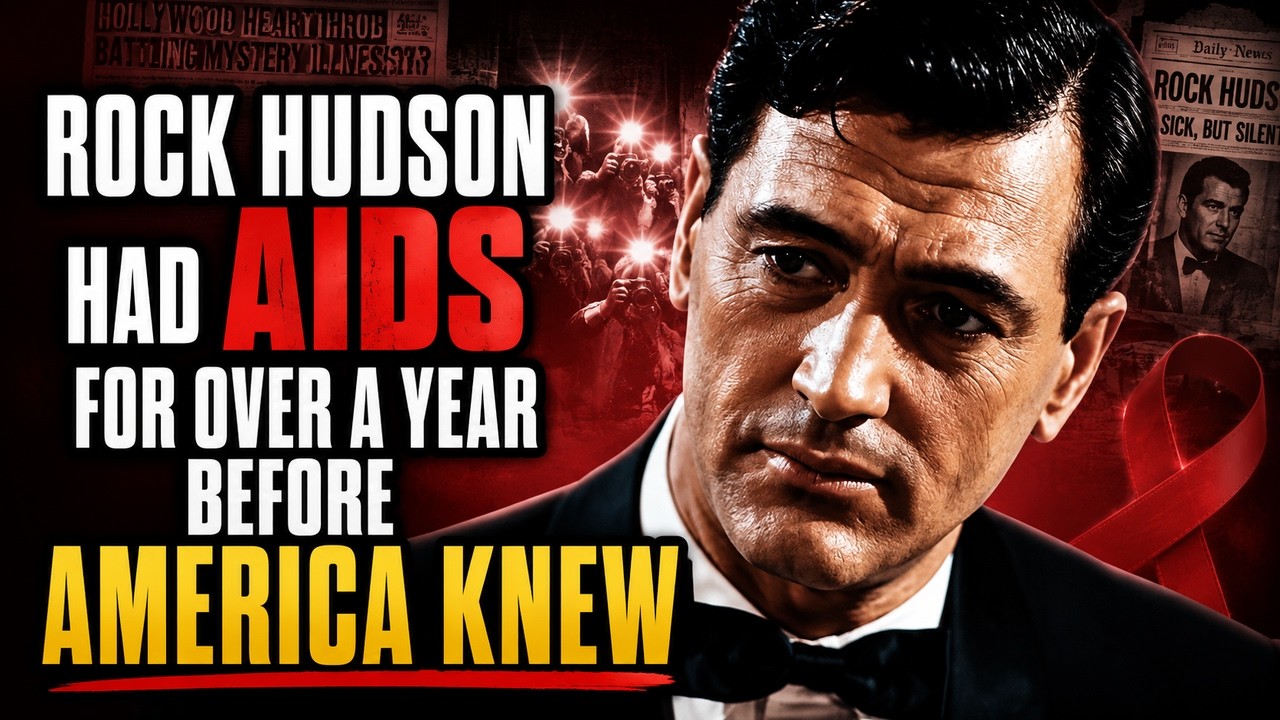
Rock Hudson’s carefully managed public image collapsed on Thursday, July 25, 1985, in Paris. A spokeswoman confirmed that the beloved actor had AIDS and had been diagnosed more than a year earlier. For millions of Americans, the shock was not just that a star was gravely ill—it was that the man who had embodied a particular ideal of American masculinity had been living with a secret for decades. Born Roy Harold Sheerer Jr.
on November 17, 1925, in Waukegan, Illinois, his early life was marked by change. His parents divorced in the early 1930s, and his mother later remarried Wallace Fitzgerald, who adopted the boy and legally changed his name to Roy Fitzgerald. He graduated from New Trier High School in 1944 and enlisted in the U. S.
Navy, serving in the Philippines during World War II. After his discharge in 1946, he headed to California, working as a truck driver while trying to break into the movies. His physical presence—unusually tall and conventionally handsome—caught the attention of agent Henry Wilson. Wilson saw commercial potential and set about rebuilding the young man.
Roy was given caps for his teeth, took acting and vocal lessons to lower his speaking voice, and worked on his posture and manners. The most visible change was his new name: Rock Hudson, reportedly combining the Rock of Gibraltar with the Hudson River. The transformation was labor, not magic. His first film role in 1948’s *Fighter Squadron* required nearly 40 takes for a single line.
Despite this rocky start, director Raoul Walsh saw promise, and Universal International eventually acquired his contract. The studio system gave Hudson repeated supervised practice, training him in drama, diction, voice, horseback riding, and even sword fighting. He took small roles—detectives, truck drivers, football players—while the studio figured out what kind of actor he could become. Hudson’s breakthrough came through director Douglas Sirk.
In *Magnificent Obsession* (1954), paired with Jane Wyman, he took on a major romantic role that demanded more than good looks. Audiences responded. The film’s success made him a bankable lead. In *All That Heaven Allows* (1955), he again worked with Sirk and Wyman, playing a younger man whose relationship with an older widow challenges social expectations.
The irony of his playing characters constrained by societal rules was not lost on modern viewers, but there’s no evidence he played the role as a coded confession about his own sexuality. By this time, Hudson was learning two forms of performance at once. One was acting; the other was public presentation. He was gay, a fact understood by many in his professional and social circles, but it was never communicated to the American movie audience.
This secrecy was not merely a personal choice. Homosexuality was heavily stigmatized, and gay men faced legal prosecution and employment discrimination across much of the country. For a leading man sold as an object of heterosexual romance, disclosure threatened his career, reputation, and ordinary security. In 1955, George Stevens cast Hudson as Bick Benedict in *Giant*, opposite Elizabeth Taylor and James Dean.
The production required him to play a character across decades, from a proud young rancher to an older patriarch. The set was tense, especially between Hudson and Dean, whose acting styles clashed. But Hudson held his own against two of the most magnetic stars of the era. His performance earned him his only Academy Award nomination for Best Actor.
His friendship with Taylor, forged during this production, would become vitally important near the end of his life. As his fame grew, so did the pressure on his private life. Magazines were asking why such a famous bachelor wasn’t married. In November 1955, Hudson proposed to Phyllis Gates, Henry Wilson’s secretary.
Gates later insisted she had fallen in love with him and that she was not a knowing participant in a publicity stunt. They married in Santa Barbara, with Wilson arranging the small ceremony and quickly informing gossip columnists. The union had immediate publicity value, but Gates later described emotional distance and anger. She filed for divorce in April 1958, charging mental cruelty, which Hudson did not contest.
By the end of the decade, Hudson was eager for a change. He had become typecast as the serious romantic hero. *Pillow Talk* (1959) offered something new: comedy. Hudson initially hesitated, telling director Michael Gordon he’d never done comedy and didn’t know how to be funny on purpose.
That uncertainty became useful. Opposite Doris Day, he discovered he could bend his polished romantic persona without breaking it. The film was a success, leading to *Lover Come Back* and *Send Me No Flowers*, both with Day and Tony Randall. Hudson’s comedy worked because he was willing to make his own masculine image part of the joke.
In the early 1960s, Hudson began seeking more control over his career, creating his own production company. Privately, he continued relationships with men in a world where discretion was essential. One relationship, with Lee Garlington, lasted from about 1962 to 1965. Garlington later recalled that discretion shaped even simple choices, but on trips to Puerto Vallarta, they could walk on the beach and be comfortable being themselves.
These memories complicate the idea of Hudson as a man who never had a private life. In 1966, Hudson took a strange and daring risk in John Frankenheimer’s *Seconds*, a psychological thriller about a middle-aged man offered a new identity and a new face. The premise seemed almost too close to Hudson’s own biography—he had been renamed and reshaped by Hollywood. The film was unsettling for audiences and not a popular success, but it later attracted renewed critical interest.
It also changed how his earlier transformation could be understood, showing he was more than his polished image. The late 1960s saw his film career become uneven as the industry changed. Turning seriously toward television, he took the lead in *McMillan & Wife*. He initially wanted it to be a one-shot movie, but after the pilot, he accepted the series.
The show premiered in September 1971 and became a durable success, putting him in American living rooms regularly. His co-stars remembered him as light-hearted, easygoing, and generous. When a cinematographer’s job was threatened, Hudson drew a line and used his leverage to protect him. During the 1970s and early 1980s, Hudson remained recognizable but no longer the industry’s central romantic star.
In 1984, he appeared on *Dynasty* as Daniel Reece. But by then, his body was under attack. On June 8, 1984, Hudson was conclusively diagnosed with AIDS. He was 58.
He did not disclose this to the public, nor did he disclose it to Marc Christian, a man with whom he had been in a sexual relationship since the previous year. Later court findings are stark. A jury concluded that Hudson knew he had AIDS while continuing the relationship, concealed the diagnosis, and misrepresented his health to keep it going. Christian learned of the diagnosis only when the news became public in July 1985.
He underwent repeated testing, which remained negative for HIV. This dark episode stands alongside the memories of generosity from co-workers. Human character is rarely consistent enough to fit either saint or villain. Hudson continued working after his diagnosis, preserving routine and professional identity.
On *Dynasty*, producers and actors were not informed. A romantic scene with Linda Evans later became a source of anxious publicity. The fear reflected the period more than biology—HIV is not transmitted through closed-mouth kissing. But in the mid-1980s, fear attached itself to ordinary contact.
In July 1985, Hudson went to Carmel to appear with Doris Day on her cable program. He was visibly thinner and frailer. Day later recalled her shock at his appearance. She did not yet know the truth the public would learn within days.
Despite this, they walked together and laughed. The reunion became one of the last moments where the old and new Rock Hudson occupied the same frame. During his travels for treatment, Hudson collapsed at his hotel in Paris and was taken to the American Hospital. Initially, his publicist said he had inoperable liver cancer.
But the story couldn’t hold. On July 25, the statement came: Rock Hudson had AIDS and had been diagnosed more than a year earlier. The contrast with his screen image was immediate. News organizations treated the revelation as more than celebrity illness—a disease many Americans had kept at a distance now had a face they had known for decades.
President Ronald Reagan called him in Paris. Hudson was flown back to Los Angeles and admitted to UCLA Medical Center. The revelation did not merely expose him; it altered the public visibility of AIDS. In Los Angeles, one clinic’s AIDS-related calls rose from about 30 per day to 150.
In New York, Gay Men’s Health Crisis reported 700 calls in two days. People sought prevention information and offered money. Celebrity did not substitute for public health, but it changed the size of the audience listening. Elizabeth Taylor was among the friends whose response extended far beyond grief.
In September, a major AIDS Project Los Angeles benefit took place. Hudson was too ill to attend, but a message was read. “If that is helping others, I can at least know that my own misfortune has had some positive worth,” he said. Around the same time, the American Foundation for AIDS Research was formed, and Hudson donated $250,000 shortly before his death.
There was also an effort to record his own account. Publisher William Morrow announced an authorized book, *Rock Hudson: His Story*, with journalist Sara Davidson. Hudson gave tape-recorded interviews. Davidson later explained she had only a few substantial sessions before his health deteriorated.
He could be candid in one area and guarded in another. Rock Hudson died on October 2, 1985, at his Beverly Hills home from complications of AIDS. He was 59, weeks short of his 60th birthday. His ashes were scattered at sea.
Later that month, about 100 friends gathered for a private memorial. Mexican food was served, margaritas were poured, and mariachi music played. Friends remembered laughter as well as illness. The speed of the public arc was startling.
In July, most of the world didn’t know he had AIDS. In October, he was dead. Obituaries revisited the familiar landmarks but also returned insistently to the secret. The temptation was to treat his career as evidence of a double life.
This misses the nature of acting—Hudson’s performances were not fraudulent because he was gay. The deception lay not in the work, but in the demand that the public image be mistaken for the whole man. After his death, the legal case cast a long shadow. In February 1989, a California jury found in Marc Christian’s favor on claims including intentional misrepresentation and intentional infliction of emotional distress.
The findings were formal answers to evidence, not gossip. Phyllis Gates’s account created a different kind of reckoning, insisting her love had been genuine. Lee Garlington’s memories preserved the tenderness that secrecy also sheltered. His films also began to change meaning.
Sirk’s melodramas received deeper critical attention. *Seconds* underwent a remarkable reassessment. The romantic comedies survived, preserving the pleasure of his timing with Doris Day. As more participants spoke, the picture widened.
In 2023, HBO released the documentary *Rock Hudson: All That Heaven Allowed*, returning to the conflict between a manufactured image and a private life. Turner Classic Movies marked the centennial of his birth in November 2025 with a month-long tribute. Hudson’s story resists a single shape. The films remain, but so do Gates’s memories, Christian’s court record, Garlington’s photographs, the AIDS donation, and the hospital reports from Paris.
No single archive cancels another. Together, they describe a life in which what could be seen and what had to remain hidden were never simple opposites.