For 17 years, Margarete Himmler received letters from the man orchestrating the murder of six million people. She read about his headaches, his travel plans, and his complaints about work. Among 273 recovered family letters, there was exactly one mention of the camps: a single postcard that read, "I am off to Auschwitz. Kisses your Heiney."
When Allied interrogators finally captured her, they concluded she knew nothing. That conclusion reveals something far more disturbing than guilt ever could.
The woman who chose him first. Before Heinrich Himmler became the architect of genocide, he was a sexually timid 27-year-old party functionary with big ambitions and an empty wallet. Margarete Siegroth was seven years older, divorced, financially independent, and running her own nursing clinic near Berlin.
She didn't wait for him to make a move. She pursued him.
They met in 1927 at Bad Reichenhall, a resort town in Bavaria. Himmler was giving lectures for the Nazi party, traveling from city to city. Margarete attended one of those lectures. Something about the awkward young man caught her attention. By the following July, they were married.
Margarete didn't marry into power. She bankrolled it before it existed. Her family money funded Himmler's early political career. Her savings kept them afloat while he climbed the Nazi party ranks. She was the investor, not the trophy wife.
This power dynamic would matter later when everything inverted. When Himmler gained real authority, when he became Reichsführer SS and one of the most powerful men in Germany, he didn't just drift away from Margarete. He abandoned her completely.
By the late 1930s, he visited home only to see their daughter, Gudrun. His secretary, Hedwig Potthast, 19 years younger than Margarete, became his mistress. Hedwig gave him the sons that Margarete couldn't have after birth complications left her unable to conceive again.
New Year's Eve 1938, Margarete wrote in her diary, "What I experienced this year was unimaginable." Her marriage became a hollow arrangement. The man she had financed, supported, and believed in was designing the Holocaust while she sat in their home in Gmund, humiliated and discarded.
But despite the abandonment, Himmler still played the devoted father when it suited him. This leads to the most disturbing family outing in history.
On July 22nd, 1941, just weeks after Heinrich Himmler ordered the mass murder of Soviet Jews, he brought his 12-year-old daughter Gudrun and her mother Margarete to Dachau concentration camp. This wasn't a secret Himmler kept from his family. This was a family trip.
Dachau was the first concentration camp the Nazis established, opened in 1933 just weeks after Hitler took power. By 1941, it had become a model for the entire system, a template of organized cruelty replicated across Europe.
Gudrun's diary entry afterward captures something grotesque in its innocence. She wrote, "We saw the gardening work. We saw the pear trees. Then we ate. Then everybody got a present. It was lovely. A very big operation."
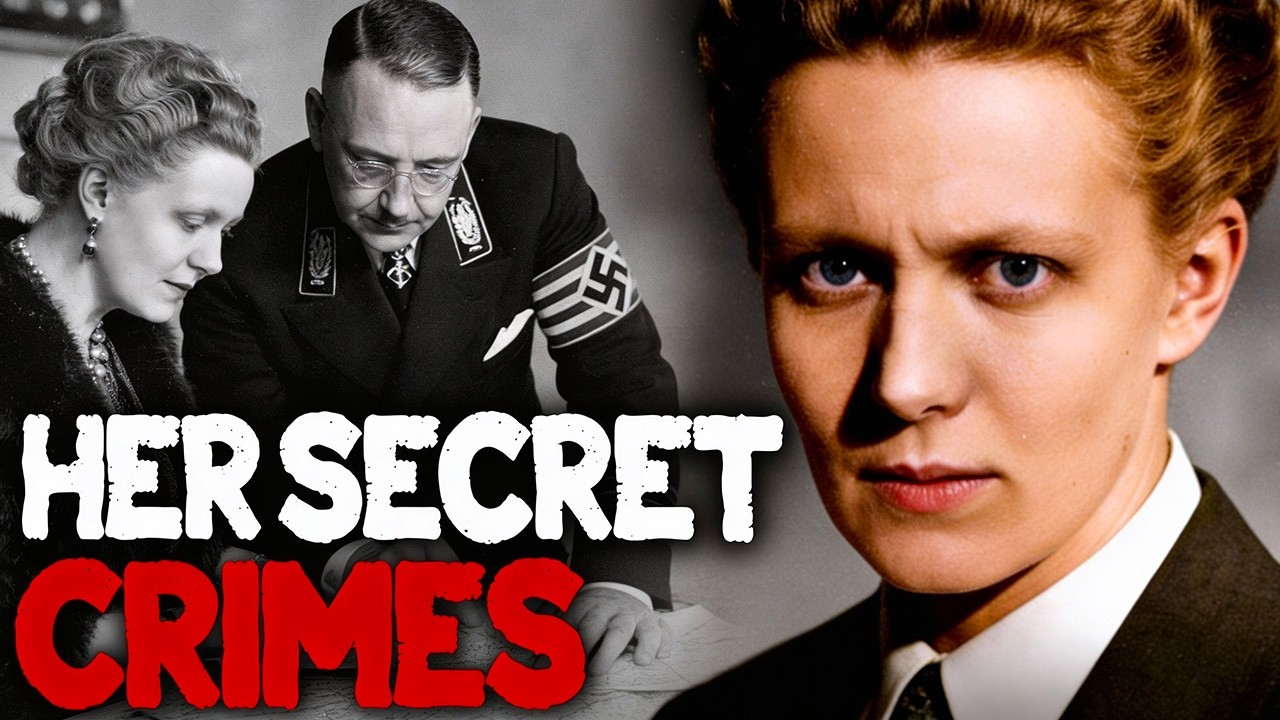
The sanitized tour. The curated version. A child recording her visit to a death machine as if it were a pleasant afternoon at an estate.
What did Margarete see that day? The same careful staging. The gardens, the orderly prisoners, the carefully hidden reality. Camp administrators knew how to present their work to visitors. They kept the worst out of sight.
But did Margarete see more? Did she notice the emaciated figures beyond the tour route? The fear in people's eyes? The smell that no amount of perfume could mask? Did she wonder why prisoners flinched when guards approached? Or why certain buildings were kept locked?
The question becomes inescapable. What did Margarete actually witness at Dachau? And what did she choose not to see?
Documentary filmmaker Vanessa Lapa recovered 273 letters from the Himmler family archives. Pages upon pages of domestic trivia spanning nearly two decades. Himmler complained about caviar left too long in the refrigerator. Margarete reminded him about their forgotten wedding anniversary. They discussed the weather, their daughter's schoolwork, mundane travel updates.
Except this marriage belonged to the man running the Final Solution.
Among all those letters, there was exactly one reference to the concentration camps. A single postcard: "I am off to Auschwitz. Kisses your Heiney." Not a confession, not an explanation, just a casual mention, like noting a business trip to Frankfurt.
For decades, this was used to support the idea that Margarete was kept in the dark. Her husband discussed everything except his work. She was an abandoned wife, out of the loop, a victim of his secrecy.
But her diary tells a different story entirely.
When Allied forces questioned Margarete after the war, they concluded she was uninformed about Nazi operations. She claimed ignorance and they believed her. But those interrogators never saw her private diary entries.
March 3rd, 1940. Margarete traveled through occupied Poland as part of her Red Cross duties, visiting Poznań, Łódź, Warsaw, and Bydgoszcz. Her diary entry that night: "This pack of Jews, the Pollacks, most of them don't look like people at all. And the indescribable dirt. It is an unheard of task to create order there."
This wasn't ignorance. This was ideology. The same dehumanizing language that appeared in Nazi propaganda, written in a private diary that no one would read. Margarete wasn't parroting her husband's views to impress anyone. She believed them.
June 22nd, 1941. The day Germany invaded the Soviet Union, launching Operation Barbarossa and the deadliest phase of the Holocaust. This single day would eventually result in the deaths of 27 million Soviet citizens. The Einsatzgruppen death squads were already mobilizing.

Margarete's diary that day: a casual note about the war beginning, followed by a reminder about caviar in the refrigerator. The invasion that would reshape the 20th century rated the same attention as leftover fish eggs.
February 1945. The Reich was collapsing. Allied forces were closing in from every direction. Germany's defeat was obvious to everyone except those who refused to see it. And Margarete wrote, "How wonderful that he is called on for such great tasks and can master them. All of Germany looks to him."
She wasn't ignorant of what her husband did. She was indifferent to its moral meaning. She saw the dehumanization of Jews as a task to be completed. She saw the war as her husband's great calling. She saw the destruction of Europe as evidence of his importance, not his criminality.
The interrogators who declared her uninformed never read these words.
Allied forces captured Margarete on May 13th, 1945 near Bolzano, Italy. She was fleeing south with her daughter Gudrun, hoping to reach safety before the net closed. Just eight days earlier, Heinrich had bitten down on a cyanide capsule rather than face capture.
The Allies faced an impossible dilemma. She was the wife of one of history's greatest criminals. But Margarete herself had committed no crime they could prosecute. She hadn't signed orders. She hadn't commanded troops. She hadn't personally harmed anyone that investigators could prove.
She had simply lived comfortably while her husband orchestrated mass murder and benefited enormously from his position. The fine home, the household staff, the financial security, all of it came from Heinrich's work.
The question became: is benefit from crime the same as complicity?
If the Allies held Margarete responsible by association, the principle known as Sippenhaft, they opened the door to prosecuting millions of German families. The entire denazification process would collapse under the weight of universal guilt.
But if they exonerated her, it suggested something equally troubling. It implied the Holocaust could function without willing accomplices, just obedient subordinates following orders while their spouses asked no questions and accepted no responsibility.
March 19th, 1951. A Bavarian denazification tribunal reviewed Margarete's case and classified her as a Mitläufer, a follower. This was the lowest category of guilt, essentially declaring her a passive bystander. Her past was officially closed. She could resume her life, collect her pension, vote in elections.
January 15th, 1953. Less than two years later, the same system reversed itself completely. A new tribunal reclassified Margarete as Belastet, burdened. This meant she was deemed a beneficiary and activist of the Nazi regime. The consequences were severe: 30 days of punitive labor, loss of her pension, and permanent revocation of her voting rights.
Same woman, same evidence, opposite verdicts.

The whiplash revealed something important about postwar justice. It wasn't really about discovering truth. It was about political convenience. By 1951, West Germany was rebuilding rapidly. The Cold War was intensifying. American priorities had shifted from punishing Nazis to building a bulwark against Soviet expansion.
By 1953, the political winds had shifted again. Public pressure demanded accountability. The tribunals tightened their standards. Margarete's comfortable classification was reopened and overturned.
The verdict had nothing to do with what she actually knew or didn't know. It had everything to do with what Germany wanted to believe about itself in any given moment.
Whatever Margarete refused to confront during her lifetime, she passed directly to the next generation. Gudrun, the girl who thought Dachau was lovely, never reckoned with her father's crimes. Not then, not ever.
After the war, Gudrun didn't distance herself from her father's legacy. She embraced it with both hands. She became a founding member of Wiking-Jugend, a neo-Nazi youth organization that trained the next generation in the ideology that had nearly destroyed Europe.
She joined Stille Hilfe, Silent Help, a group dedicated to assisting fugitive war criminals evade justice. Gudrun actively helped concentration camp guards escape prosecution. She visited imprisoned war criminals in their cells. She raised money for their legal defense and their families.
When asked about her father, Gudrun's answer never wavered across seven decades. She called him a very good and caring man until the day she died in 2018, 73 years after the liberation of Auschwitz.
The girl who recorded a lovely day at Dachau became a woman who protected the guards who had made it run. Margarete's failure to confront reality didn't die with her. It metastasized into active obstruction of justice across another generation.
Margarete Himmler committed no documented crime. No court ever proved she ordered anyone's death, signed any lethal document, or directly participated in any atrocity. By the narrowest legal definition, she was not a perpetrator.
But her story reveals something crucial about how the Holocaust actually functioned. It didn't run on monsters. It ran on people who found ways not to see, not to know, not to act. People who toured concentration camps and noticed the pear trees. People who received postcards mentioning Auschwitz and didn't ask what happened there. People who watched their country dehumanize millions and worried about caviar in the refrigerator.
Margarete profited from genocide. She looked away from genocide. And when it ended, the system built to hold her accountable couldn't decide if that made her guilty or innocent. Two tribunals reached opposite conclusions using the same evidence.
That ambiguity, not her husband's crimes, is why her story still matters. The Holocaust didn't require that every German become a murderer. It only required that enough Germans become Margarete: comfortable, incurious, willing to accept benefits without examining their source. Ready to describe atrocities as tasks and mass murder as great work.
She died on August 25th, 1967 at the age of 73. Whatever she truly knew, whatever she actually saw at Dachau, whatever she understood when she read "I am off to Auschwitz," it died with her.
But the question of what ordinary complicity looks like lives on every time we ask how atrocities happen and who lets them.