In 1920, the bestselling soft drink in the United States was not Coca-Cola. It was Moxie, a bitter, dark soda from New England, brewed from medicinal roots and sold in bottles bearing a pointing man on the label. That year, Moxie outsold Coca-Cola nationally, and the numbers were not close. Three decades later, a person could drive through twelve states without finding a single bottle.
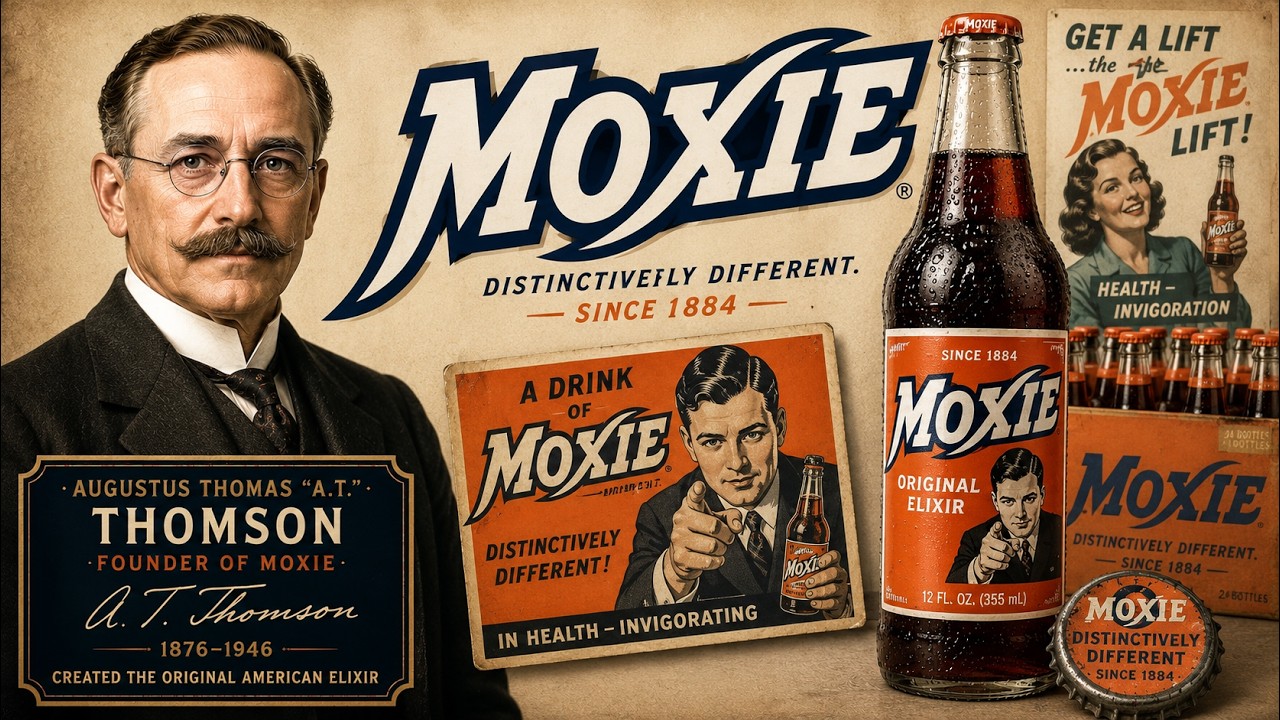
The factories went quiet, the delivery trucks stopped, and the Moxie Men—the salesmen who had rolled into tens of thousands of American towns with oversized promotional bottles—disappeared from the roads. The brand shrank back to a handful of counties in northern New England, kept alive by loyalty so stubborn it bordered on defiance. The real story of Moxie is not its collapse. It is the story of a Civil War doctor who brewed medicine in a Massachusetts mill town and accidentally helped shape the American soda industry, and it is the story of one decision made during an economic crisis that handed the future of American beverages to Atlanta.
Augustus Thompson was born in Union, Maine, on November 25, 1835. He grew up in a state where medicine and superstition were often the same thing, and he watched traveling doctors sell colored water and alcohol-laced syrup as cures. Thompson drew a conclusion that would take him decades to act on: the country needed medicine it could actually trust. He trained as a homeopathic physician in the 1850s and developed a particular interest in bitter botanical roots, especially gentian, an alpine plant whose extract had been used in European medicine as a digestive tonic.
Gentian tasted terrible, which to Thompson was precisely the point. Something that bitter, he believed, had to be doing something real. On October 1, 1862, Thompson set aside his practice and enlisted in the Union Army. He was commissioned captain of Company G, 28th Maine Volunteer Infantry.
After the war, he settled in Lowell, Massachusetts, the industrial capital of New England, where textile mills ran around the clock and the workforce was chronically fatigued. By 1876, Thompson identified a gap in the American market: there was no non-alcoholic, non-narcotic restorative that a working man could take daily without becoming dependent on it. He created a compound he called Moxie Nerve Food, based on gentian root extract, with quinine bark, sassafras, wintergreen, and caramel for color. He dispensed it as a syrup to his patients.
The first commercial bottling came in 1884, with carbonation added the following year. On March 7, 1885, the first bottle of carbonated Moxie Nerve Food was sold commercially, and Thompson received his trademark. He left his medical practice entirely in 1886 to run a beverage company, committing $15,000—equivalent to more than $350,000 in modern dollars—to marketing and sales. The early advertising made claims that would not survive a single news cycle today.
Moxie Nerve, advertisements promised, could cure paralysis, reverse softening of the brain, and treat alcoholism, insanity, and nervous exhaustion. The Lowell Sun ran these claims as though they were medical findings. In 1885, the American soda fountain was a specific institution. It lived inside the drugstore, where a druggist in a white apron mixed flavored syrups with carbonated water by hand.
The drinks were almost uniformly sweet: vanilla, cherry, lemon phosphate, cream soda. Moxie arrived and broke that assumption in half. The gentian root at the core of Moxie was not used in any other commercial beverage in the United States. It produced a flavor profile drinkers described in contradictory terms: sweet on entry, then a clean, spreading bitterness that finished with a dry, almost mineral quality that made the next sip feel necessary.
It was, as Thompson’s advertising would eventually put it, distinctively different. The bitterness was the innovation. In a market full of drinks that tried to please everyone immediately, Moxie asked drinkers to meet it halfway. Some refused.
Many came back, and a significant number came back so reliably they could not imagine the day without it. These were not casual customers; they were converts. At soda fountains, a glass of Moxie cost five cents. At a time when a mill worker in Lowell earned between $1.
10 and $1. 25 for a ten-hour shift, that price was achievable. Thompson priced Moxie to be within reach of the working-class drinkers who most needed what it offered. In the early years, Thompson built density in a contained geography, working the druggist circuit in Lowell, then the surrounding mill towns, then Boston.
By 1890, Moxie syrup was available at fountains from Portland, Maine, to Providence, Rhode Island, one druggist account at a time. The St. Louis World’s Fair of 1904 changed the scale of everything. Thompson had died the previous year, June 8, 1903, in Boston at age 67, and did not live to see what his product became.
Moxie was served at the fair to hundreds of thousands of visitors, and orders came in from distributors in states Thompson had never reached. Into this moment stepped Frank Morton Archer. Archer was not a scientist or a physician; he was a salesman who understood that selling was about making people feel something before they ever tasted the product. He had joined the Moxie operation as Thompson’s business partner and became the driving force behind the brand in the early 20th century.
Archer’s first major innovation was scale. He commissioned eight-foot-tall replica Moxie bottles built from wood and sent them around the country on horse-drawn wagons. They visited more than 40,000 American towns. The drivers, called Moxie Men, handed out samples and distributed promotional material.
The brand arrived before the product. In 1916, Archer devised the Moxie Horse Mobile: a full-scale aluminum horse mounted on an automobile chassis, with controls engineered so the driver sat in the saddle. It was by any rational measure an absurd object, and it was also one of the most effective promotional devices in the history of American consumer marketing. Crowds followed it everywhere.
Within four years of the Horse Mobile’s introduction, Moxie was outselling Coca-Cola. That sentence carries weight only if you understand what Coca-Cola was in 1920: the largest soft drink operation in the United States, backed by Atlanta capital, distributed across 46 states, and spending aggressively on print advertising. Moxie beat it on flavor loyalty, regional density, and the kinetic carnival energy of Archer’s promotional machine. The 1920s were the best years Moxie ever had.
At its peak, the operation ran out of a facility in Jamaica Plain, Boston—a full manufacturing and distribution plant at 74 Heath Street that the company called Moxie Land. The plant opened in 1928, ran a mile of conveyor belts, and stacked 150,000 cases of finished product at any given time. The advertising of this period leaned into the product’s polarizing flavor rather than apologizing for it. One campaign declared, “It’s the drink for those who are at all particular.
” Another ran, “What this country needs is plenty of Moxie. ” The phrase worked on two levels simultaneously: as a beverage advertisement and as a statement about American character. The word “moxie,” meaning nerve, grit, and determination, was already entering the American vernacular by this period. The brand had contributed a word to the English language.
Drinkers who had never tasted the soda were using the brand name as a synonym for courage. Archer added promotional giveaway items: song sheet music, Moxie-branded dishware, bottle openers, paper fans, and ornate carved clocks. In an era before radio saturation, he had built a tactile brand ecosystem, with objects in people’s homes carrying the Moxie name. The most significant celebrity association came in the 1940s with Ted Williams, the Boston Red Sox outfielder and two-time Triple Crown winner.
Williams became the face of Moxie with campaign lines built around his competitive identity. Reportedly, he actually drank the soda, and in New England, that distinction mattered. By the mid-1920s, Moxie had a specific and deep regional identity. In the working-class neighborhoods of Boston and the mill towns of New Hampshire and Maine, Moxie was not a preference; it was an inheritance.
Grandmothers served it, fathers brought it home, and children grew up with the taste. It was the flavor of a specific geography and a specific way of life. President Calvin Coolidge, a Vermont native, was known to drink Moxie and reportedly celebrated his inauguration with a bottle. Moxie was the soda of serious, self-reliant, no-nonsense Americans.
But that identity also had a ceiling. In 1923, a man named Robert Woodruff became president of the Coca-Cola Company. He was 33 years old and had never run a beverage company, but he had a systematic understanding of how markets work at scale. His first act was to build an analytics department.
His second was to hand the Coca-Cola advertising account to D’Arcy Advertising and its writer Archie Lee. Lee believed the future of consumer marketing was not information but emotion. He stripped Coca-Cola’s wordy, product-focused campaigns down to simple images: a sweating bottle on a hot day, a family at a picnic, a soldier receiving a Coke from a smiling woman. He hired Norman Rockwell and built a visual language for Coca-Cola that required no reading, no prior knowledge, and no acquired taste—only feeling.
Moxie, during these same years, stayed the course. Archer continued running the Horse Mobiles and the giveaway campaigns, and he continued slogans that rewarded the already converted and challenged the unconverted to earn the product’s respect. It was the right strategy for a brand that was winning, and entirely the wrong strategy for a brand about to face the most sophisticated marketing operation in American commercial history. The divergence between the two companies in the 1920s was quiet.
Moxie was not losing in 1925 or 1927, but Coca-Cola was building something Moxie had no answer for: a national emotional identity that belonged to no region and no acquired taste. Coke was becoming the idea of refreshment itself. Then October 1929 arrived, and the American economy collapsed. The Great Depression did not destroy Moxie immediately.
What it did was force a decision, and the Moxie company made the wrong one. As revenues contracted across the soft drink industry, the company’s leadership looked at the budget and identified the largest discretionary line item: advertising. Frank Archer’s sprawling, expensive promotional machine—the Horse Mobiles, the celebrity partnerships, the giveaway programs—was cut, not reduced, across every market, including New England. The reasoning was not irrational.
In an economic catastrophe, you protect cash, reduce exposure, and survive to fight another day. But Coca-Cola made the opposite decision. While Moxie pulled back, Woodruff and Lee accelerated. They understood that a depression is not a pause in consumer life; it is a period of intense emotional need, and the brand that shows up during that need owns the relationship that follows.
Coca-Cola increased its advertising presence during the Depression years. It placed Coke in the hands of Norman Rockwell’s figures—ordinary Americans, tired and hopeful. It told a country that was suffering that there was still something simple and good available for five cents. Moxie went silent at precisely the moment its competitor was speaking loudest.
By the mid-1930s, Moxie’s national presence had contracted visibly. The company raised its price from a nickel to a dime at a moment when unemployed Americans were counting every coin, reportedly to offset rising costs. Cheaper substitute ingredients began appearing in the formula. The exact substitutions are not fully documented, but the result is: longtime drinkers noticed the flavor that had built four decades of loyalty had shifted.
In 1939, Frank Morton Archer died. He had been the operational soul of Moxie’s marketing for more than three decades, and no successor had been developed. The Horse Mobile campaigns wound down. The theatrical promotional energy that had made Moxie a national spectacle had no one left to sustain it.
The company that remained was competent. It was not visionary. During World War II, Moxie attempted a revival of its old slogan, “What this country needs is plenty of Moxie,” reframed as a wartime rallying cry. It ran in print and had some resonance, but the wartime soft drink market was constrained by sugar rationing.
When rationing ended and the post-war consumer boom began, Coca-Cola and Pepsi had the national distribution infrastructure, advertising budgets, and emotional relationships with returning veterans to capitalize on the moment. Moxie had New England. The post-war decade saw the final narrowing. State by state, Moxie’s distribution footprint contracted.
Markets where the brand had once held shelf space—the Mid-Atlantic, the Midwest, parts of the South—went to Coke and Pepsi as those companies locked up distribution agreements and refrigerated retail space Moxie could not match. The Ted Williams campaigns of the 1940s provided a last burst of genuine regional momentum. But Williams retired from baseball in 1960, and no replacement was found. By 1970, Moxie was functionally a New England regional brand, selling about one million cases a year where there had once been a claim on the entire American market.
The collapse of Moxie did not arrive as a single event. It arrived as a series of decisions that each seemed defensible in isolation and only became catastrophic when viewed as a sequence. The first warning sign appeared in the company’s own sales data in the early 1930s, and management read it incorrectly. The numbers showed declining volume outside New England, and the interpretation was that the Depression was suppressing discretionary spending.
What the data was also showing was a structural shift. Moxie’s acquired-taste flavor profile required active marketing to convert new drinkers. Without the Horse Mobiles, the celebrity campaigns, and the constant theatrical presence Archer had built, the conversion pipeline dried up. Existing loyal drinkers kept buying; new drinkers never started.
The base aged and did not replenish. The decision that could not be undone was made sometime between 1929 and 1931. No board meeting minutes have survived to give it a precise date, but the historical record confirms the outcome: Moxie’s advertising budget was cut to a level that effectively ended its national promotional presence at the exact moment Coca-Cola was doubling down on emotional brand building. The customer response was not immediate.
Loyal drinkers do not abandon a brand the moment its advertising disappears, but they tell fewer people, they recommend it less, and they do not bring their children into the habit with the same conviction. The conversion of the next generation requires active effort. Moxie stopped making that effort. In New England drugstores through the 1930s and into the 1940s, longtime drinkers noticed something else: the flavor was changing.
The change was subtle enough that no single drinker could have proved it in a blind test, but the observation accumulated into a pattern. The gentian bitterness that had defined the drink for 50 years had softened. The cheaper ingredient substitutions of the Depression era had altered the compound in ways that were economically rational and commercially damaging simultaneously. There was an attempt at recovery.
In the 1940s, the Ted Williams campaigns provided documented sales increases in the New England market. Williams was the right endorser at the right cultural moment: a New Englander, a veteran, an uncompromising figure whose association with Moxie carried authenticity. But the campaigns could not compensate for two decades of national retreat. The structural problem was distribution.
By the late 1940s, the American soft drink industry was reorganizing around a new retail reality: the supermarket. Chain grocery stores were replacing the independent drugstore as the primary point of soft drink purchase. Supermarket shelf space was finite and allocated by sales volume. Coca-Cola and Pepsi commanded premium placement; Moxie had the volume of a regional specialty.
A drink that requires an acquired taste cannot acquire new tasters if new tasters cannot find it on a shelf. The ownership structure complicated recovery further. The company had split into two entities: the Moxie Company, retaining New England bottling rights, and Moxie Company of America, holding national distribution rights. A division of territory that had once seemed efficient became a coordination failure.
The brand that needed to speak with one voice was speaking with two, or increasingly with none. Moxie Land, the Jamaica Plain factory that had once processed 150,000 cases at a time, closed in 1953. The building at 74 Heath Street, with its rooftop advertisement and its arrow pointing toward Logan Airport, went quiet. Production moved to contracted bottlers.
The closure was not announced with ceremony; it was the administrative conclusion of a financial reality that had been building for 20 years. Through the 1960s and into the 1970s, Moxie’s distribution continued to contract. States fell away one by one, not through dramatic losses, but through the quiet arithmetic of unsustainable economics. A bottler in Pennsylvania dropped the line.
A distributor in New York stopped carrying it. Each individual loss was manageable. The cumulative loss was the national market. By 1980, Moxie was available in perhaps six states.
By the early 1980s, even within its New England stronghold, the brand was in genuine danger. Shelf space was shrinking, and bottler agreements were lapsing. In 1982, a local business owner in Lisbon Falls, Maine—a small river town of fewer than 9,000 people—looked at what was happening to the soda his community had grown up on and decided it was not acceptable. He organized, petitioned, and launched a campaign to save Moxie from extinction.
Out of that campaign came the Moxie Festival, an annual three-day celebration in Lisbon that drew crowds and reminded Maine that Moxie was still there, still worth fighting for. In 2000, a beverage company based in Bedford, New Hampshire, operating as the Moxie Beverage Company, acquired the trademark and resumed production at a facility in Londonderry. The brand stabilized, selling approximately one million cases per year—a number that sustained a brand but not a movement. It did not recover its national presence.
The final chapter arrived on August 28, 2018. Coca-Cola announced the acquisition of Moxie—the company that had outmaneuvered Moxie during the Great Depression, taken its national market share city by city across four decades, and made its promotional silence in the 1930s into a death sentence. Coca-Cola now owned Moxie. The price was not disclosed.
Production stayed in Londonderry. The formula remained. The pointing Moxie Man on the label kept pointing. A Coca-Cola spokeswoman said the company’s goal was to protect Moxie’s heritage and regional culture while exploring the opportunity to bring the brand to a wider audience.
In Lisbon, Maine, at Frank’s Pub and Restaurant, named for the man who founded the Moxie Festival, the regulars absorbed the news the way New Englanders absorb most news: quietly, with suspicion, and without visible panic. One local put it simply: “Moxie once outsold Coke in New England. It’s like Ford buying Chevrolet. ”
Moxie did not die.
That is the first and most complicated fact of its legacy. Under Coca-Cola ownership, production continued at the Londonderry, New Hampshire facility, using the same plant that had been bottling Moxie since the earlier years. The formula was not reformulated. The label was not redesigned.
For a consumer picking up a bottle in a Maine grocery store in 2024, the experience was functionally identical to what it had been a decade earlier. Beneath the surface, the acquisition changed everything that mattered to the people who cared most. The Moxie loyalists of New England—a specific, identifiable, and entirely unironic community—received the news with the particular weariness of people who have watched institutions they love get absorbed by larger ones. The National Moxie Congress, an organization founded to preserve the brand’s history and advocate for its availability, continued operating independently of the Coca-Cola Company.
The Moxie Festival in Lisbon, Maine, persisted. Every summer, the town of 8,800 people hosts a three-day event that draws approximately 30,000 visitors—a ratio of attendees to permanent residents that almost no American food or beverage festival can match. At the Matthews Museum of Maine Heritage, a dedicated Moxie collection houses memorabilia, advertising materials, and production artifacts spanning more than a century. The secondary market for vintage Moxie memorabilia is active and specific.
An original Moxie neon bar sign in working condition sells for between $400 and $900 on eBay and typically sells within hours of listing. On May 10, 2005, Maine’s governor signed a bill designating Moxie the official state soft drink. The legislation passed with the kind of bipartisan support that Maine’s legislature rarely produces on anything. It was a codification of something that had been culturally true for over a century: that Moxie and Maine were, in some specific and unmetaphorical sense, the same thing.
The reason the original still matters, the functional reason, is the gentian root. No other commercially produced soft drink in the United States contains it. The flavor that gentian produces cannot be approximated with artificial bitterness compounds or citrus derivatives. There is no casual Moxie drinker.
There are Moxie drinkers and people who tried it once. The brand’s inability to expand beyond its loyal base was always a distribution and marketing problem, not a product problem. The product was irreplaceable. It still is.
The physical site of Moxie Land, 74 Heath Street in Jamaica Plain, Boston, no longer houses a beverage operation. The building that once ran a mile of conveyor belts has been converted to residential use. The rooftop advertisement is gone. The arrow that pointed toward Logan Airport points at nothing.
The surprise footnote belongs to the word itself. “Moxie,” meaning nerve, courage, and determination, entered the American English lexicon sometime in the 1920s, drawn directly from the brand. It appears in dictionaries without attribution to its commercial origin, used by people who have never tasted the drink and would not recognize the bottle. The brand lost the American market.
The word it gave to the American language never left. What Moxie represents across its 150-year arc is a specific and recurring American failure mode: the failure of a genuinely superior regional product to survive the transition from regional loyalty to national scale. Moxie was not beaten because it was inferior. It was beaten because the company that made it believed at the critical moment that what had worked would keep working, and it cut the engine precisely when its competitor was building a new one.
The Great Depression did not kill Moxie. The decision made inside a boardroom in the face of the Great Depression killed Moxie. American consumer culture does not reward products with regional identity; it rewards the brand that shows up everywhere for everyone with a consistent emotional message. Coca-Cola understood that in 1923.
Moxie understood it too late, or not at all. The tragedy is not that Moxie lost. The tragedy is that it was winning and chose, at the precise moment of maximum consequence, to stop fighting. Somewhere in New England right now, in a gas station or a grocery store or a diner that has been serving the same regulars for 40 years, there is a bottle of Moxie in a refrigerator case.
It is cold. It is bitter. It tastes exactly like it tasted in 1920, when it outsold Coca-Cola and the whole country seemed to be paying attention. The person who reaches for it knows what they are reaching for.
They drove past the Coke and the Pepsi and the 37 other options, and they picked the one with the pointing man on the label. The one that has been there longer than any of the others. The one that gave a word to the American language, beat the biggest brand in the world, and then, quietly and without sufficient explanation, let the world forget it.