For thirty seconds, twelve armed men faced each other in an empty lot behind the O. K. Corral in Tombstone, Arizona Territory. Two of them were brothers who had each sworn to kill the other, and the entire town had gathered to watch the matter settled.
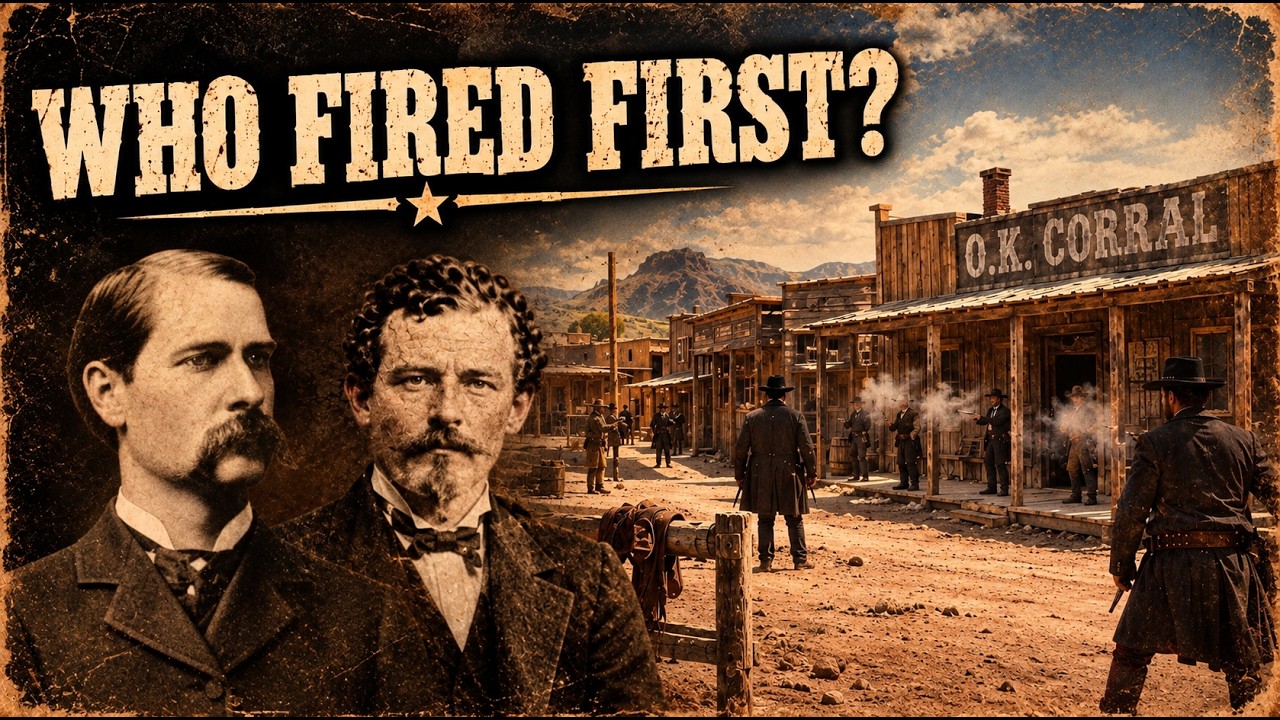
It was three o’clock in the afternoon on October 26, 1881, under a blazing desert sun. The crowd pressed in behind the gunmen, watching with the kind of attention usually reserved for an execution. Not out of love for justice, but for the sight of blood. Every man walking into that lot knew that not all of them would walk out alive.
On one side were the men with official badges: Wyatt Earp, his brothers Virgil and Morgan, and a dying dentist named Doc Holliday, who coughed blood into his handkerchief and smiled the whole way there. On the other side were the Cow Boys: Ike Clanton, his brother Billy, and Frank and Tom McLaury. Cattlemen, rustlers, and men who answered to no law but the one they made for themselves. Tombstone appeared to be a thriving silver town, a place where men came to get rich and left either wealthy or dead.
But beneath the surface, the town was split in two. There was the Earp side, representing law, business, and the men who wanted order because order was good for the price of silver. And there was the Clanton side: ranchers and cattlemen who saw the law as a tax on their freedom. The newspapers of the time had a specific term for men like the Clantons.
They called them “Cow Boys,” and it was never a compliment. The word meant thief and rustler, a man who drove stolen cattle across the border and counted his money in the dark. The Cow Boys did not rob banks. They stole cattle by the hundreds, killed anyone who got in their way, and mocked a justice system that could not reach beyond the county line.
The town tolerated them because Tombstone was built on silver, silver needed shipping, shipping needed ranchers, and some of those ranchers were Cow Boys. The stage for that October afternoon had been set long in advance, in grudges, politics, money, and fear. It was set every time a Cow Boy rode into town and the deputies looked the other way. Then the Earps began to take notice.
Virgil Earp was the town marshal, and his task was to put an end to cattle rustling. But when he pursued the Cow Boys, he found himself tied up at every turn by a sheriff who would not back him, a county that refused to prosecute, and a town that preferred to look away. Wyatt Earp was the one who swore he would not look away. A lawman, gambler, and saloon owner, he had made the Cow Boys his enemies simply by standing up to them.
The Clantons had threatened him openly. Ike swore he would kill him, and the McLaury brothers backed the threat with words that carried their own weight. The weeks before the gunfight were like a slow-burning fuse. Threats were exchanged in saloons.
The Cow Boys bragged about what they would do. The Earps, in the quiet manner of men who do not make threats, said they would not be driven out of their own town. Word reached the Cow Boys that the Earps intended to disarm them, that the law had finally come for them. On the morning of October 26, the Clantons and McLaurys gathered in town, armed, alert, and ready.
The Earps, having heard rumors of what was being planned, made a decision that would echo for 140 years. They decided to walk to that vacant lot and arrest them. Wyatt, Virgil, Morgan, and Doc Holliday, who had borrowed a shotgun from a local and hid it under his coat, walked down Fremont Street, four men facing four, with the whole town trailing behind them. Women, miners, shopkeepers, and gamblers rushed out of saloons and storefronts to watch.
Everyone in Tombstone knew that something was about to explode. At one point, a man named Billy Allen called out to Doc Holliday, asking in a low voice whether the Earps would keep walking or actually do something. Holliday looked at him and, in his dry voice, spoke words that would be remembered long after he was gone: they were going to shoot. The two groups reached the lot at almost the same moment.
The Earps came from the west. The Cow Boys stood near the wooden fence of the stable. Wyatt spoke first, telling them they had been looking for a fight and now they could have one, and ordering them to raise their hands. The Cow Boys were armed.
In that county, carrying a weapon inside the city limits was against the law, and the Earps intended to enforce that law there, by force if necessary. What happened next was lost in smoke and gunfire. There is always a dispute over who fired first. But in those first seconds, the air filled with the sound of shots and the smell of gunpowder, and men on both sides started falling.
Billy Clanton fell first, hit in the hand, then in the chest. He died by the fence with his gun in his hand, the man who had told everyone he did not want to fight. Frank McLaury was hit, and his brother Tom fell almost immediately after, killed without firing a single shot. As for Ike Clanton, who had sworn to kill Wyatt, he raised his hands and ran toward Wyatt, shouting that he was unarmed.
Wyatt pushed him back and told him to leave. For the rest of his life, people would remember Ike Clanton as a man who ran. In a strange mercy, of the three men in that lot who had sworn to kill each other, only one would leave on a stretcher. In thirty seconds, it was all over.
Three men lay dead: Billy Clanton, Frank McLaury, and Tom McLaury. Two others were wounded. Virgil was hit in the leg, and Morgan in the shoulder. The Earps and Holliday had killed three men in broad daylight in front of a crowd, then walked away unhindered.
The town, which had watched the gunfight, turned on the Earps. The coroner’s inquiry lasted for weeks. The Cow Boys called the gunfight murder. Even some townspeople who had cheered the Earps began to wonder whether the law had gone too far.
The Cow Boys swore revenge, threatened the Earps openly, and bragged about what they would do. In March 1882, they carried out their threat. Morgan Earp was shot in the back of the head and killed while playing billiards in a saloon. Cold-blooded murder, a brother killed in front of a crowd that again stood and watched and did nothing.
Wyatt Earp was not the kind of man to let that pass. He gathered a group of men, including Holliday, who was coughing and dying but remained loyal to the end, and began what became known as the Vendetta Ride. He hunted down the men he believed had killed his brother. Those who were not fortunate enough to face a court were found under the desert sun, their lives ended in the dust.
The West called it justice. The East called it crime. In the years that followed, the story was told again and again until truth and legend tangled like two snakes that could not be separated. The gunfight at the O.
K. Corral was not a battle between good and evil. It was a fight between men who believed they needed the law and men who believed they could be the law. History turned it into a story about heroes and villains.
But if you look closely, you will see something smaller and sadder: a town that did not want to be saved, a marshal who died for a version of justice the town never really wanted, and a dying man who coughed blood and walked into a gunfight out of loyalty, not to the law, but to a friend. Those thirty seconds changed the face of the West, but not the way the legend says. They proved that frontier law was not a shield. It was a gamble, and the price of losing was watching your brother die in the dust, with more gunfire as the only answer.
The remains of that day still exist: the papers, the photographs, the headstones. But none of them can tell you who was right that evening. Only that by 3:30 p. m.
on October 26, three men were dead, and the West had invented its most famous story. And the West preferred the story to the truth, because the truth is harder to bear.