The Civil War was a conflict defined by massive armies, brutal tactics, and devastating casualties. But behind the smoke of traditional muskets and cannons, inventors on both sides were dreaming up weapons that seemed to belong in the pages of science fiction. From hand-cranked machine guns to a combat submarine, these are some of the most bizarre and insane weapons ever used on American soil.
The Coffee Mill Gun
One of the earliest attempts at a machine gun was the Agar Coffee Mill gun, invented in 1861. It looked like a kitchen tool, but this hand-cranked weapon could fire up to 120 rounds per minute, a staggering rate for the era. Instead of standard bullets, it fired metal tubes preloaded with powder and ball. It even featured a water cooling system, decades before machine guns became standard. President Lincoln personally test-fired one and ordered several, but military officers were skeptical. The gun jammed easily and was heavy, so most were relegated to guarding forts and supply lines rather than charging into battle.
The Ketchum Grenade
The Ketchum grenade looked more like a dart or a plunger than a weapon of war. Invented by William Ketchum in 1861, it had a thin tail for stability and a rubber plunger on the nose. The problem was that it had to land perfectly tip-down to detonate. If it bounced, it failed to explode, and Confederate soldiers sometimes picked them up and threw them back. Despite the flaws, Union troops used them during the sieges of Vicksburg and Petersburg, paving the way for modern hand grenades.
The Triple Barrel Colt Revolver Rifle
This rare experimental firearm featured three stacked barrels in a rotating cylinder. The idea was to give soldiers more shots before reloading, but the design was a nightmare. It was heavy, awkward to aim, and prone to misfires. Early revolvers had a nasty habit of chain firing, where multiple chambers ignited at once. Imagine that happening with three barrels. Colt quickly realized the design wasn’t practical, and only a few were ever made.
The LeMat Revolver
At first glance, the LeMat revolver looked like any other sidearm, but hidden beneath its main barrel was a deadly surprise: a shotgun. Invented by Jean Alexandre LeMat, a Confederate supporter from New Orleans, this revolver featured a nine-shot .42 caliber cylinder and a second barrel capable of firing a .63 caliber buckshot blast. A soldier could fire nine bullets, then flip a switch and unleash a shotgun blast at close range. It was heavy and required special ammo, but for Confederate cavalry officers, it was the ultimate backup plan.
The Requa Battery Gun
Before machine guns became standard, the Union Army experimented with the Requa Battery Gun. Picture 25 rifle barrels lined up side by side on a frame, like a miniature pipe organ. It could unleash all 25 shots in a single massive volley or fire them in rapid sequence. It was mostly used to defend bridges, forts, and choke points. One blast could shred a charging line, but it was bulky, hard to aim, and required a crew to operate.
The Whitworth Sniper Rifle
In a war dominated by muskets that could barely hit a barn door at 100 yards, the Whitworth rifle was a precision instrument of death. Made in Britain and used by elite Confederate sharpshooters, it fired a .45 caliber hexagonal bullet through a twisted barrel that gave it incredible spin and accuracy. It could hit targets over 800 yards away, more than twice the effective range of standard rifles. It was also one of the first rifles equipped with a telescopic sight, making it a true early sniper weapon.
The Steam Powered Gun
The Union Army actually tested a steam-powered machine gun in 1861. Invented by William Jocelyn, this bizarre weapon used pressurized steam to fire .58 caliber bullets at rapid speed. It could reportedly launch 400 rounds per minute, but it took too long to heat up and was huge and hard to move. It was captured by Confederate cavalry before it ever saw combat, and they were so baffled by it that they eventually destroyed it.
The Chain Shot Cannon

Chain shot wasn’t a single cannonball, but two smaller balls connected by a length of iron chain. When fired, the balls would spin wildly through the air, the chain whipping around like a giant steel blender. Originally used in naval warfare to shred sails, it found a darker use against infantry in the Civil War. Fired into groups of soldiers, it acted like a flying buzzsaw, capable of decapitating or dismembering multiple men in a single pass.
The Greek Fire Cannon
Inspired by the ancient Byzantine weapon, the Confederacy reportedly experimented with a flame-based cannon that could launch a stream of flammable liquid. Records from 1863 describe a compressed air cannon used to spray burning fuel, potentially built to defend key southern ports like Charleston. It likely never saw wide deployment due to being too risky and unstable, but the idea of a flamethrower on American soil in the 1860s was real.
The Caloric Engine Gun
One inventor had a wild idea: what if you could fire bullets using heat and compressed air instead of gunpowder? The caloric engine gun used a hot air engine to generate pressure and shoot projectiles. The concept was elegant, but completely impractical. The gun needed to heat up for minutes before firing, and maintaining the right pressure was a logistical nightmare. It lacked the velocity and range of traditional firearms, making it brilliant in theory but broken in the field.
The Harmonica Gun
This bizarre firearm used a horizontal sliding magazine that resembled the reed plate of a harmonica. The shooter would slide the metal bar left or right to align the next preloaded chamber with the barrel. Some versions could hold seven to ten shots, a big deal in the single-shot era. But the design was bulky, the sliding bar could jam with dirt, and it was possible to accidentally fire multiple chambers at once.
The Puckle Gun

Invented way back in 1718, the Puckle gun was over a century old by the time of the Civil War, but some inventors tried to bring it back. It looked like a giant revolver mounted on a tripod, with a cylinder that rotated manually between shots. It could fire up to nine rounds per minute, faster than most muskets of its time. Its design inspired more advanced weapons like the Ager gun and even the Gatling gun.
The Hailstorm Gun
Also known as the Vandenberg Volley Gun, this weapon featured 88 barrels mounted side by side. The idea was to fire all barrels at once to unleash a storm of bullets. In theory, it could mow down entire lines of infantry, but in practice, it was a disaster. The gun was enormous, difficult to reload, and required a crew to operate. Most were abandoned or destroyed before ever being used.
The Gatling Gun
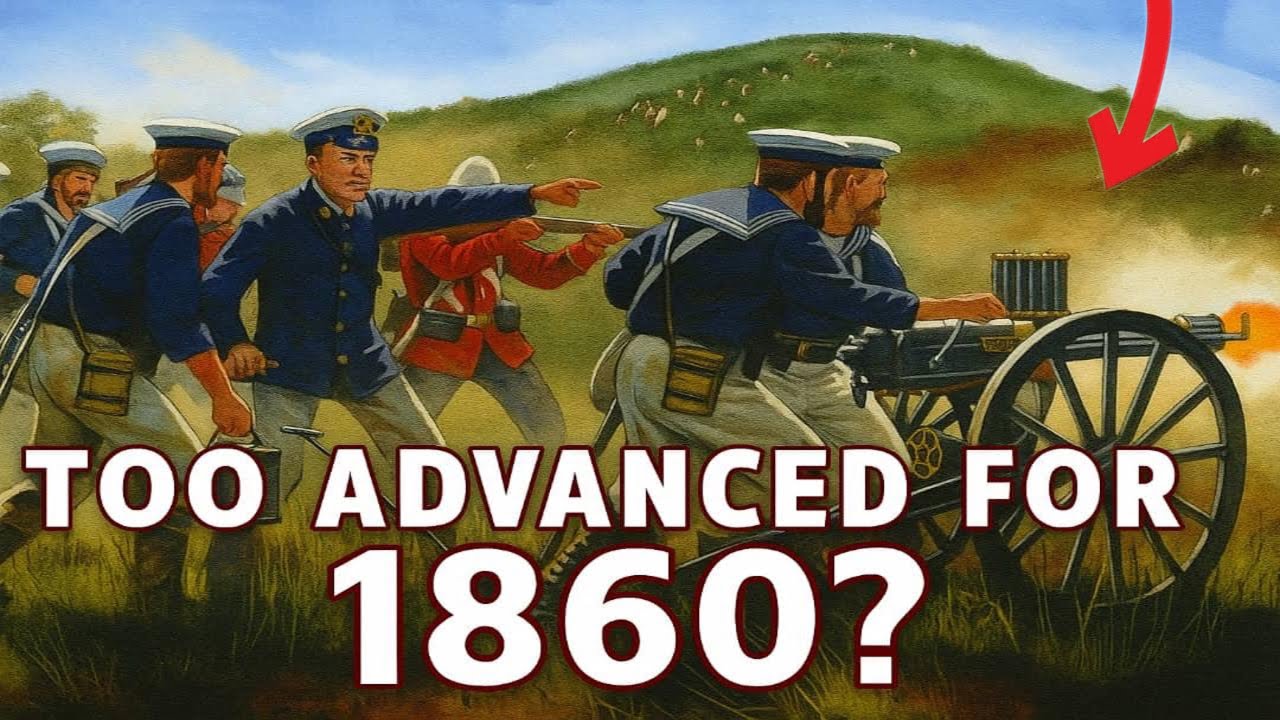
Invented by Dr. Richard J. Gatling in 1861, the Gatling gun was the first successful crank-operated machine gun, capable of firing up to 600 rounds per minute through multiple rotating barrels. Gatling believed that by making war more deadly, nations would think twice before starting one. Though the Union Army bought some units, they were rarely used in major battles. But when it was used, it was devastating, and it inspired every machine gun that followed.
The H.L. Hunley Submarine
In an age of steamships and muskets, the Confederacy built a combat submarine. The H.L. Hunley was an iron, hand-cranked submarine just over 40 feet long, operated by a crew of eight men. On February 17, 1864, it made history by becoming the first submarine to sink an enemy warship, the Union’s USS Housatonic, using a spar torpedo. But moments after the attack, the Hunley mysteriously sank, killing the entire crew. It remained lost for over 130 years before being recovered in 2000.
The Civil War didn’t just tear a nation apart. It quietly birthed the future of modern combat. Machine guns, submarines, and even early chemical weapons all have their roots in this conflict. These inventions were a mix of brilliance and catastrophic failure, but every one of them was real and used on American soil.