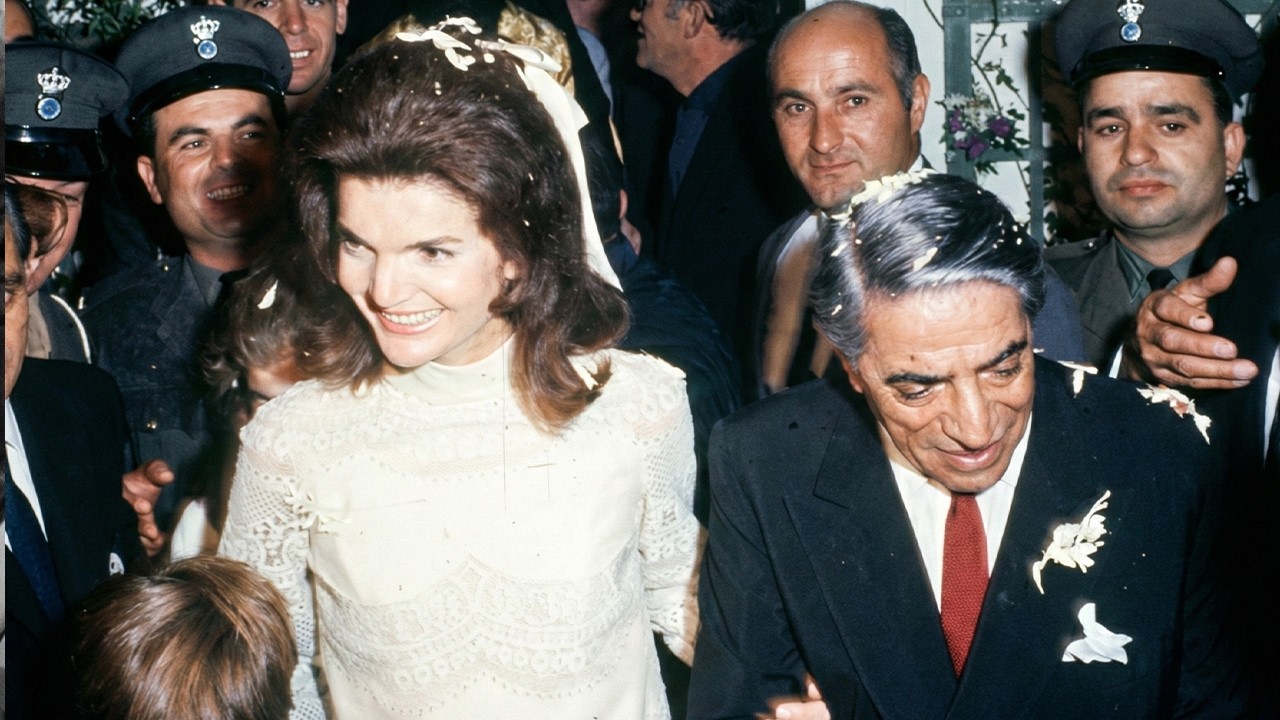
On October 20, 1968, Jacqueline Bouvier Kennedy stood in a small Greek Orthodox chapel on Scorpios Island and married Aristotle Onassis, a Greek shipping magnate 23 years her senior. The ceremony was small, with 40 guests and flickering candles. Caroline and John Jr. held candles during the service.
In America, the reaction was immediate and brutal. Newspapers ran headlines like “Jackie marries blank check.” The Vatican newspaper called her a public sinner marrying for money. Former admirers turned vicious. The public saw a grieving widow chasing wealth. But the fear driving her decision was invisible to most of the country.
She had said it clearly after Bobby’s death: “If they are killing Kennedys, my children are the number one targets. I want to get out of this country.” This was not a love story. It was an escape plan.
The trauma began on November 22, 1963, in Dallas. Jackie Kennedy sat beside her husband in an open limousine when gunshots rang out. The president’s head exploded, and blood and brain matter sprayed across her pink suit. She crawled onto the trunk of the speeding car, reaching for pieces of her husband’s skull. At Parkland Hospital, she refused to leave his side and refused to change her blood-soaked clothes. “Let them see what they’ve done,” she said.
For the next five years, Jackie lived with that trauma. Biographer Barbara Leaming documented her symptoms: nightmares, insomnia, flashbacks, obsessive ruminations about the assassination, thoughts of suicide, and paranoia. She moved to New York to build a normal life for Caroline and John Jr., but normal was impossible. She was America’s most famous widow, and the press stalked her relentlessly.
After JFK’s death, Robert F. Kennedy became Jackie’s lifeline. He visited constantly, helped raise Caroline and John Jr., and became a surrogate father. He had been there during her darkest moments before Dallas. When she miscarried, it was Bobby who stayed with her at the hospital. When Patrick died just months before the assassination, Bobby comforted her. After Dallas, he was her counselor, her protector, and a father figure to her children.
Jackie supported Bobby’s 1964 Senate run. When advisers urged him to enter the 1968 presidential race, Bobby reportedly said, “That depends on what Jackie wants me to do.” Jackie didn’t want him to run. She was terrified. But Bobby felt obligated. The Vietnam War was spiraling, Johnson was failing, and the country needed leadership. So Bobby ran.
On June 5, 1968, at the Ambassador Hotel in Los Angeles, Bobby Kennedy had just won the California primary. The nomination was his. He walked through a kitchen hallway toward a press conference. A gunman stepped forward and fired eight shots from a .22 caliber revolver. Bobby fell. He died 25 hours later.

Jackie flew to Los Angeles and walked into the hospital room. She saw Bobby’s body, and something inside her shattered. According to friends, she became convinced that if they were killing Kennedys, her children were targets. It wasn’t paranoia. Martin Luther King Jr. had been assassinated two months earlier. Race riots burned through American cities. Violence was everywhere. The Kennedys were being eliminated, and Jackie couldn’t risk waiting to see who was next.
She had to get out of America, out of the spotlight, out of the kill zone. She needed protection that Secret Service agents had failed to provide for Jack and political handlers had failed to provide for Bobby. She needed a fortress. She needed money. She needed someone powerful enough to keep her children safe. She needed Aristotle Onassis.
Onassis was one of the world’s richest men, a Greek shipping magnate who owned Olympic Airways and controlled a fleet of tankers. He was also crude, divorced, and 62 years old. He smoked cigars, drank heavily, and preferred belly dancers to ballet. But Jackie didn’t need Prince Charming. She needed a shield.
Onassis had been in Jackie’s life for years. He had comforted her after baby Patrick died in 1963 and invited her on his yacht to recover. After Bobby’s death, he offered something no one else could: escape. His private island in the Ionian Sea, his 325-foot yacht, his homes in Paris, Athens, and New York. His wealth could buy privacy, security, and distance.

Jackie accepted. Biographer Barbara Leaming documented that Jackie was suffering from PTSD that flared up after Bobby’s assassination. She wasn’t thinking about romance. She was thinking about survival. After Onassis died in 1975, Jackie’s statement was carefully worded: “Aristotle Onassis rescued me at a moment when my life was engulfed with shadows.” Rescued. Not loved.
The wedding took place less than five months after Bobby’s death. As a result of the marriage, Jackie lost her Secret Service protection, a privilege entitled to widows of US presidents. She gave up federal protection to marry Onassis because she believed his private security was better, more loyal, and more effective.
Critics called her a gold digger. Onassis’s own children referred to her that way from the start. But the question was whether it was about money or about buying safety. The press crucified her. They coined the nickname Jackie O. Headlines screamed betrayal. The Vatican condemned her. Catholic groups debated whether she should be excommunicated. But Jackie told friends she was done being America’s grieving widow, done standing on pedestals, done playing the role assigned to her.
The marriage was difficult. Onassis preferred bouzouki music and Greek businessmen. Jackie loved ballet and literature. They lived separate lives. Paparazzi never stopped, and the privacy she hoped for never materialized. Onassis allegedly resumed his relationship with opera singer Maria Callas. After his son Alexander died in 1973, Onassis was never the same. When he died in 1975, reports leaked that he had been planning to divorce Jackie.
Did Jackie flee America fearing for her children’s lives? Yes. Her words after Bobby’s death were explicit. She believed someone was systematically eliminating the Kennedy family. The marriage gave her distance from America, financial independence, and security that money could buy. It wasn’t perfect. The marriage was unhappy, and America never forgave her. But Caroline and John Jr. survived. They grew up. They lived.
After Onassis died, Jackie returned to New York and worked as a book editor, first at Viking Press, then at Doubleday. She built a life on her own terms. She died in 1994 at age 64 and was buried beside JFK at Arlington National Cemetery. Her son described her at the funeral as having three defining attributes: love of words, bonds of family, and spirit of adventure. He left out one more: survival instinct.
Jackie Kennedy survived two presidential assassinations, survived PTSD, survived a difficult marriage, survived public condemnation, and she kept her children alive. On October 20, 1968, when she married Aristotle Onassis, it wasn’t about love or money. It was about escape from America, from the spotlight, and from whoever was killing Kennedys. Sometimes the bravest choice looks like betrayal.