In June 1940, France was in chaos. Roads were clogged with refugees, and families pushed handcarts loaded with whatever they could carry from their homes. In barely six weeks, the French army—once considered among the strongest in Europe—had collapsed. Paris was occupied by Nazi Germany, and the elderly Marshal Pétain, a former hero of Verdun, went on the radio to tell the nation that the fighting must end.
Among the wounded and displaced was a French woman, a former teacher now working as a nurse. She was determined, in her own words, to die if necessary as a martyr for France. Within a year, she would help build one of the largest Allied spy networks in occupied France. But she would later betray it all to the Germans.
Her agents, codes, and secrets were handed over in a single night to save her own life. Dozens of resistance fighters were sent to prisons and concentration camps, and some never returned because of her actions. Her name was Mathilde Carré.
Born Mathilde Lucie Belloir on June 30, 1908, in Le Creusot, an industrial town in eastern France, she showed early academic promise. In the 1930s, she studied at the Sorbonne in Paris and qualified as a teacher. In 1933, she married Maurice Carré, a fellow teacher, and the couple moved to French North Africa. The marriage did not last.
By the time World War II reached France in 1940, Carré had returned to the continent. She was an ambitious and restless young woman in a world about to be turned upside down. When Germany invaded in May 1940 and the country fell within six weeks, she was working as a nurse and watched her homeland fall under occupation.
That autumn, she met the man who would give her life its decisive direction. Roman Czerniawski was a Polish Air Force officer who had escaped the French defeat and was building an intelligence network for the Allies. The Poles knew him by the code name Valentin, and the French called him Armand. His organization, called Interallié, was a Franco-Polish network reporting to British intelligence in London, and it grew with remarkable speed.
At first, microfilms were sent to the United Kingdom via a contact line to Marseille, then transported to London. By spring 1941, the organization had established wireless contact with London, and soon the network had agents operating across almost the entire German-occupied zone of France. It became one of the largest resistance networks in the country.
Carré joined the headquarters section. Following the network’s practice of giving its central staff code names starting with V, she became known as Victoire. But the nickname that stuck was “La Chatte”—the Cat—because of the discretion and calm that marked her work. Her contemporaries were also amazed at her ability to escape death repeatedly, convinced she had nine lives like a cat.
She and Czerniawski became lovers, and she quickly rose to become one of Interallié’s most valuable members. With her composure and charm, she could draw information from German officers she met at social events. Her wireless messages to London became known for their opening line, “The Cat reports,” and she was known by that name within British intelligence circles as well.
In October 1941, the network caught the attention of the Germans. The task of dismantling it was given to Hugo Bleicher, a French-speaking intelligence sergeant who would become one of the most effective German spy hunters in occupied France. A captured agent gave him names and addresses, and the arrests began. In November, about 21 members were captured in Cherbourg, and on November 17, the leaders, including Czerniawski and Carré, were arrested in Paris.
After just one night in custody, Carré broke. She asked to speak to Bleicher and revealed everything: the names of network members, where documents were hidden, and the locations of safe houses and materials. This information allowed the Germans to dismantle almost the entire Interallié network. She was released the next day and went to live with Bleicher, who became both her lover and her handler.
She kept her old code name, Victoire, but now she worked for the Abwehr, German military intelligence, against the people she had once fought alongside. She accompanied the Germans on raids, and on at least one occasion, she personally identified a former comrade, greeting him with a kiss in a café moments before he was led away. She helped the Germans arrest at least 60 of her former colleagues. Many were imprisoned, some were deported, and others were executed.

The Germans also seized four of the network’s radio transmitters. With Carré’s help in using the codes, broadcast schedules, and agreed security procedures, they continued sending messages to London as if nothing had changed. It was that captured radio link that attracted the man who would end her double game.
Pierre de Vomécourt, a British intelligence agent with the Special Operations Executive, worked under the code name Lucas. He had no wireless operator of his own and no way to reach London, and he was funding his work with his own money. In late December 1941, he was introduced through a lawyer in Paris to Carré, who offered him access to a transmitter. To test her, he had her send a request to London for money. Two days later, the reply came, and he collected the funds.
Reassured, he did not know the network had already been exposed, or that the woman helping him was working for a higher power. Bleicher had introduced him to her as a Belgian resistance leader named Jean Gustave. Doubts returned to de Vomécourt in January 1942 when he asked Carré for forged identity papers, and she produced them too quickly and too well. When confronted, she admitted she had been working for the Germans.
By that time, she had become his lover. Instead of exposing her or killing her, de Vomécourt devised a more ambitious plan. He convinced her to take on a third role: to persuade the Germans that she needed to travel to London with him to spy on the British. In reality, he intended to hand her over to the British. The Abwehr agreed, expecting her to report back after her return from London.
On the night of February 27, 1942, after several failed attempts, the two crossed to England aboard a British naval vessel. That was the end of Carré’s career as an agent for either side. In London, she was thoroughly interrogated by British intelligence about Abwehr methods, and her radio link was operated for a time to deceive the Germans until it was no longer useful.
Then, at the request of French authorities and in light of her role, she was arrested in the summer of 1942 and held for the rest of the war—first at Holloway Prison in London, then at Aylesbury women’s prison, where she went on hunger strike at one point to protest her conditions. She remained in British custody for about three years.

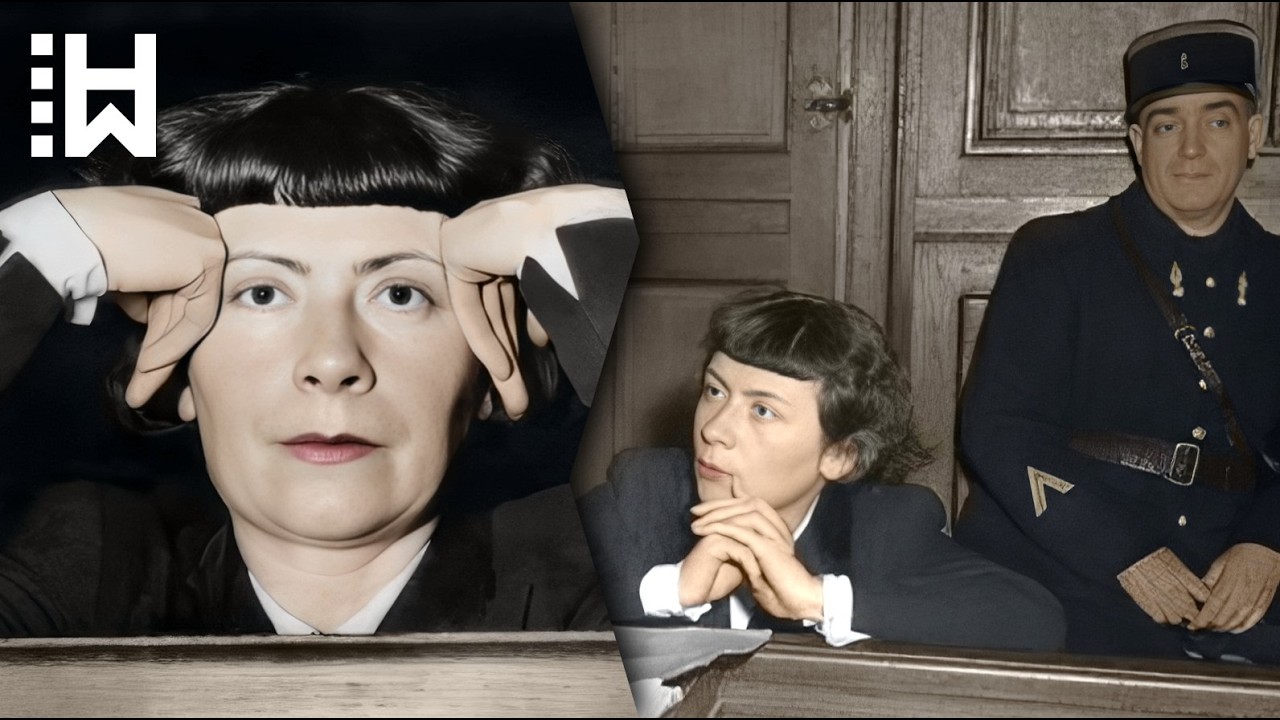
After the war ended in 1945 and France was liberated, Mathilde Carré was flown to Paris and handed over to French authorities. She spent the following years in detention at La Santé prison and in Rennes while her case was prepared. Her trial began on January 3, 1949, and lasted four days. The prosecution read aloud from her wartime memoirs a line that would define her image in the public mind: that she longed above all for a good meal, a man, and to hear Mozart’s Requiem once more.
Her defense did not deny her betrayal of the network but argued the impossibility of her situation, reminding the court that she had begun the war as a genuine member of the resistance. On January 7, 1949, she was sentenced to death. But the sentence was never carried out. Three months later, it was commuted to life imprisonment with hard labor, then reduced again. She was released in 1954 after spending about 12 years in detention across two countries.
In 1959, she published her memoirs under the title *J'étais la chatte*—“I Was the Cat.” The book was revised and republished in 1975 as *On m'appelait la chatte*, or “They Called Me the Cat.” In those memoirs, she maintained her innocence and sought to minimize her guilt, presenting herself as a woman trapped by circumstances rather than a traitor who chose her own survival over the lives of her comrades.
After her release, Carré withdrew almost completely from public life. Her isolation was so complete that reference works for decades recorded her death around 1970, and her true fate was not revealed until much later. In fact, she lived quietly in France for more than half a century after her wartime betrayal.
Carré’s story illustrates the complexities of human life during the greatest conflict in history. For a time, she was exactly what her comrades believed: brave and trusted with the secrets of one of the Allied networks in occupied France. But after one night in a cell, everything changed. Forced to choose between loyalty and survival, she betrayed the network she had helped build. Dozens of those who trusted her were arrested, deported to concentration camps, or killed.
For some, her betrayal made her worse than the Nazis themselves. The resistance expected treachery from the occupiers, not from a trusted member of their own network. Despite everything, the former Cat served her sentence and then lived a long life in the country she had once betrayed. Mathilde Carré died in Paris on May 30, 2007. She was 98 years old.