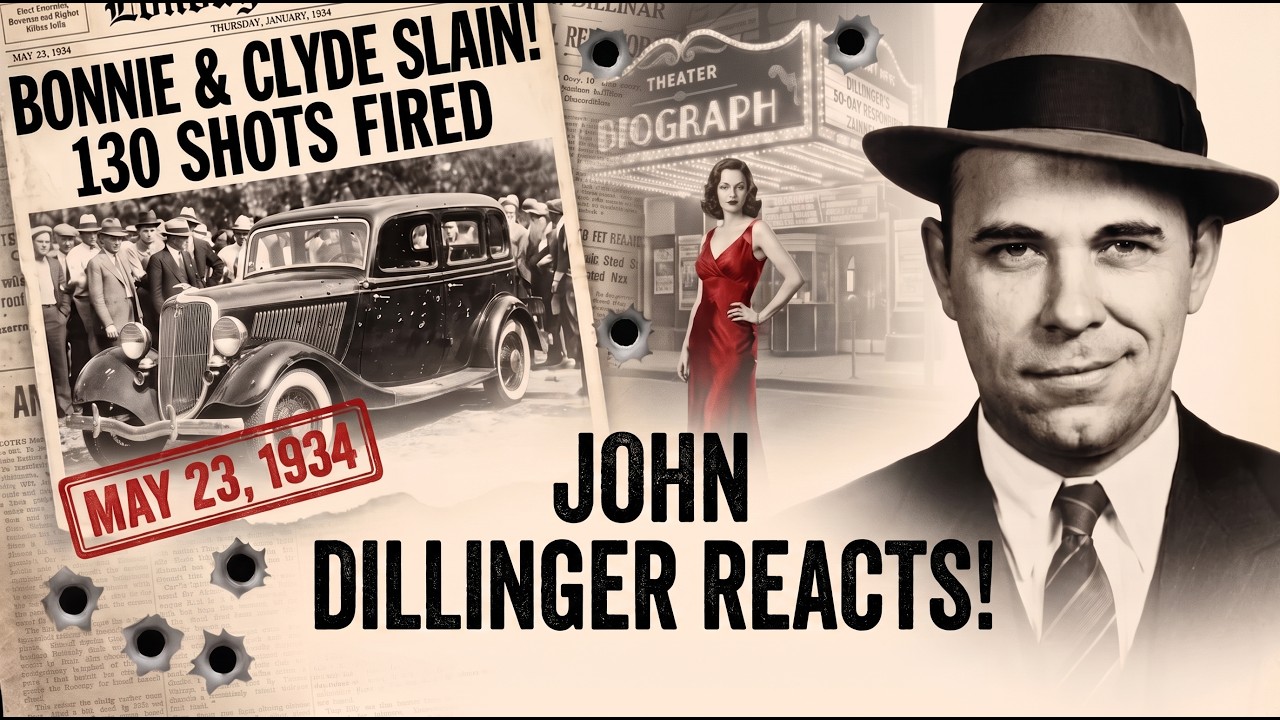
On May 23, 1934, John Dillinger was hiding out in Calumet City, Illinois, just outside Chicago. That same morning, in Bienville Parish, Louisiana, a six-man posse fired around 130 bullets into a stolen Ford V8 carrying Clyde Barrow and Bonnie Parker. Neither of them got a weapon up.
The story hit every front page and radio in America that evening. Dillinger didn’t need anyone to explain it to him. No warrant was read on that road, and no warning was shouted. The lawmen studied the pair, picked their spot, and waited in the bushes until it was time to empty everything they had brought.
Dillinger had already given his opinion on Bonnie and Clyde on the record. While locked up at the Crown Point jail earlier that year, a reporter asked him about them. He said they were a couple of punks.
That was the professional’s assessment. Real bank men looked at the Barrow gang the way a licensed electrician looks at a brother-in-law who watched one video and rewired the garage. They robbed gas stations and grocery stores for lunch money and got into panic shootouts with small-town constables. Pretty Boy Floyd reportedly wouldn’t even work with them.
Dillinger was at the top of the outlaw ladder. Bonnie and Clyde were down around the bottom rung, and he had said so in the newspaper. That makes his next five days so telling. The punks were dead, and the professionals understood something the papers were not printing.
Those 130 rounds didn’t check anybody’s resume on the way in. Being good at your job had nothing to do with it.
The very same day Bonnie and Clyde died, a federal judge in St. Paul gave Billy Facet two years in prison for harboring Dillinger. His girlfriend went to the pokey, and his colleagues got shot to pieces on the same calendar day.
Dillinger already had a plan in motion before any of this happened. The plan involved plastic surgery. His lawyer, Louis Piquett, had set it all up back in April, not long after Dillinger shot his way out of the Bohemia Lodge ambush in Wisconsin.
The surgeon was Dr. Wilhelm Loeser. He had practiced in Chicago for 27 years before a narcotics conviction sent him to Leavenworth. The price was $5,000. Piquett, Loeser, and an investigator named Arthur O’Leary split $4,400 of it, and Dr. Harold Cassidy got $600 to run the anesthetic.
The operating room was the living room of a man named John Probasco on the north side of Chicago. When your surgery happens at a house with a fellow’s name on the mailbox instead of a hospital, you’re not on a good path.
The ambush happened, and you’d think a man might pause and maybe look into Canada. Dillinger didn’t cancel or even push things back a week. He moved into the Probasco house within days. On the evening of May 28, Loeser and Cassidy showed up to operate. Bonnie and Clyde had been dead for five days.
Loeser testified later about exactly what Dillinger ordered. He wanted the moles taken off his forehead, the corner of his left eye lifted, and the dent in his nose filled. The scar on his upper lip was coming out, and the dimples were going too. He also had the corner of his mouth pulled up.
He was deleting himself one feature at a time.
He chose to go fully under for it, and that decision nearly beat every lawman in America to the punch. Cassidy gave him too much ether. Dillinger swallowed his tongue, turned blue, and quit breathing right there on the table.
Loeser grabbed forceps and pulled the man’s tongue out of his airway. Then he drove his elbows into Dillinger’s ribs until he started breathing again. The most wanted man in the country came about a minute from dying in a bar owner’s living room, five days after the two he called punks died on a Louisiana road.
A few days after that, Loeser burned Dillinger’s fingerprints off with a caustic soda mix. After all that money and all that risk, friends who saw him said he looked like he had the mumps.

A scared man disappears. Dillinger healed up through June and then went right back out into the city. He kept a machine gun in an open case underneath Probasco’s piano. There was a shotgun under the parlor table too.
Then he started dating a 26-year-old waitress named Polly Hamilton from a sandwich shop on Wilson Avenue. She knew him as Jimmy Lawrence. He took her to restaurants and movie theaters in downtown Chicago while every cop in America carried his photograph.
Homer Van Meter was staying in the same house. Witnesses later said Van Meter kept warning Dillinger about picking up women he knew nothing about.
Bonnie and Clyde died specifically because somebody inside their circle sold their location. Henry Methvin’s family set that ambush up in exchange for leniency. It was in the papers, and Dillinger read them. Then he took his new girlfriend to the movies anyway.
The government kept stacking wood. On June 6, President Roosevelt authorized reward money for criminals. Congress followed on June 18, giving federal agents full arrest powers and the guns to go with them. On June 22, the Attorney General named Dillinger America’s first Public Enemy Number One.
That happened to be his 31st birthday. Most men get a card, maybe a fishing trip. Dillinger got the federal government’s top spot and celebrated by taking Polly out on the town.
Then he went back to work. On June 30, 38 days after the ambush, he walked into the Merchants National Bank in South Bend, Indiana, with Van Meter and Baby Face Nelson. They robbed it. A police officer got shot during the job.
That was the whole answer to the summer’s big question. The ambush hadn’t run him to Mexico or into a hole somewhere. He watched two outlaws get shot to pieces without a warning, then got himself a new face and a new girlfriend and hit another bank inside of six weeks.
The bet lasted 60 days.
Polly Hamilton lived with a woman named Anna Sage. Sage ran a brothel over in Gary, Indiana, and she recognized Jimmy Lawrence. She was facing deportation to Romania, so she called the Federal Division of Investigation and offered to hand him over for reward money and help with her immigration case.
On the night of July 22, 1934, she went out to the movies with Dillinger and Polly at the Biograph Theater wearing an orange skirt so the agents could pick the group out of the crowd. The movie was Manhattan Melodrama, a Clark Gable gangster picture.
When Dillinger walked out around 10:30 in the evening, Melvin Purvis lit a cigar to signal the waiting agents. Dillinger pulled a pistol and ran for the alley. They shot him down before he reached it.
Line it up next to May 23, and it’s the same job with different scenery. Somebody inside the circle traded him to the government. The lawmen studied his habits and picked the ground. Nobody gave him a usable warning before the shooting got ruled justified.
The surgery he nearly died for made no difference at all. The woman standing next to him sold the agents, which meant they had to shoot.
The crowd finished it off. While Dillinger lay in the alley, souvenir hunters dipped newspapers and handkerchiefs in his blood. Just two months earlier in Louisiana, crowds swarmed the death car and tried to cut pieces off the bodies before the officers pushed them back.
About 15,000 people filed past Dillinger at the Cook County morgue over the next day and a half. The same treatment the punks got from the same public. Whatever gap Dillinger believed sat between a professional and a couple of amateurs in a stolen Ford, neither that ambush nor the crowd ever saw it.