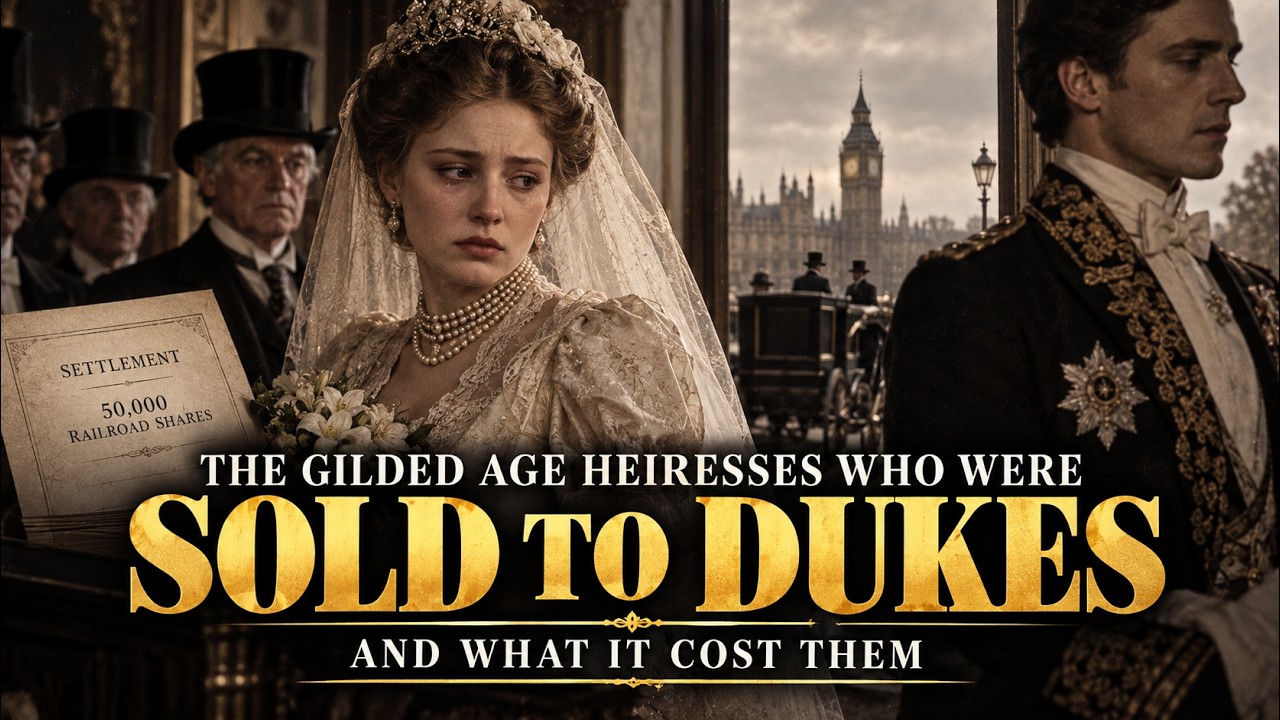
In the late 19th century, a peculiar transatlantic trade reached its peak. American heiresses crossed the ocean to marry into the British aristocracy, and the newspapers called it romance. The paperwork, however, told a different story. It was a market where fortunes were exchanged for titles, and the women at the center often paid the highest price.
The arrangement solved two problems at once. In New York, old society families closed ranks against the new money of railroad and steel barons. In Britain, cheap American wheat had devastated agricultural rents, leaving grand estates unable to pay for themselves. One side had money and no rank. The other had rank and a leaking roof.
The first famous crossing came in August 1873. At a sailing regatta at Cowes, the Prince of Wales introduced a 19-year-old from Brooklyn named Jennie Jerome to Lord Randolph Churchill. They were engaged within three days. The subsequent negotiations over money were ugly, with Jennie’s father eventually settling on a figure of £50,000. Less than eight months after the wedding, Jennie gave birth to a son named Winston at Blenheim Palace.
Two years later, another American girl went further. Consuelo Yznaga married the heir to the Duke of Manchester. The marriage went wrong almost at once, as her husband spent heavily on gambling. By 1890, he was declared bankrupt. Consuelo was left a widowed duchess with a bankrupt estate, and she outlived both of her twin daughters, who died in their teens and early twenties.
By 1890, the traffic was steady enough to need a directory. A New York publisher printed a book titled *Titled Americans*, listing American ladies who had married foreigners of rank. At the back was a list of eligible British peers, complete with their acres and incomes. It was a shopping list for the mothers of Fifth Avenue, with every name carrying a figure.
The most determined mother was Alva Vanderbilt. She had divorced her husband and walked away with a settlement of more than $10 million. She turned all of her attention to one project: securing a duke for her daughter. She had already decided which one.
Consuelo Vanderbilt was raised to be the final proof of her mother’s social ambitions. By the time she was 17, she had fallen in love with a New York society man named Winthrop Rutherford. They planned to elope. When her mother found out, she locked Consuelo in her room and threatened to murder Rutherford. When that didn’t break her daughter, Alva took to her bed, claiming her heart was failing and that Consuelo’s refusal was killing her.
Consuelo gave up Rutherford and agreed to marry the Duke of Marlborough. On the wedding morning, she cried until her eyes were red and swollen. She later called her veil a blessing because it meant no one could see her face. The settlement put 2.5 million dollars in stock into trust for the Duke, with a guaranteed income of $100,000 a year.

On the honeymoon, the facade fell off. The Duke told her plainly that he had given up a woman he loved in England to marry her, and that he had done it for one reason: her money was the only way to save Blenheim Palace. She gave birth to two sons, the heir and the spare, and stayed for 11 years. The marriage was empty, and in 1906, they formally separated.
That same year was a bad one for three of the women in this story. Alice Thaw’s marriage to the Earl of Yarmouth had been marked by last-minute negotiations over her dowry. In June 1906, her brother Harry Thaw shot and killed the architect Stanford White in front of an audience at Madison Square Garden. Three weeks later, Mary Curzon died in London at the age of 36. She had never fully recovered from an illness she contracted in India.
Alice Thaw watched her family name turn into a murder trial. Her brother was eventually found not guilty by reason of insanity. That same year, her own marriage was annulled on the ground of non-consummation, declared void as if it had never happened. All financial interests were returned to her. She later remarried an American and had two sons.
The first Consuelo, the godmother, outlived her husband by 17 years and both of her daughters. In 1895, the same year her goddaughter walked up the aisle to marry a duke, her own daughter May died at 16. The two Consuelos were living the same bargain at opposite ends. One was just signing it. The other had already paid it off.

The knot finally came loose in one summer. In June 1921, the Duke of Marlborough married his mistress. Days later, Jennie Jerome died in London after complications from a fall. On July 4th, American Independence Day, Consuelo Vanderbilt married a French aviator. By her own account and by everyone else’s, it was a happy marriage.
In 1926, the Duke wanted his first marriage declared null by the church so he could become a Roman Catholic. The decisive witness was Alva, who testified that the marriage had been coerced. The words attributed to her have been quoted ever since: "I forced my daughter to marry the Duke. I have always had absolute power over my daughter." The marriage was annulled.
Nobody was ever held to account for any of it. The Duke kept Blenheim, restored with Vanderbilt money, and passed it to Consuelo’s son. His second marriage turned bitter, and he died in 1934. Consuelo died in 1964 and was buried near the palace she had paid for and walked out of. Weeks later, Winston Churchill was buried in the same churchyard.
Historians count about 102 American women who married British aristocrats between 1870 and 1914. The money went into roofs, drains, libraries, and gardens that tourists still pay to walk through. The women went into rooms where they were outsiders for the rest of their lives. The families on both shores divided the proceeds, and the daughters got the bill.