The grave of Billy the Kid has been robbed three times. But the real mystery was never about what was stolen. It was about what remained buried beneath the surface.
For over 140 years, the identity of the body in that grave has been debated. Entire communities, historians, and even law enforcement have been pulled into the controversy.
The truth, it turns out, was documented by a forgotten army contractor in 1906. His discovery challenged a myth that had been building for decades.
The story begins at Fort Sumner, New Mexico, in 1881. The former military post sat along the Pecos River in the high desert. The army had decommissioned the fort after the Civil War.
In 1870, Lucien Maxwell, one of the largest private landowners in American history, purchased the property. He turned the old officers' quarters into his ranch headquarters.
The cemetery was divided into two sections. One held the remains of soldiers from the 1860s. The other held civilians buried without much ceremony.
It was a dusty, unremarkable patch of ground. It would become one of the most contested pieces of dirt in American history.
Billy the Kid was likely born Henry McCarty in New York City around 1859. He went by William Bonney and other aliases. He was charming, literate, and fluent in Spanish.
By 21, he had been credited with killing as many as nine men. He was the kind of outlaw people sheltered willingly.
Pat Garrett was his opposite. A former buffalo hunter and bartender, Garrett had been friendly with Billy before becoming sheriff of Lincoln County. He was tall and methodical.
Garrett killed Billy on the night of July 14, 1881, at Fort Sumner.
Garrett sat in a darkened room speaking with Pete Maxwell. Billy walked in from the porch with a knife in one hand. He sensed a figure in the darkness he didn't recognize.
He asked, "¿Quién es?" "Who is it?"
Garrett fired twice. The first bullet struck Billy in the chest just above the heart. He died within moments. He was 21 years old.
The next morning, a coroner's jury assembled to examine the body. They interviewed Garrett and other witnesses who had known Billy personally.
The foreman delivered a simple verdict: "This is the kid's body." The men who knew Billy in life confirmed his identity in death.
That evening, Billy received a candlelight wake. The women of the fort prepared his body. The people who attended were friends and neighbors who had sheltered him.
He was buried in the civilian section of the cemetery alongside two men who died before him: Charlie Bowdre and Tom O'Folliard.
Bowdre was Billy's close associate during the Lincoln County War. Garrett's posse caught up with him at Stinking Springs in December 1880. He took bullets in the chest and died on his feet.
O'Folliard was younger, a devoted follower of Billy's. Garrett's posse killed him in an ambush at Fort Sumner on December 19, 1880. He lingered for about 30 minutes before dying.
All three lay in a row. Billy first, Bowdre second, O'Folliard third.
A simple wooden marker was placed over Billy's grave. It wouldn't last long.
Within a few years, the marker was riddled with bullet holes. Drunken soldiers from the nearby garrison used it for target practice. By the late 1880s, it was gone entirely.
For approximately 35 years, the grave sat unmarked. An entire generation grew up without knowing which patch of earth held Billy the Kid.
In the early 1900s, Pat Garrett returned to the cemetery. He tried to identify the precise location using natural landmarks. He remembered salt grass and greasewood bushes near the burial site.
In 1926, journalist Walter Noble Burns published "The Saga of Billy the Kid." The book turned Billy from a regional folk figure into a national legend.
In 1927, a new marker was installed to meet demand from tourists. But it was placed in the wrong spot.
In October 1904, the Pecos River flooded. A rumor began to circulate that the flood washed away Billy's grave. The casket was swept downstream. The bones were scattered.
This rumor persisted for over a century. But it wasn't true.
In 1906, the United States Army hired a contractor named Charles Dudrow. His job was to disinter 22 military graves from the Fort Sumner Cemetery and relocate them to Santa Fe National Cemetery.
Dudrow had no interest in Billy the Kid. He needed to know which graves were military and which were civilian. He needed a map.
To make that map, he consulted the old-timers of Fort Sumner. Chief among them was Deluvina Maxwell.
She was a Navajo woman who had been taken captive as a child and adopted into the Maxwell family. She grew up at Fort Sumner. She was present when Billy was killed. She was one of the people who prepared his body for burial and was a pallbearer.
Using her testimony and the input of other old-timers, Dudrow methodically mapped the entire cemetery. He marked with precision the location of three civilian burials in a row: Billy the Kid, Charlie Bowdre, Tom O'Folliard.
Dudrow also made another discovery. The military graves were intact. The burial mounds were still visible. The remains were well preserved.
Not a single one of the 22 military burials had been disturbed by the 1904 flood.
If the flood couldn't move the soldiers, it couldn't move Billy.
Historian David G. Thomas later studied Dudrow's records extensively. He described the contractor's civilian grave identifications as having formidable credibility.
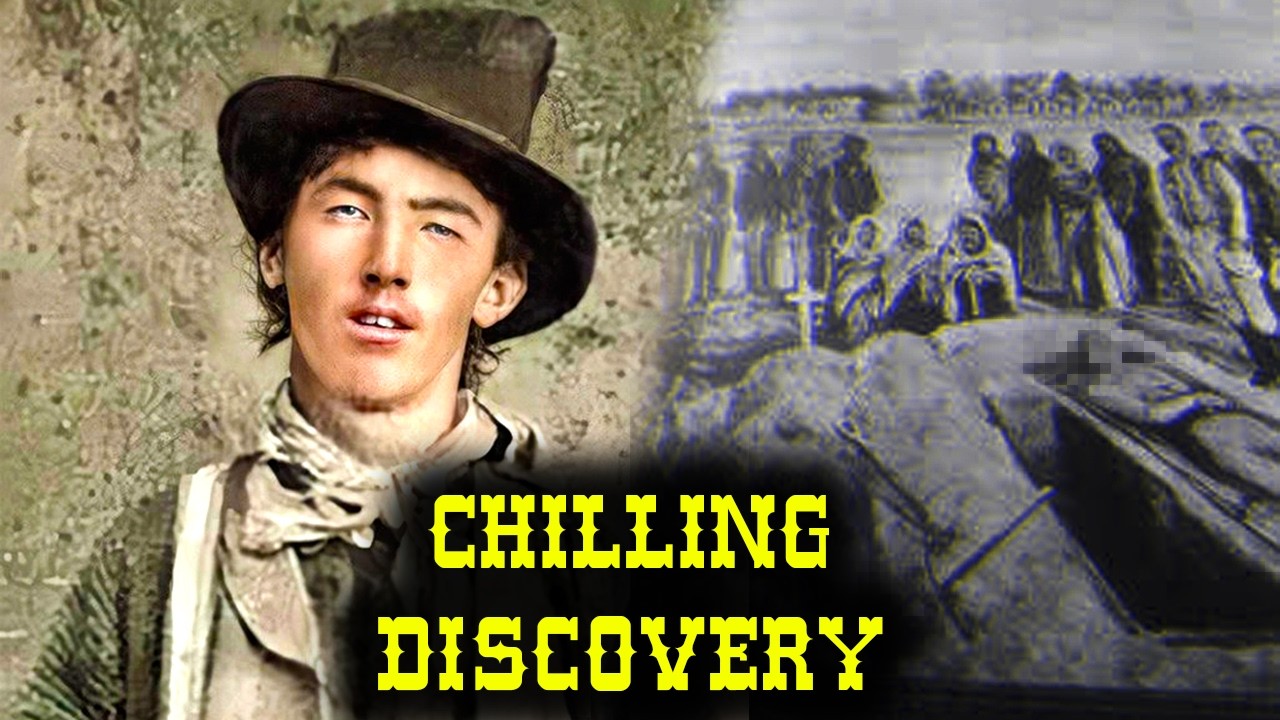
In 1930, four men visited the cemetery. Three of them knew Billy the Kid personally. They independently identified the grave's location.
Their identification aligned with Dudrow's 1906 map to within a few feet. Concrete curbing was added to mark the grave permanently.
Sometime in the 1940s, a granite tombstone was installed. It bore the inscription: "Billy the Kid, the boy bandit king, he died as he lived."
In 1950, the tombstone vanished. Someone walked into the cemetery, uprooted the granite slab, and carried it away.
The stone stayed missing for about 25 years. Then, in July 1975, a woman named Sophie Essinger received a tip. The tombstone was in Granbury, Texas, on a property once owned by a family named Branam.
When a man named Wright began clearing the property, he unearthed the stolen tombstone buried in the earth.
On June 19, 1976, during Fort Sumner's annual Old Fort Days celebration, the tombstone was reset at the grave. This time, it was placed inside a protective cage.
The cage wasn't strong enough.
On February 1, 1981, someone cut the locks on the cage. The tombstone was gone again. A second stone from another grave was also taken.
Five days later, the New Mexico State Police received an anonymous phone call from Huntington Beach, California. The caller gave them a name: Walter Nicholson, a trucker.
Detectives located the tombstone hidden under a blanket in Nicholson's possession.
On February 13, 1981, Lincoln County Sheriff Tom McBride flew to Los Angeles to personally retrieve the stolen tombstone. He arrived wearing a Stetson hat and cowboy boots.
McBride brought the stone home. It was reset in a much stronger cage, just in time for the centennial celebrations.
The tombstone had been stolen and recovered three times. Each time, the body beneath it stayed exactly where it had been since that July night in 1881.
The real secret of Billy the Kid's grave is not that the body was moved. It's not that the flood washed it away. It's not that Garrett killed the wrong man.
The secret is something more human.
Billy the Kid was a 21-year-old who was killed, identified by sworn testimony, mourned by people who loved him, and buried by friends. Within a decade, his grave was unmarked. Within two decades, people questioned whether the body was even there.
Within a century, the tombstone had been stolen three times. A flood myth had erased public confidence in the burial. Conspiracy theories claimed Billy wasn't even dead.
The grave was never lost. The body was never moved. The identity was never in doubt to the people who were actually there.
What was lost was the simplest thing imaginable: the ability to let a dead man rest.
Every piece of evidence points to the same conclusion. The grave is real. The body is there. The truth was never hidden.
Historians weren't shocked by a secret inside the grave. They were shocked by how thoroughly the truth had been buried under legend.
Today, Billy the Kid's grave sits behind heavy steel bars. The granite marker that reads "He died as he lived" is the same slab that traveled to Texas, to California, and came home each time.
Tourists come by the thousands. They take photographs through the bars. They leave flowers, coins, bottles of whiskey. Some leave bullets.
The cage isn't there to keep Billy in. It's there to keep us out.
The dead man is exactly where he's always been. It's the living who can't stop disturbing him.
Despite the evidence, the conspiracy theories persist. Books still repeat the flood myth. Videos still ask whether the grave is empty.
There's a reason for this. A confirmed grave is the end of the story. And people don't want the story to end.
Billy the Kid alive. Billy the Kid escaped. Billy the Kid's bones scattered by a flood. These are stories that keep going.
Billy the Kid dead and buried in a known grave, confirmed by multiple independent sources across decades, is just history.
The men and women who actually knew the truth are long dead now. Their testimony survives only in documents that most people will never read.
What survives in the popular imagination is the myth. The empty grave. The missing body. The endless mystery.
The real disturbing secret of Billy the Kid's grave is that we chose legend over evidence. Not because the evidence was hidden, but because the story was better without it.
The tombstone behind the steel cage at Fort Sumner has traveled more miles since Billy's death than Billy traveled in his entire short life. Three times stolen, three times recovered.
Each theft was a small act of mythology. Someone believing that possessing the stone meant possessing the legend.
Beneath it, undisturbed since that hot July night in 1881, lies the body of the boy born Henry McCarty. Exactly where his friends buried him by candlelight.
No flood moved him. No conspiracy erased him. No secret waited in the earth to shock historians.
The only thing that was ever truly disturbing about Billy the Kid's grave was us.