On December 21, 1866, ten years before the Battle of the Little Bighorn, 81 U.S. soldiers disappeared over a snow-covered ridge in northern Wyoming. Not one returned. Every man was dead within 40 minutes, and almost none of them were killed by gunfire.
That final fact is enough to stop you cold. Eighty-one rifle-armed soldiers, moving in formation under trained officers, were wiped out in less than a mile of marching. When the army recovered the bodies, surgeons found that only six men had been killed by bullets. Six out of 81. The rest were killed at close range by weapons most Americans considered primitive.
It was the worst defeat the U.S. Army ever suffered on the Great Plains. Not Little Bighorn, but a battle most people have never heard of. A battle where a captain boasted he could ride through the entire Sioux nation with 80 men, and then marched those 80 men straight into death.
The Fetterman Fight did not just kill 81 people. It shattered the myth of U.S. military invincibility on the frontier. It forced a nation to face the reality that westward expansion could be stopped, not just by terrain or weather, but by a coalition of warriors acting with precise planning.
By the end, you will understand how a young warrior named Crazy Horse helped orchestrate one of the most perfectly executed ambushes in American military history, and how a prophecy made days earlier predicted the exact death toll. You will understand how a man carrying captured firearms, war clubs, and lances built a trap designed not to wound or repel, but to completely annihilate.
And you will understand why the cause of Fetterman’s death is still debated today. Did he die by his own hand, or by the blade of a warrior named American Horse?
To understand how a trained military officer, explicitly ordered not to cross that ridge, went beyond it and died, you first need to know what brought them to that frozen hill.
The year was 1866. The Civil War had ended just 12 months earlier. The nation’s eyes were fixed westward with an almost religious hunger. Gold had been discovered in Montana Territory, and the fastest route to the goldfields ran directly through the Powder River country, the last great hunting ground of the Lakota Sioux, Northern Cheyenne, and Arapaho.
That road was called the Bozeman Trail, and it cut through the heart of treaty-protected land. The Fort Laramie Treaty of 1851 had guaranteed this area to the Lakota. The government’s decision to build military forts along the road was not just expansion. It was a direct violation of their own treaty, and everyone knew it.
When Lakota leader Red Cloud refused to negotiate as the army began building forts along the road, he organized a sustained campaign of raids, ambushes, and harassment against every soldier and wagon train moving through his territory. This was not scattered resistance. It was organized warfare across bands and seasons, designed to make the Bozeman Trail so costly that the United States would abandon it entirely.
The warriors who gathered that winter carried more than weapons. They carried memories. In 1864, Colorado militia attacked a peaceful Cheyenne and Arapaho camp at Sand Creek, killing more than 150 people, mostly women, children, and the elderly. The militia mutilated the bodies and displayed body parts on the streets of Denver. Sand Creek was not a battle. It was a massacre, and it ignited a fury across the northern plains that no treaty council could soothe.
Fort Phil Kearny itself was a wooden stockade in present-day northern Wyoming, built in the summer of 1866. It sat in heavily wooded hill country that offered cover to attackers from every direction, a fact its commander understood better than anyone. Colonel Henry B. Carrington was an engineer by training, not a combat officer. He designed the fort meticulously, but he had never led men in battle. His caution came not from cowardice but from self-awareness. He knew what he did not know.
The garrison under his command lived in a state of perpetual siege. Wood-cutting parties were attacked almost daily. Soldiers could not venture beyond the walls without risk of ambush. The fort felt less like a fortress and more like a target painted on the Wyoming grassland.
Into this pressure cooker arrived Captain William J. Fetterman. He was a Civil War veteran, recently posted to the frontier, and burning with contempt for the warriors harassing the fort. Fetterman had fought Confederates in some of the bloodiest battles of the war, and he carried the certainty of a man who believed his experience translated to every battlefield.
He reportedly boasted, and that statement would follow him into history and into the grave: “Give me 80 men and I’ll ride through the whole Sioux nation.”
Fetterman represented every officer who believed the lessons of Shiloh and Chickamauga applied to Powder River country. They did not. But that December, Fetterman was not the only one making plans.
Miles from the fort, in camps hidden in frozen creek bottoms, more than a thousand warriors were preparing something the U.S. Army had never faced on the plains. A coordinated, multi-tribal ambush designed for total annihilation. Oglala and Miniconjou Lakota warriors. Northern Cheyenne. Arapaho. These were not scattered raiding parties thrown together in haste. This was a deliberate military coalition organized under the broader strategic framework of Red Cloud’s War, numbering over a thousand warriors.
Think about the scale of that. A thousand warriors from different language groups and different spiritual traditions, working in disciplined coordination under a single tactical plan. Nothing like it had ever been organized in the living memory of the northern plains.
The plan was brilliant in its simplicity and terrifying in its ambition. A small group of about ten warriors would advance toward the fort and provoke the soldiers. They would attack the wood train or directly taunt the garrison. When the soldiers came out to chase them, these decoys would feign weakness. They would retreat slowly, always staying just beyond effective rifle range, always looking vulnerable enough to pursue. They would draw the soldiers north, over Lodge Trail Ridge.
And on the far side of that ridge, hidden in ravines and lying in the frozen grass behind rocks, the main force of over a thousand warriors would be waiting.
Before the battle, a Cheyenne medicine man named Crazy Mule performed a ritual that would echo through history. He prophesied that exactly 100 soldiers would be killed, by the hands of the warriors. The coming battle was given a name: “The Battle of the Hundred in the Hands.” To those who heard it, this was not mere superstition. Crazy Mule’s prophecy galvanized the coalition. The warriors reached their hidden positions carrying not just weapons, but spiritual certainty. They believed the outcome of the battle was already determined by forces greater than tactics.
Among the decoys chosen for the most dangerous role was a young Oglala Lakota warrior named Crazy Horse. He was not yet the legendary figure he would become at Little Bighorn a decade later, but he was already respected among the senior warriors for extraordinary courage and tactical instinct. Crazy Horse was chosen because the decoy role required a particular and terrifying kind of mental fortitude. He would ride close enough to 80 armed soldiers that they would be forced to fire. He would hold steady under their bullets, turn his horse, and fall back just fast enough to keep them chasing, but not so fast that they gave up.
Think about what that required. These decoy warriors had to ride into rifle range of 80 armed soldiers and convincingly pretend to be losing. A horse stumbling at the wrong moment. A warrior falling from his mount. A decoy riding too fast or too slow. Any single mistake would collapse the entire ambush. The soldiers would turn back. The thousand warriors hiding behind the ridge would have waited for nothing. Everything depended on those ten men riding the razor’s edge between provocation and death.
The soldiers at Fort Phil Kearny carried Springfield muzzle-loading rifles, single-shot weapons that required a complex reloading process after every round. In the bone-cracking December cold, fingers went numb within minutes. Handling paper cartridges, ramrods, and percussion caps in extreme cold was an ordeal. Some cavalrymen carried Spencer repeating carbines with a seven-round capacity, but ammunition was limited and the Spencer’s feed tubes emptied quickly.
The warriors, by contrast, carried bows that could loose 10 to 20 arrows per minute, far more effective than a muzzle-loader. Stone or bone-headed war clubs, lances with iron or sharpened bone points, and knives. Some warriors carried captured or traded firearms, but most relied on weapons perfected over generations for exactly this kind of fighting—fast, close-quarters, and overwhelming.
The entire warrior strategy was built on closing the distance. Once the two forces were within arm’s reach, the soldiers’ rifles became useless clubs. The warriors’ weapons were made for exactly that distance.
Lodge Trail Ridge ran roughly north from Fort Phil Kearny, a long grass-covered hill that was the dividing line between survival and destruction. On the side facing the fort, everything was visible. There was reinforcement, artillery support, or the chance to fall back to the fort. On the other side, the ground sloped down into a maze of ravines, rock outcroppings, and frozen creek beds. Terrain that could swallow a thousand men without a trace visible from the ridge.
The December environment was brutal. The ground was covered in snow. Temperatures were far below freezing. Breath froze in the air. The cold made soldiers’ hands sluggish, their skin stiffened, and touching metal barrels with bare hands was agonizing.
By the morning of December 21, 1866, every piece was in place. The decoys knew their route. The warriors were hidden in the ravines, wrapped in buffalo robes against the cold, weapons at their sides. And inside Fort Phil Kearny, a wood train was about to be attacked again. What happened next was as precise as a trap snapping shut.
The morning was bitterly cold. Frost coated every surface inside the fort. The wood train, soldiers and wagons heading to the hills west of the fort to cut timber, went out through the gate as it did every day, moving across the frozen ground toward the trees. And as on almost every day, warriors appeared and attacked them.
The sound of gunfire drifted back to the fort on the still winter air. Carrington had to send a relief force. He could not abandon the wood train. He chose Captain Fetterman to lead it.
What happened next is one of the most critical moments in the history of the American frontier. Colonel Carrington gave Fetterman clear and unambiguous orders. Rescue the wood train, drive off the attackers, and return to the fort. Under no circumstances was Fetterman to pursue the enemy beyond Lodge Trail Ridge. Do not cross the ridge. Do not go out of sight of the fort.
Carrington was so concerned about Fetterman’s temperament, his reckless aggression, and his open contempt for the warriors, that after Fetterman departed, he sent a second messenger to repeat the order. This was not advice from a timid bureaucrat. It was a direct order from a commanding officer who understood the tactical reality that his subordinate refused to accept.
Fetterman’s force assembled inside the fort, both infantry and cavalry. Roughly 80 to 90 men, including two civilians, experienced frontiersmen who volunteered to join the column. Horses stamped their feet in the cold. The men’s breath rose in clouds. They checked their weapons, tightened saddle straps, and pulled on gloves over stiffening fingers.
The gate opened. Fetterman led his force out of Fort Phil Kearny into the frozen expanse. He rode toward the wood train, but before he reached it, the decoys appeared. On the slopes at the base of Lodge Trail Ridge, they suddenly emerged. A small group of warriors, perhaps ten, riding with reckless bravado. They taunted the soldiers. They came close enough to loose arrows or wave weapons, then wheeled away in apparent disorder.
They looked exactly like what Fetterman expected to see. A handful of insolent raiders, easily scattered by one determined charge. The decoys did exactly what they were supposed to do. Fetterman took the bait.
Instead of proceeding to the wood train, which was his original mission and direct order, he turned his entire force toward the decoys. The pursuit began. The decoys fell back slowly, always staying just beyond effective rifle range. When the soldiers slowed, the decoys slowed. When the soldiers pressed forward, the decoys increased speed just enough to maintain the gap without breaking contact. It was a masterclass in controlled provocation, with Crazy Horse at its center, making it all look effortless while staying within gunshot distance of 80 armed soldiers.
The column began climbing the high ground toward Lodge Trail Ridge. Behind them, the fort was still visible, a dark wooden rectangle against the white landscape. The wood train, now completely forgotten, lay to the southwest. Fetterman’s entire attention was fixed on the warriors dancing just out of reach.
This is where the engagement turned from reckless to fatal. The decoys reached the crest of Lodge Trail Ridge and disappeared over the far side. Fetterman followed, crossing the ridgeline with his entire command. They were out of sight of Fort Phil Kearny. They had violated Carrington’s direct order. They were now in terrain they did not control, pursuing an enemy they did not understand, descending into a basin that held a force they could not see and could not imagine.
From the crest, the soldiers saw the ground drop away into broken terrain, gullies cutting into the hillside, scattered rocks, and frozen grass flattened by wind and snow. The decoys were still visible below, still retreating, still looking small and manageable. What the soldiers could not see was the ambush arrayed on both sides of the slope. Over a thousand warriors lay motionless in the ravines and behind rocks, formed in a massive crescent that was open where the soldiers entered but closing behind them as they descended.
From their positions, the warriors could hear the horses. They could feel the vibration of the column through the frozen ground. Every muscle was taut. Every hand gripped a weapon. The discipline held.
Fetterman had been given 80 men, almost exactly the number he had once said he needed to defeat the entire Sioux nation. He was about to learn how wrong he was.
The decoys scattered. In the same instant, the whole world seemed to explode. Warriors rose from cover on every side. From ravines, from behind rocks, from within the frozen grass where they had lain motionless in the deadly cold. War cries crashed over the column like a wall of sound. Hundreds of voices at once, a roar echoing across the frozen terrain, coming from every direction. There was no place the sound was not coming from.
The soldiers’ advance stopped abruptly. Officers shouted orders, but the cries swallowed them in the chaos. Horses reared and fought their reins. Soldiers tried to identify the threat, but the threat was everywhere. Then the arrows began to fall like rain.
In the next 30 minutes, every person in Fetterman’s command was killed. And the manner of their deaths would haunt the U.S. Army for a generation.
What happened next took no more than 40 minutes. It took 40 minutes to kill 81 men. In 40 minutes, the fate of the Bozeman Trail was decided. History turned on a single ridgeline.

The ambushing force attacked from three directions simultaneously. A crescent of warriors swept around behind the column, cutting off any retreat. The soldiers were trapped in a kill zone, and almost immediately the column broke apart. The infantry, weighed down by heavy coats and ammunition, could not keep pace with the cavalry. Within minutes, a gap opened between the two groups. The infantry bunched up on the slope. The cavalry veered north.
That separation was their death sentence. A force that might have held together, formed a defensive perimeter, or bought time for relief, was now two isolated groups, each too small to survive the assault. The warriors did not attack as a single mass. They attacked in waves, small groups of riders coming from different directions, loosing arrows at close range and wheeling away before the soldiers could return fire. Another group would hit from the opposite side moments later. The effect was relentless, constant pressure from every direction. The soldiers could not form a firing line because there was no single direction to face.
The warriors’ cries, the hiss of arrows through the frozen air, the roar of the few firearms the warriors carried, the screaming of horses struck by arrows, and beneath it all, the terrible slowness of reloading. To use a Springfield muzzle-loader, a man had to tear the paper cartridge with his teeth, pour the powder, seat the ball with the ramrod, and fit a percussion cap on the nipple. In ideal conditions, this took 15 to 20 seconds. In freezing cold, with numb fingers, surrounded by warriors closing in and arrows falling like hail, many soldiers never got off a second shot.
Fetterman and roughly 50 men of his infantry made a desperate run for the large rocks on the slope. They were fighting for a defensive position. Any position, any piece of terrain that might slow the tide. Fetterman, whatever his failures as a tactician, did not panic. He moved his men behind the rocks. But the rocks were not a fort. They were waist-high boulders on an open hillside. They offered some cover, but arrows arced over them and dropped vertically onto the huddled soldiers. Warriors crawled through dead ground the soldiers could not see, attacking from angles the rock geometry left open.
Crazy Horse, his decoy role complete, now joined the main assault. The young warrior who had ridden alone within rifle range of the entire column moments before was now fighting with the full strength of the coalition.
What set this fight apart from nearly every other engagement in the Indian Wars was this: the warriors were not trying to drive the soldiers off. They were not looting. They were not harassing. They were trying to kill every single one of them. This was a trap designed not to wound or scatter, but to annihilate.
Among the rocks, the fight became hand-to-hand killing. As soldiers died, their defensive circle shrank. Each death compressed the survivors into a tighter knot. The warriors tightened the circle with them, using the broken terrain to approach from angles the shrinking perimeter could not cover. The arrow storm darkened the air over the rocks. A trained warrior could loose an arrow every three to four seconds. Multiply that rate by hundreds of archers, all concentrating their fire on a rock pile no larger than a single house. Soldiers who raised their heads to aim were struck before they could fire. Soldiers who kept their heads down could not fight at all.
Then the warriors closed to arm’s reach, and the nature of the fight changed completely. War clubs crashed down on soldiers’ skulls, shattering the bone beneath their caps. Lances punched through heavy wool coats and the flesh beneath. The soldiers fought back as best they could. Rifle butts swung like clubs, bayonets thrust at point-blank range, knives drawn for the first and last time. But every fight was one against twenty. Personal courage could not overcome those odds. Personal skill could not overcome those odds. Nothing could overcome those odds.
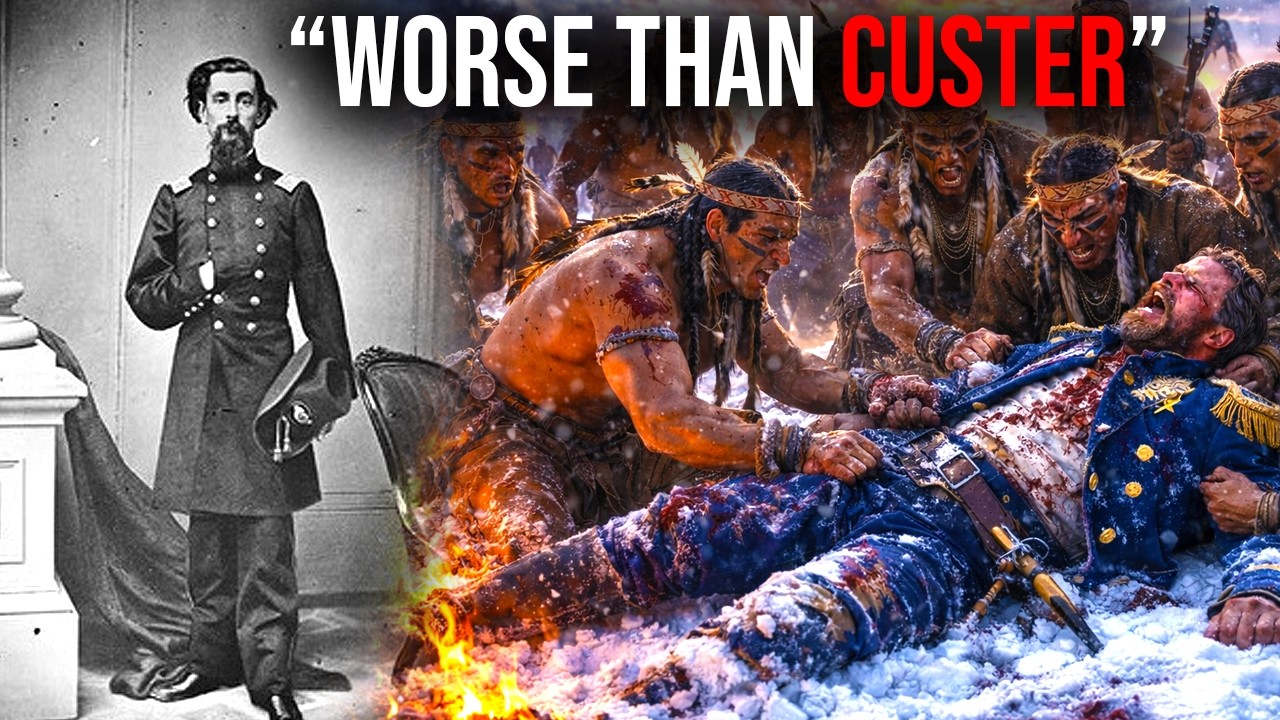
Captain William J. Fetterman died among the rocks. The manner of his death is still debated. The army’s official autopsy recorded a powder-burned wound to the throat, consistent with a shot fired at point-blank range. Some accounts from the soldiers’ side suggest that Fetterman and Captain Frederick Brown pressed revolvers to each other’s temples and fired together, choosing death on their own terms over capture.
But Lakota oral history tells a different story. A warrior named American Horse fought his way through the chaos of the rock position and reached Fetterman at knife distance. American Horse’s blade cut Fetterman’s throat, whether by his own error or American Horse’s skill. The man who had boasted of trampling the Sioux nation died surrounded by that nation, in a circle of rocks where he was never supposed to be. On the hillside he was ordered not to cross, the infantry was cornered and killed.
About 20 minutes after the ambush began, the fight among the rocks fell silent. Fetterman and roughly 49 of his men were dead. Not wounded. Not captured. Dead. The warriors took no prisoners that day. Their bodies were later found in a small circle, shoulder to shoulder, facing outward. They had fought back to back until the last man fell. The manner of their deaths tells the whole story.
To the warriors, this was not a massacre. It was war. They, too, lost people. The hand-to-hand fighting among the rocks was ferocious, with warriors killed by bayonet and rifle fire. But the moment the column crossed the ridge, the outcome was decided. What remained was only the grim accounting of the dead.
The frozen air carried the bitter smell of gunpowder and blood, and the sound of weapons striking against rocks faded into silence. The silence lasted only a moment before the war cries turned north. The fight was only half over.
Four hundred yards to the north, the cavalry was still alive, and they were about to face the full force of a thousand warriors with no cover at all.
At the moment of the ambush, the cavalry, being faster, had pulled away from the infantry and moved north, creating a gap of 400 yards between themselves and Fetterman’s men. Whether this was a planned attempt to escape the encirclement or a panicked flight is debated by historians, but the result was the same. Roughly 30 cavalrymen were now trapped on an open hilltop with no cover. No rocks. No trees. No depressions. Just frozen grass and scattered snow.
They dismounted. Army doctrine required every fourth man to hold the horses while the others formed a firing line. But a firing line requires a direction to face. The warriors were coming from every direction. The cavalry had Spencer repeating carbines, seven-round weapons that could be fired rapidly by working the lever. In a brief and desperate moment, rapid fire created a killing zone around the perimeter that kept the closest warriors at bay. Spent brass casings scattered across the ice as smoke rose.
The Spencers roared in rhythm, but Spencer ammunition came in pre-loaded tubes, and the soldiers had limited supplies. When the tubes ran empty, the rate of fire dropped to that of a single-shot, then stopped altogether. And the warriors, who had been watching, waiting, and counting the shots, knew exactly when the fire slackened.
With the infantry dead, the entire coalition turned north. A thousand warriors fell upon 30 men standing in an open field with ammunition running out and no avenue of escape.
Lieutenant George W. Grummond drew his saber. It was a nearly obsolete weapon, a relic from a previous century of warfare, already losing its relevance. But Grummond used it. As the warriors broke through the collapsing line, he swung the heavy blade with a desperate strength, as if he knew his death was imminent and wanted to take someone with him. He wounded at least one warrior who came within reach. It was a wild and futile act of courage. It changed nothing.
The warriors poured through the gaps from every direction. Grummond was knocked down and killed. The last few minutes were hand-to-hand combat across the entire position. Men with empty cartridge boxes fought against lances and war clubs. Some soldiers swung empty rifles like clubs. Some drew belt knives. Many simply stood and were overwhelmed. The horses screamed and became uncontrollable, bolting through the noise of battle, their hooves pounding the frozen ground.
Twenty minutes. That is how long the cavalry lasted after the infantry fell. Twenty minutes in a shrinking circle on open ground. The circle contracted with each man who fell until the last soldier was dead. Not one man from Fetterman’s command survived. Not one. No survivors. No ambiguity. No excuses.
What happened next defied all reason, at least from the army’s perspective. A force of warriors with bows, clubs, and lances had annihilated an entire U.S. Army command in less time than it took to eat lunch. On a frozen hill in Wyoming, the era of American invincibility on the frontier came to an end.
Back at Fort Phil Kearny, Carrington heard the gunfire. He heard the intensity of the war cries carried on the icy wind. The sound was too large for a small skirmish, too sustained for a routine engagement. And then the sounds stopped. The silence was worse.

Carrington sent a relief force under Captain Tenodor Ten Eyck, who pushed his men toward the ridge, ignoring the terrain and the bitter cold. Ten Eyck’s men reached the crest of Lodge Trail Ridge and saw nothing. No line of soldiers. No orderly retreat. The battlefield stretched before them in terrible silence. Then they began finding the bodies.
The bodies were scattered in two positions: the rocky area on the slope where the infantry had made its last stand, and the flat ground 400 yards north where the cavalry had died. Every body had been stripped. Every body showed evidence of post-mortem mutilation. These acts carried spiritual purpose in warrior tradition and served as retribution. To the coalition carrying the memory of Sand Creek, where their own women and children had been similarly desecrated by Colorado militia, what happened here was a cruel and deliberate revenge.
The infantry bodies were found in their tight circle among the rocks, exactly where they had made their final stand. The cavalry bodies were scattered across the open ground, lying where they had fallen, tangled with dead horses. In the sub-zero cold, blood had frozen where it spilled. The expressions on the dead faces were preserved in the frost, contorted, rigid, staring at a sky they could no longer see.
Ten Eyck’s men were psychologically shattered. Some were Civil War veterans who had survived Antietam, Gettysburg, and the Wilderness. Men who thought they had already seen the worst of war. They would later admit, some in writing, that the Fetterman battlefield was the most horrific sight they had ever witnessed. The silence of the battlefield pressed down on the living like a physical weight. The wind moved across the hill. The frozen grass crunched underfoot. Where 81 men had been alive an hour before, there was now nothing human left. The emptiness was louder than the gunfire had been. The silence was more terrible than the shots.
Carrington now understood the full scope of the disaster. The officer he had directly ordered had disobeyed, crossed the ridge, and lost every soldier under his command. The question that would consume the colonel, the army, and the entire nation was simple and unanswerable. How?
Inside the fort, Carrington ordered every remaining soldier to take up arms. The garrison was critically reduced. The loss of 81 men was a devastating percentage of the total force. Women and children were moved into the powder magazine, and Carrington gave an order that chilled everyone’s blood. If the fort fell, the powder magazine would be detonated. He would rather end his own people in an explosion than surrender them to the enemy. That was the level of fear gripping Fort Phil Kearny.
Carrington needed to get word to the outside world. The nearest telegraph was 236 miles south at Fort Laramie, through territory controlled by the warriors who had just destroyed Fetterman’s command. A civilian scout named John Phillips, known as Portuguese Phillips, volunteered for the ride. He slipped out of the fort under cover of darkness, riding Carrington’s own thoroughbred horse through a blizzard. He would ride for four days through sub-zero temperatures and hostile territory. Arriving at Fort Laramie on Christmas night, frostbitten and nearly unconscious, he staggered into the officers’ holiday ball and delivered the news that changed everything. Portuguese Phillips’ ride remains one of the greatest feats of endurance in American frontier history. Two hundred thirty-six miles through enemy territory in a blizzard, but that is a story for another video.
The final casualty count was this. Eighty-one dead. Seventy-six enlisted soldiers, three officers, Fetterman, Brown, and Grummond. Two civilians who had voluntarily joined the expedition. Every one of them killed. And the autopsy reports confirmed what was stated at the beginning of this story. Of the 81, only six were killed by gunfire. Seventy-five were killed by arrows, war clubs, lances, and knives. That statistic says everything about the nature of the fight. The warriors had closed the distance. They had fought at hand-to-hand range. They had defeated the soldiers with weapons made for exactly that kind of fighting.
Native casualties are uncertain, as is common for battles of this era. Estimates range from 10 to over 60 killed, with many more wounded. The warriors recovered and removed their dead, a practice that makes accurate counting impossible for historians.
Whether Fetterman died by his own hand or by American Horse’s blade, the official record mentions the throat wound, and Lakota oral history tells of American Horse. Either way, the man who boasted of riding through the Sioux nation with 80 men died surrounded by exactly that number of bodies.
Three lives in the aftermath of the battle show what it cost. Frances Grummond, Lieutenant Grummond’s wife, was inside the fort when the column returned, not with living soldiers but with wagon loads of bodies. She was expecting their first child. She later described in a memoir the moment she learned of her husband’s death. The creaking of the ambulance wagons through the gate, the wailing of the other wives from their quarters, and the frozen bodies being carried past her like cargo. Her account survives as one of the most vivid and heartbreaking primary sources of the disaster.
Colonel Carrington was relieved of command within weeks. The army needed a scapegoat, and the man who had given the correct order, the order that was disobeyed, was the one punished. Carrington spent the rest of his life arguing that Fetterman’s disobedience caused the disaster, not his own leadership. History eventually vindicated him, but not in his lifetime. The stigma of the Fetterman Fight followed him to his grave.
Among the Lakota and Cheyenne, the returning warriors were received as victors who had fulfilled a prophecy. Crazy Mule’s prophecy, a hundred in the hands, had been confirmed. The actual number of 81 was close enough to the prophesied hundred that the medicine man’s spiritual authority remained unquestioned. A prophecy written in blood and confirmed by arithmetic. The victory strengthened the coalition’s resolve and proved that the Bozeman Trail could be held.
When Phillips’ news reached the telegraph office and spread east, newspapers seized on the story with the kind of alarm reserved for total defeat. An entire command wiped out, annihilated to the last man. The political impact was immediate. Congress erupted in debate over frontier policy. Generals argued over whether to launch punitive expeditions or abandon the trail entirely. Hawks demanded more troops and larger campaigns. Doves argued that the forts were indefensible and should be abandoned before more soldiers died. The Fetterman disaster became ammunition for both sides of the argument that would define the next decade of American expansion.
The immediate military response was an order to send a powerful force west. But the larger strategic question hung unanswered in the winter air. Could the army hold the Bozeman Trail at all?
The end of the battle was only the beginning. The Fetterman Fight did not just take 81 lives. It set in motion events that would reshape the American frontier for a generation. Red Cloud’s War continued through 1867 and into 1868, with the Fetterman disaster as their most powerful argument. The fight had proven, in the harshest possible terms, that the Bozeman Trail forts could not be held, and that the soldiers stationed there were not displaying American strength but offering themselves as targets.
In 1868, the United States sued for peace. The resulting Treaty of Fort Laramie gave the Lakota ownership of the Black Hills and the Powder River country, and crucially, it obligated the army to completely abandon the Bozeman Trail forts. Fort Phil Kearny was evacuated. As the last soldiers marched out through the gate, Lakota warriors moved in and burned the fort to the ground.
Red Cloud’s War is one of the rare conflicts in American history where a Native nation forced the United States to back down and achieved treaty-guaranteed territorial concessions through military strength. But that victory carried the seeds of its own destruction. Within a decade, the discovery of gold in the Black Hills shattered the 1868 treaty exactly as the Bozeman Trail had shattered the earlier one. The Great Sioux War of 1876 followed. In June of that year, at Little Bighorn, another overconfident officer, George Armstrong Custer, led another force to destruction against Lakota and Cheyenne warriors, including the battle-hardened Crazy Horse.
The parallels between the two disasters are painfully clear. A commander who underestimated his enemy and ignored orders to be cautious. A divided force that was separated and defeated. The frozen ridge had delivered the lesson 30 minutes earlier. The army simply refused to read it.
The army’s official account blamed Fetterman for disobeying orders and Carrington for failing to control his subordinate. Both explanations contain truth. But neither tells the whole story. For over a century, the story of the Fetterman Fight was told almost exclusively from the American military perspective. A story of one officer’s arrogance and another’s incompetence. The other side of the story, the months of planning, the coalition-building across tribal lines, the spiritual preparation, and the tactical intelligence of setting the trap, was treated as a footnote rather than the narrative.
To the Lakota, Cheyenne, and Arapaho, the Battle of the Hundred Hands is remembered as a triumph of coordination, spiritual power, and tactical brilliance. It is the story of a people defending their homeland against an invading army. A narrative that has been almost entirely absent from American textbooks for over a century.
Modern archaeological research at the battle site has confirmed much of the Native oral history. The positions of the remains match the accounts passed down through generations. The distribution of arrowheads and hand-to-hand weapon fragments across the battlefield confirms the warriors’ accounts. This battle was won in close combat.
Eighty-one soldiers went over a ridge and disappeared within 40 minutes. Almost none of them were killed by gunfire. Now you understand not just what happened, but why it happened. An arrogant officer who disobeyed a direct order. A coalition of warriors who executed a plan with lethal precision. A prophecy that came true, depending on how you count.
The Fetterman Fight was the battle that proved the frontier could fight back, and they did so with devastating perfection. Ten years before Little Bighorn, that lesson was written in blood on a frozen ridge in Wyoming. The army simply refused to read it.