In April 1956, the world watched Hollywood actress Grace Kelly sail from New York Harbor toward a tiny principality most people had barely heard of. The press had already declared it the wedding of the century—a prince, a movie star, a fairy tale made literal. But what happened inside the Palace of Monaco, behind the ceremonies and the carefully managed public image, was far more complicated, more human, and at times more painful than the headlines ever captured. To understand what Prince Rainier III was looking for in a wife, it helps to understand what he stood to lose.
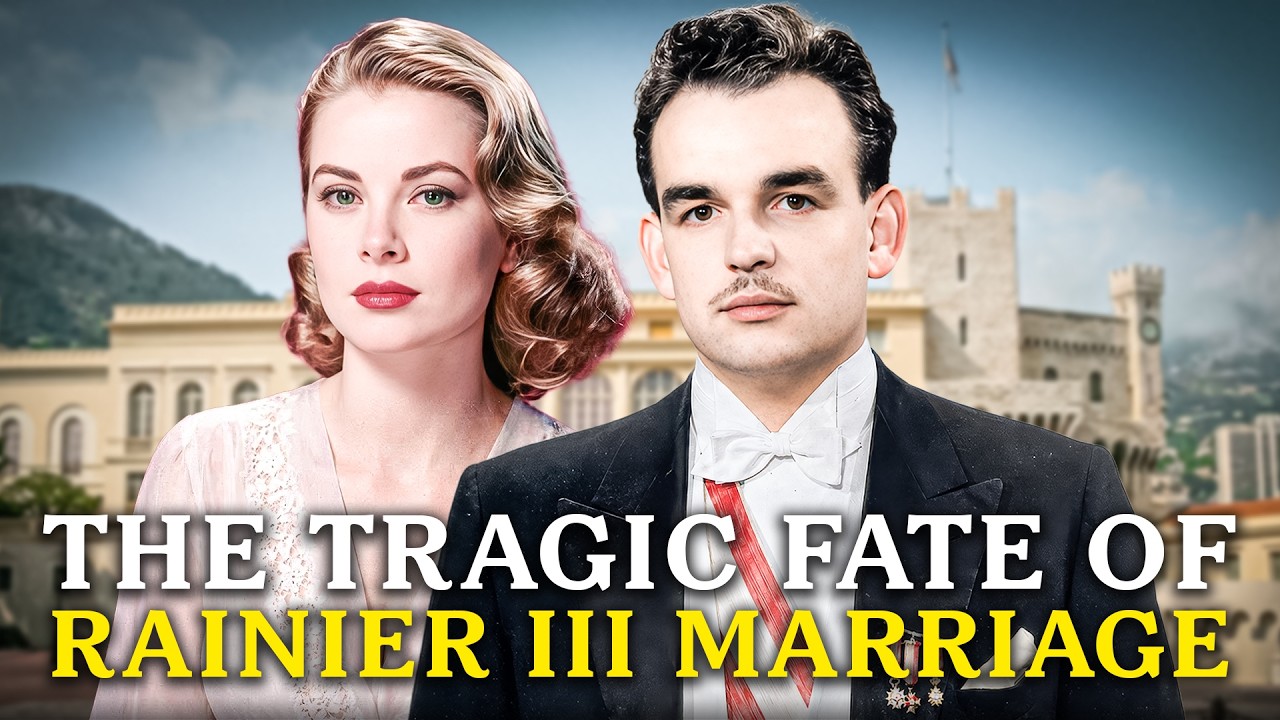
Monaco is a city-state on the French Riviera covering less than two square kilometers, one of the smallest sovereign nations on Earth. In the early 1950s, it was known primarily for its casino. The Grimaldi family had ruled since 1297, making their dynasty one of the oldest reigning houses in Europe. But Monaco’s sovereignty rested on a specific arrangement with France: if the Grimaldi line produced no legitimate heirs, the principality would revert to French control and cease to exist as an independent nation.
Rainier had become sovereign prince in 1949 at age 26, following the death of his grandfather. He was educated in Switzerland, France, and England, spoke several languages, and had a genuine interest in zoology. But by his early 30s, he was a prince without a princess—and without a legitimate heir, the clock on Monaco’s independence was ticking. Before Grace Kelly, Rainier had been in a serious relationship with French actress Gisèle Pascal.
For a time, she seemed likely to become his princess. The relationship ended, reportedly at least in part, because advisers raised concerns about whether she could bear children. The suggestion was humiliating for Pascal and painful for Rainier, and it said something important about the nature of the decision he faced. This was not simply a marriage.
It was a succession strategy. Grace Kelly was born on November 12, 1929, in Philadelphia into a prominent, ambitious Irish-Catholic family. Her father, Jack Kelly, was a wealthy brick magnate and former Olympic gold medalist in rowing. Her mother, Margaret, was a former model and physical education instructor who placed enormous value on presentation and achievement.
Grace was quieter and more interior than her siblings, possessed of a self-contained radiance that made it difficult to look away from her. She pursued acting with determination, studying at the American Academy of Dramatic Arts in New York and supporting herself with modeling. Her film career accelerated rapidly: High Noon in 1952, Mogambo in 1953, Rear Window and Dial M for Murder in 1954, and The Country Girl in 1954, which won her the Academy Award for Best Actress. To Catch a Thief followed in 1955.
By age 25, she was one of the most famous actresses in the world. Her private life was more complicated than her polished public image suggested. She had relationships with men who were often considerably older, often already attached, and often unavailable. The pattern suggested someone more comfortable with desire at a distance than with a commitment that could actually be kept.
Despite the Oscar and the fame, she was not entirely happy in Hollywood. She was tired of the relentless attention to her appearance, the typecasting, the sense that she was valued primarily as an image. In May 1955, she attended the Cannes Film Festival. A meeting was arranged between Grace Kelly and Prince Rainier III.
By most accounts, it was not immediately electric—both were somewhat shy and formal—but something registered between them. The months between that meeting and the formal engagement announcement in January 1956 were not a leisurely courtship. They were, in many respects, a negotiation. Rainier visited Grace in the United States in December 1955 and met her family in Philadelphia.
There was a prenuptial agreement. There was a dowry: the Kelly family contributed $2 million. Rainier’s advisers reportedly required some form of medical assurance regarding Grace’s ability to bear children—a requirement that echoed what had ended his relationship with Gisèle Pascal, though it was never publicly confirmed. Grace accepted Rainier’s proposal in December 1955.
The public announcement came in January 1956, and the response was immediate and overwhelming. The press declared it the most romantic story of the age. Grace gave up her MGM contract, her career, her apartment in New York, and the friendships in the industry that had defined her adult years. She did so publicly and apparently willingly.
In April 1956, she boarded the SS Constitution in New York Harbor surrounded by 84 friends, family members, and members of the press. She was 26 years old, sailing toward a country she had visited once. She was about to become the most famous princess in the world. Almost nothing about the life waiting for her would be what she had imagined.
The wedding took place over two days. The civil ceremony was April 18. The religious ceremony at the Cathedral of St. Nicholas was April 19, watched by an estimated 30 million television viewers across Europe.
Grace wore a gown designed by MGM costume designer Helen Rose, a gift from the studio, constructed from antique rose point lace and silk taffeta. The photographs from that day are among the most reproduced royal wedding images in history. Less photographed was what Grace’s closest friends said about her in the days immediately before and after the ceremony. Several described a Grace who was quieter than expected, more subdued, occasionally uncertain in ways she did not show publicly.
The enormity of what she had committed to was settling on her with a weight the excitement of the preceding months had obscured. The honeymoon was a Mediterranean cruise on the prince’s yacht. By accounts that emerged over the decades from Grace’s letters and the recollections of her circle, it was not entirely what she had hoped for. Rainier was not given to emotional expressiveness.
He was reserved, sometimes remote, with a temper that could surface unexpectedly. The gap between the fairy tale the world was consuming and the actual daily reality of the marriage was, from very early on, considerable. Grace moved into the Palace of Monaco and began learning what being a princess required. The answer, it turned out, was almost everything she had previously been.
The life she entered was governed by protocol in ways she had not fully anticipated. Every public appearance was regulated. She could not walk out of a building without a driver, a security detail, and a photographer waiting nearby. She had also left behind the entire social world she had built.
Her friends were an ocean away. In Monaco, her acquaintances were largely the wives of diplomats and businessmen, people in a very different position from a reigning princess. The loneliness of those early years emerges consistently in accounts from people close to her. The palace was full of people, and she was almost always alone in the way that matters.
The Monegasque people were initially not universally welcoming. There was a reserve, sometimes a coldness, toward the American actress who had arrived to rule over them. She understood she had to earn her place, and she set about doing so with the same quiet determination she had brought to everything else in her life. She learned French, which she had not spoken fluently on arrival.
She established the Princess Grace Foundation to support arts and crafts. She helped found the Monte Carlo Ballet and built connections with artists, writers, and performers, giving Monaco a cultural identity it had not previously possessed. But all of this public building happened alongside a private life that was increasingly strained. Rainier was consumed by modernizing Monaco’s economy, transforming it from a gambling resort into a financial and commercial center.
He was developing banking, real estate, and infrastructure. It absorbed him entirely. In the hours when Grace needed a husband, she often found a sovereign. Their children arrived: Caroline in January 1957, Albert in March 1958, and Stephanie in February 1965.
Grace threw herself into motherhood with genuine devotion. By the accounts of all three children and those who observed the family closely, it was the aspect of her Monaco life that gave her the most uncomplicated happiness. But the children could not fill everything, and as the years passed, what Grace had surrendered became harder to ignore. The question of whether she might return to acting came up most concretely in the mid-1960s, when Alfred Hitchcock approached her about starring in his film Marnie.
Grace wanted to do it. Rainier initially agreed, and the announcement was made. The Monegasque public’s reaction was immediate and negative. There was a widespread feeling that their princess appearing in a Hollywood thriller was beneath the dignity of the principality.
Protests and petitions followed. The project was abandoned. The role went to Tippi Hedren, and Grace Kelly never appeared in another film. She spoke about it afterward with characteristic restraint, without bitterness.
But those who knew her well said the way the decision was effectively made for her marked something: the clearest possible confirmation that her life was not simply hers to direct. She found other outlets—flower pressing and botanical art, poetry readings that allowed her to use her trained voice. But the film career was gone. The children grew up in an unusual environment, even by royal standards.
Caroline, the eldest, was the most photographed royal child in Europe outside the British family. By her teens in the early 1970s, her escapades with the European press were a source of real anxiety for Grace. Caroline later married Philippe Junot, a French businessman 17 years her senior, over the family’s significant reservations. The marriage was troubled from the beginning and ended in divorce in 1980.
For Grace, it was a genuine heartbreak. Albert, the son and heir, was quieter and more contained, understanding from early on that he would one day rule Monaco. Stephanie, the youngest, was the most like her mother in certain surface ways—physically striking, drawn to the creative world, difficult to contain within formal expectations. The marriage through the 1960s and 1970s looked from the outside like the dignified arrangement of a long royal union.
From the inside, by the accounts of those who observed them closely, it had become genuinely difficult. There were long stretches when they were not warm with each other. There were periods when Grace was deeply unhappy. She had considered, at least once, whether the marriage was one she could continue.
The last few years of her life were, by some accounts, slightly better. She and Rainier had found a kind of companionate stability, something quieter and more settled. Then came September 1982. On the morning of September 13, 1982, Grace was driving from the family’s country house at Roc Agel down to Monaco, with Stephanie in the car.
The car, a Rover 3500, went off the road on a hairpin bend and fell approximately 35 meters down the hillside. Stephanie survived with injuries. Grace was taken to the Princess Grace Hospital, where she remained on life support for a day. On September 14, the decision was made to turn off the machines.
She was 52 years old. The official medical explanation was that she had suffered a stroke while driving. That account has been debated in the decades since, with various alternative explanations proposed, none conclusively established. What is not in dispute is that Grace Kelly died on that mountain road, and that Stephanie, 17, was beside her when it happened.
Those present in the hours and days after described Rainier as visibly destroyed—not the contained, controlled prince they knew, but someone from whom the structure had been entirely removed. He told those close to him that he had not known, until she was gone, how much of what he was had been held together by her presence. He wore his wedding ring for the rest of his life. He never remarried.
He died in April 2005 at age 81 and was buried beside Grace in the Cathedral of St. Nicholas, where they had married 49 years earlier. It is worth pausing on what Rainier actually accomplished. When he became prince in 1949, Monaco’s economy was almost entirely dependent on the casino.
He oversaw the development of its banking sector, encouraged construction on a scale that transformed the principality, and developed Monaco’s status as a center for international business. By the time of his death, Monaco had one of the highest per capita incomes in the world and had established itself as a stable, prosperous, genuinely sovereign microstate. The cost in personal terms was something he bore quietly. The children’s lives were not easy.
The loss of Grace left a wound that never healed. By the accounts of those who knew him in his final decades, he carried considerable sadness beneath the composed exterior of the sovereign. Albert succeeded him in 2005 and married Charlene Wittstock in 2011. The Grimaldi line continued.
Monaco remained independent. The succession strategy that had driven so much of Rainier’s decisions in the early 1950s had worked. But outcomes and costs are different things. Grace Kelly has been dead for more than four decades, and the myth of her has only grown.
She appears regularly on lists of the most beautiful women of the 20th century. Her wedding gown has been exhibited in museums. The Hermes bag she used to shield her pregnant stomach from photographers is now called the Kelly bag, among the most coveted objects in fashion. But the enduring image is from April 1956—the lace gown, the composed face, the fairy tale.
What gets lost is everything that came after: the 26 years in Monaco, the loneliness, the abandoned film career, the complicated marriage, the death on a mountain road at 52. She was not, as the myth sometimes suggests, simply a woman who chose glamour over artistry. She was a woman who made a choice at 26 under considerable social and family pressure, with incomplete information about what the life ahead would actually contain, and then spent 26 years making the best of it with considerable grace in both senses of the word. Her friends from before Monaco spoke consistently about her intelligence, warmth, humor, and the particular quality of attention she gave to people she cared about.
The letters she wrote show a woman who thought carefully about her life and maintained through considerable strain a fundamental generosity of spirit. She also did genuine good: the Princess Grace Foundation has supported thousands of artists and craftspeople over the decades, and the cultural institutions she helped build gave Monaco a dimension it would not otherwise have had. The temptation in any story like this is to assign fault—to decide Rainier was cold and controlling, or that Grace was naive, or that the whole thing was a cynical arrangement dressed in romantic language. None of those readings is quite right.
Rainier was a man handed an enormous responsibility at 26 who spent his entire adult life trying to fulfill it. Grace was a woman of extraordinary gifts who made a choice that was in some respects freely made and in other respects constrained by the expectations of her family, her era, and the social world she inhabited. The marriage produced children they both loved. It gave Monaco two and a half decades of a princess who transformed the principality’s image and culture.
It gave Rainier a partner through the most consequential years of his reign. But it was also built on a negotiation conducted at speed between a man who needed a legitimate heir and a woman who needed, or believed she needed, the stability and significance the offer represented. That foundation was real, and it was not enough. Both of them spent 26 years building on top of it, and around it, and sometimes despite it.
The world watched the wedding and called it a fairy tale. The people inside it knew better. And the grief Rainier carried for the rest of his life—the wedding ring he never removed, the grave where they were buried side by side—said something the fairy tale language never quite could. It said that whatever the marriage had been, it had mattered.
And that some reckonings come far too late to be of any use.