The smoke had barely cleared over the ruins of Atlanta when William Tecumseh Sherman began the most audacious gamble of the Civil War, a march that would not merely defeat the Confederacy but systematically dismantle the very idea that it could ever win. Four years earlier, standing in the parlors of Louisiana, he had warned the men who would become his enemies exactly what was coming. They had smiled, patted him on the back, and told him he did not understand the Southern spirit.
As his 62,000 veterans crossed the Chattahoochee River on November 15, 1864, Sherman was not seeking revenge. He was collecting a debt that had come due with interest.
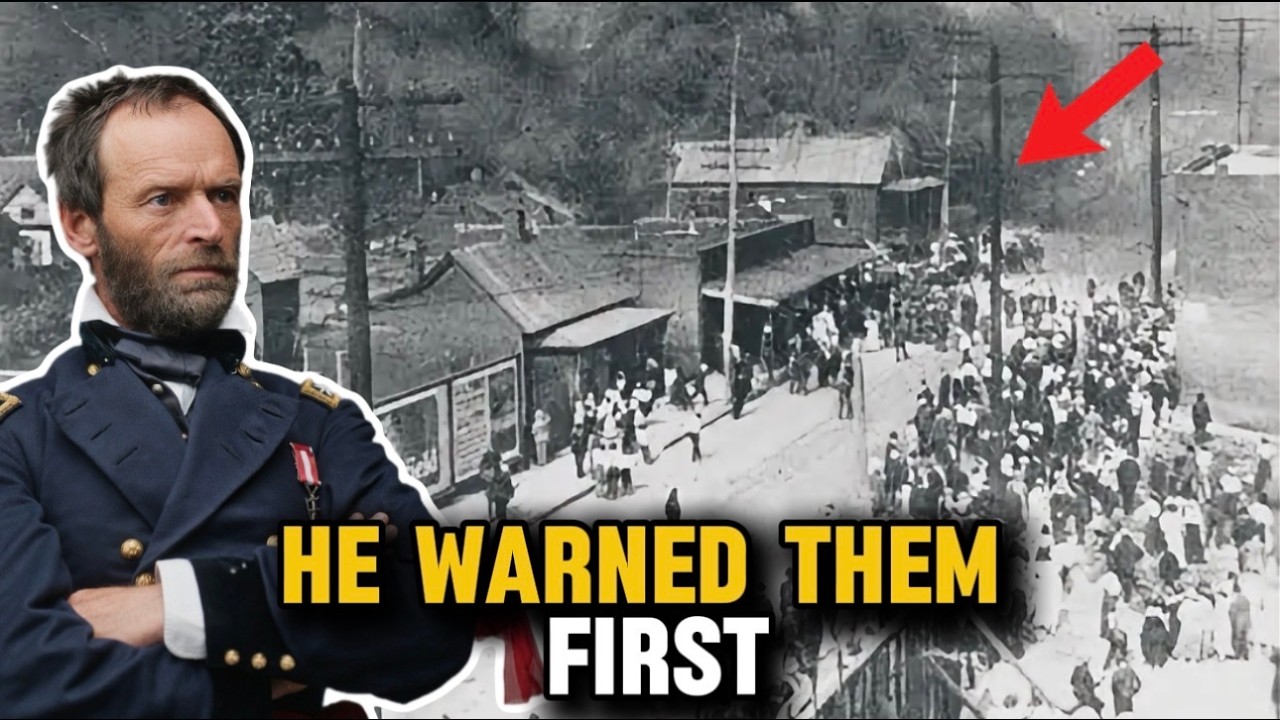 The man who would become the most hated figure in Southern history was, by every contemporary account, a man who genuinely loved the region he was about to devastate. As superintendent of the Louisiana Military Seminary in Alexandria, he had dined at the tables of the planter class, taught their sons mathematics and engineering, and formed friendships that would last a lifetime. When the secession crisis erupted in the autumn of 1860, Sherman did not lecture or moralize.
He simply told his friend David Boyd what he knew to be true, that the North’s industrial capacity and overwhelming population advantage would crush the South in a war of attrition. He described a conflict that would not be decided by cavalry charges or duels between gentlemen, but by logistics, supply lines, and the brutal arithmetic of manufacturing output.
The men who heard him that night were not fools. They were products of a military culture that had produced some of the finest officers in the American army, men who had distinguished themselves in Mexico and who carried themselves with the practiced confidence of professional warriors. They believed, with genuine conviction, that the Northern public would grow weary of casualties long before the Southern will to fight was exhausted.
They believed that fighting on home soil for a way of life would give Confederate soldiers an unbreakable moral advantage. What they failed to account for was that Sherman had done the math, and the math was merciless. He resigned his post in January 1861, writing farewell letters to his Southern friends that read like an epitaph for a relationship that could not survive the coming storm.
The early years of the war did nothing to disabuse Sherman of his grim predictions, but they did sharpen his understanding of what victory would require. He was at Bull Run, watching the Union Army dissolve into a panicked mob fleeing back to Washington. He was at Shiloh, where Grant’s forces nearly were pushed into the Tennessee River before rallying to hold the field.
He watched Confederate guerrillas tear up Union supply lines in Tennessee and Mississippi with impunity, and he watched the Army of Tennessee rebuild itself after losses that would have destroyed any conventional European force. The reason was simple and maddening: the Confederate countryside kept feeding it. Farms resupplied men.
Railroads moved troops. Civilians who had never fired a rifle were sustaining a war machine in ways the Union kept failing to account for.
The conclusion Sherman reached was not complicated, but it was revolutionary for its time. As long as the Southern economy functioned, as long as crops came in, rails stayed intact, and the population behind Confederate lines believed the war was winnable, the Confederacy could keep fighting regardless of what happened on any individual battlefield. The solution was not to defeat the Confederate army in a single decisive engagement, but to make the war unbearable for the people who were enabling it.
He had told the men in Louisiana this four years earlier, and they had smiled politely. Now he was going to show them what he meant.
The fall of Atlanta on September 2, 1864, gave Sherman the platform he needed. For the next six weeks, he argued through telegraph wires with Washington, facing down skepticism from Halleck and cautious approval from Grant, who understood instinctively what Sherman was proposing. The plan was audacious in its simplicity: cut loose from the supply line entirely, abandon the long vulnerable rail connections stretching back to Chattanooga, and march the army across the heart of Georgia, living off the land and destroying everything of military value in its path.
Grant eventually agreed. Lincoln, facing a brutal re-election campaign and desperate for something to change the political weather, agreed. On November 15, 1864, the warehouses, rail yards, and machine shops of Atlanta went up in flames.
Sherman watched the conflagration from a hillside, saying almost nothing. An aide later wrote that he seemed to be absorbing the moment, a culmination of three years of grinding frustration and strategic insight. The army that moved out of Atlanta was a specific kind of instrument, carefully crafted for the task ahead.
Sherman had spent months culling it, sending away the sick, the reluctant, and the men he did not trust to maintain discipline under conditions that had no precedent in this war. What remained was roughly 62,000 soldiers organized into two wings, each capable of operating independently, each foraging aggressively off the surrounding countryside. They moved on a front forty to sixty miles wide, a deliberate choice that made the column impossible to block or contain.
 John Bell Hood, the Confederate commander, had taken what remained of the Army of Tennessee and moved it north toward Nashville, a decision that was either a desperate gambit or a catastrophic strategic miscalculation, depending on how charitable one wants to be. The practical effect was that Sherman’s march into the Georgia interior was opposed by almost nothing. A patchwork force under William Hardee, consisting of Georgia militia that included old men and boys who had never held a rifle in earnest, and Confederate cavalry under Joseph Wheeler could harass the column’s edges but could not stop its forward momentum.
Sherman covered roughly fifteen miles a day, and in three weeks, he had crossed three hundred miles of Confederate territory.
What his men left behind was not a wasteland in the total sense that Southern memory would later insist upon, but it was not gentle either. The foraging parties, which Sherman called bummers, a term that stuck, fanned out ahead of the main columns each morning, pulling food and livestock from the farms in their path. Corn, sweet potatoes, hogs, cattle, horses, mules.
They took what the army needed and destroyed what they could not carry, so it could not be used by Confederate forces after they passed. Smokehouse contents, stored grain, and cotton gins received particular attention, because cotton gins had nothing to do with feeding Confederate soldiers and everything to do with sustaining the Southern economy that was keeping this war alive.
The railroads got the most systematic attention. Sherman’s men had developed a technique they were almost proud of. They would pull up the rails, heat them over fires of their own cross ties, and then bend them around trees, creating what soldiers called Sherman’s neckties.
A twisted rail is not just inconvenient. It cannot be straightened and reused without industrial equipment the Confederacy no longer had access to. Every mile of ruined track was a mile that Confederate logistics could not recover before the war ended.
The private homes Sherman passed through existed in a complicated middle ground. His orders explicitly prohibited the burning of private residences and the 𝓪𝓫𝓾𝓼𝓮 of civilians, but those orders were enforced unevenly at best.
Some of his officers kept tight control of their men. Others looked the other way. Some units burned what they were told not to burn.
Some soldiers took what they had no authorization to take. The March produced real suffering among Georgia’s civilian population, and no honest accounting of it pretends otherwise. But Sherman’s purpose was never to destroy Georgia for the satisfaction of it.
Every time his men tore up a railroad, burned a depot, or drove off a herd of cattle, they were doing something precise. They were converting Confederate military infrastructure into nothing. They were making the calculations inside Richmond about supply, about movement, about what was possible harder and harder to fulfill.
And they were delivering a message that no amount of official Confederate messaging could now unsay.
That message was simple. Your government cannot stop this. The Confederate Army that was supposed to protect you is somewhere else right now.
 And the men marching through your county are doing it because there is nothing to prevent them. If you are waiting for relief, it is not coming. Jefferson Davis understood the danger immediately.
He issued statements insisting Sherman would be crushed, that Georgia would rise up and destroy the Union column, that the Confederate Army would cut Sherman’s supply line and leave his men stranded in the wilderness. None of it happened because the men in Richmond had no means to make it happen. George Thomas was dealing with Hood in Tennessee.
Lee was pinned at Petersburg by Grant. The Confederacy that had held the Union at bay for three years had nothing left to send to Georgia.
Savannah fell on December 21, 1864. Sherman sent a telegram famously offering the city to Lincoln as a Christmas present. The President wrote back expressing a relief that was personal as much as political.
The march had taken thirty-six days. Sherman had lost fewer than seven hundred men killed, wounded, and missing across three hundred miles of enemy territory. His army had consumed and destroyed an estimated one hundred million dollars worth of Confederate property by post-war estimates.
More importantly, it had demonstrated something that the Confederate government had lost control of its own interior. When Sherman turned north into the Carolinas in early 1865, the dynamic shifted. South Carolina was treated with considerably less restraint than Georgia had been.
The reasons were partly practical, South Carolina had less food to begin with, and partly the accumulated anger of men who had been told and believed that this state had started the war. Columbia burned on the night of February 17, 1865, and the argument over who started that fire has never been completely settled. Sherman blamed retreating Confederate cavalry.
Others blamed his men. The most credible account suggests both played a role. What mattered strategically was that it made no difference anymore.
By the time Columbia burned, Lee had fewer than sixty thousand men at Petersburg facing twice that number. Hood’s Army of Tennessee had been shattered at Franklin and Nashville and now barely existed as a fighting force. The Confederacy was not losing the war.
It had lost it.
The question was only how much longer it would drag on. Sherman reached North Carolina in March. Joseph Johnston, pulled out of retirement by a desperate Confederate government, had assembled whatever remained of multiple depleted Confederate forces and was trying to slow him down.
Johnston managed to land a blow at Bentonville, the largest battle of Sherman’s entire Carolinas campaign, but it was a holding action against an army that could not be held. Johnston retreated. Sherman pressed on.
 When Lee surrendered at Appomattox on April 9, 1865, Johnston was still in the field but had no realistic option and knew it. He asked Sherman for terms two weeks later.
The conversation at the Bennett farmhouse in North Carolina was unlike the one at Appomattox. Sherman offered Johnston terms so generous that they were immediately repudiated by Washington, generous enough that Secretary of War Stanton suspected Sherman of some kind of political overreach and 𝓵𝓮𝓪𝓴𝓮𝓭 it to the press. Sherman was furious, and the fury was instructive.
He had not been soft. He had made the calculation, the same calculation he always made, that the fastest route to ending the war was to make continued resistance cost more than surrender. He had walked sixty thousand men across the Confederate interior to prove it, and he had been right.
The Lost Cause mythology that emerged in the decades after the war did something specific with Sherman. It transformed the march from a military operation into an atrocity, because an atrocity could be condemned and used to define Confederate suffering as righteous. If Sherman was a monster, then what he did to Georgia was not evidence that the South had been warned and refused to listen.
It was simply evidence that the North was barbaric. But the record does not cooperate with that framing. Sherman wrote and spoke extensively about what he intended.
He explained his reasoning in letters to Grant, to Halleck, to his own subordinates in terms that were clear and consistent.
He believed that war is not an abstraction. It is not something that happens only where armies are facing each other. It exists in the cotton gin, in the railroad depot, in the storehouse full of cured pork.
It exists in every farm that feeds an army and every blacksmith shop that shoes its horses. Until the population sustaining a war feels that war in a tangible way, the men fighting it have little incentive to quit. He had said as much in almost those exact words to men in Louisiana who had laughed politely and told him he was wrong.
They were not laughing in December of 1864. And the ones who were still waiting to be proven right ran out of time in April of 1865.
The war that the Confederate leadership had imagined, clean, quick, decisive, fought by gentleman soldiers on agreed upon battlefields, was never the war they were going to get. Sherman had known that before the first shot was fired. He had said it out loud.
He had committed it to paper. When the moment came to prove it, he did not hesitate. That is the history that tends to get lost beneath the flames and the mythology.
Not the burning, not the bummers pulling hams out of smokehouses. The thing underneath all of it, the fact that a man had looked at the South and told it exactly what was coming. And the South had decided he was wrong.
And he spent four years proving otherwise. The warning was always on the table. Sherman just made sure they could not ignore it anymore.