The prophecy the Fire-Eaters of Charleston and Richmond had been preaching for a generation finally arrived in the person of a red-haired Ohioan who had once genuinely loved the South. William Tecumseh Sherman had lived among Southerners, knew their land, understood the particular pride with which a planter surveyed his cotton fields, and liked them. When war came, he became with almost surgical precision the exact man the secessionists had warned everyone about, not out of hatred, but out of a cold, methodical conviction that the war itself left him no other choice. Sherman was born in Lancaster, Ohio in 1820, the sixth of eleven children.
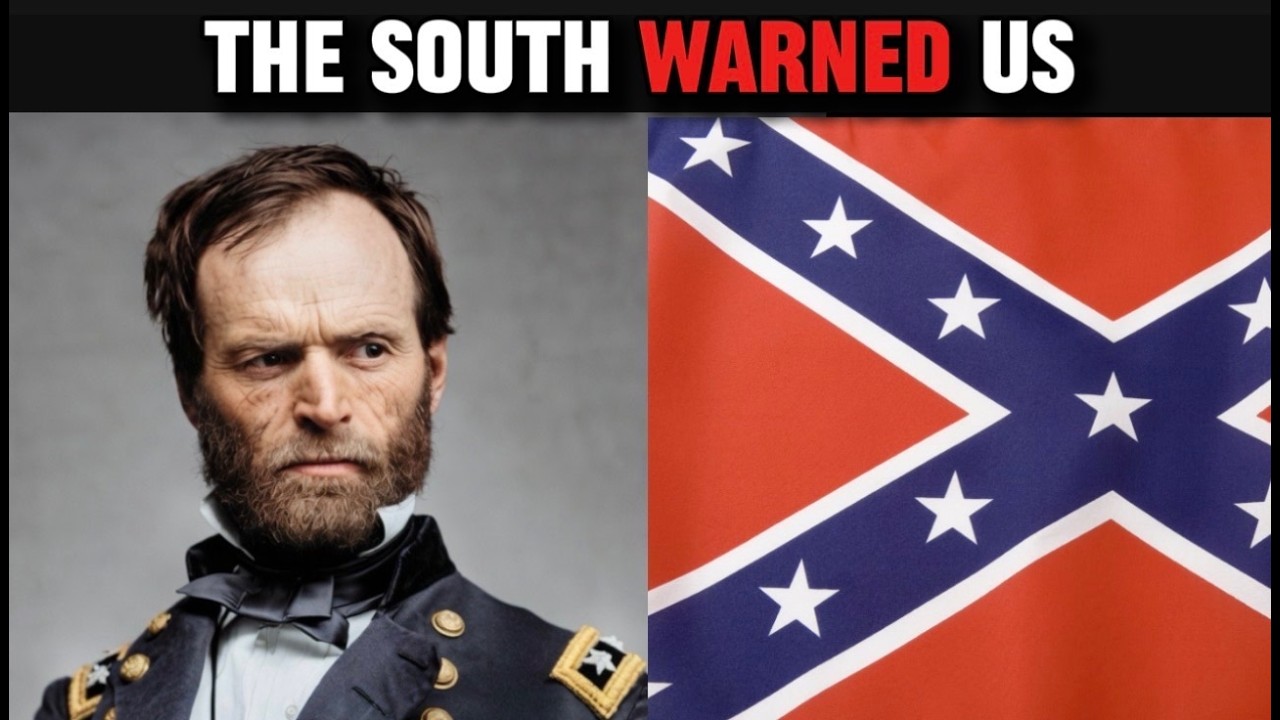
When his father died, the family scattered, and young William was taken in by Thomas Ewing, a prominent Whig politician. He was named after the Shawnee leader Tecumseh, a fact his foster family considered slightly embarrassing and quickly softened by adding William. He graduated from West Point in 1840, sixth in his class, a ranking that reflected real intellectual ability along with a steady accumulation of demerits. Posted to Florida and then to Charleston, South Carolina, he developed during those years a lasting affection for the South, for its ease, its hospitality, and its people.
When the war came, Sherman did not burn with hatred for the Confederacy. He hated what secession had done, but he held no animus against the South itself. His transformation into the architect of total war grew out of something else, a lesson learned at Shiloh in April 1862. There, the Confederate Army of the Mississippi committed virtually everything it had in the Western theater to a single desperate offensive.
Sherman was wounded twice, had three horses shot from under him, and held his line with a tenacity that surprised everyone, including himself. The following morning Grant counterattacked and rolled the Confederate Army back. After the battle, in the stunned quiet of an April night with thousands of dead men lying in the peach orchard, Grant told Sherman he had given up thinking about retreating. The lesson of Shiloh was not simply about courage.
Two days of fighting had produced roughly twenty-four thousand casualties between the two sides, and nothing strategic had changed. No territory had decisively shifted. No will had been broken. The war that politicians and newspaper editors still described in terms of swift resolution had revealed itself as something without precedent, a conflict that would consume men in industrial quantities.
And it had revealed something else: Confederate armies were not going to collapse under military pressure alone. Vicksburg fell in July 1863. Gettysburg had turned back Lee’s second invasion of the North the same month. Yet the Confederacy continued.
Southern newspapers still published defiant editorials. Southern women still sent their sons and husbands to the front. The machinery of Confederate resistance was not located primarily in its armies. It was located in the civilian population, in the farms and railroads and warehouses that fed and supplied those armies, in the political culture of resistance that had sustained the war for two years against all rational expectation.
Sherman drew the logical conclusion most completely, and then acted on it. In the spring of 1864, Grant went east to command all Union armies and grind down Lee in Virginia. Sherman took command of the military division of the Mississippi. Their strategic conception was simple and ruthless.
Grant would hold Lee in Virginia and destroy the Army of Northern Virginia through attrition if necessary. Sherman would drive into the Confederate heartland, take Atlanta, and demonstrate to the Southern people and the watching world that the Confederacy could not protect its own territory. Neither side would be free to shift resources from one theater to relieve pressure in the other. Across four months, Sherman fought Joseph Johnston and later John Bell Hood across one hundred miles of Georgia mountain and Piedmont in a campaign of almost continuous flanking movements, forcing the Confederates to abandon position after position, bleeding them slowly while preserving his own army with care that bordered on the obsessive.
He was notably reluctant to order frontal assaults. The disaster at Kennesaw Mountain in June 1864, where he ordered a direct attack on a fortified Confederate position and paid for it with nearly three thousand casualties, was the exception that proved the rule. He hated the butcher’s bill and understood its political cost as well as its human one. Atlanta fell on September 2, 1864.
The political consequences were immediate and enormous. The Democratic Party had nominated George McClellan on a platform that effectively acknowledged the failure of the war effort. Lincoln himself had expected to lose the November election. Atlanta changed the calculation overnight.
The fall of the city told northern voters the war was being won, and Lincoln won re-election by a margin that made continued prosecution of the war a settled question. Sherman, more than any other single military figure, had saved Lincoln’s presidency, and with it the political possibility of reunion and emancipation. But Sherman was already thinking past Atlanta, about what would happen after the armies stopped shooting, about whether Confederate will to resist could be broken before it reconstituted itself in some other form after a formal surrender. He called it hard war.
The march to the sea began on November 15, 1864. Sherman burned Atlanta’s military and industrial infrastructure, issuing orders against the destruction of private residences, orders that were only partially followed. Sixty thousand men moving through a landscape of relative plenty with orders to forage liberally off the land were not entirely controllable, and Sherman knew it. He made a calculated decision that imperfect discipline was an acceptable price for the strategic objective, and that the fear generated by an army moving unopposed through Georgia’s heart would itself serve his purposes.
The evidence was in the letters and diaries of the Georgians who watched it happen. The terror was not primarily physical; actual casualty rates among Georgia civilians were low, and documented instances of killing non-combatants were rare. The terror was psychological. The Confederate government in Richmond had been unable to stop sixty thousand Yankee soldiers from walking through Georgia as if it were occupied territory.
They could not protect the homes, the food, or the symbols of everything the Confederate cause claimed to be fighting for. The plantation mistresses who wrote in their diaries about Sherman’s soldiers taking their silver and their horses and their smokehouse hams were writing, without fully knowing it, the obituary of Confederate political legitimacy. Savannah fell by December 21, and Sherman famously telegraphed Lincoln offering him the city as a Christmas gift. The Carolina campaign that began in February 1865 was more intense than Georgia.
South Carolina was the birthplace of secession, the state that had fired on Fort Sumter. Sherman’s soldiers moved through it with a purposefulness that went beyond mere foraging. Columbia, the state capital, burned on the night of February 17. Confederate cavalry burned cotton stores on their way out of the city.
Sherman’s troops entered in large numbers, were not well controlled during a night featuring substantial quantities of alcohol liberated from the city’s cellars, and the wind spread whatever fires had been set. By morning, much of Columbia was ash. Sherman blamed Confederate General Wade Hampton, who had ordered the cotton burned. Hampton blamed Sherman.
The truth resisted the clean assignment of responsibility that both sides needed. Columbia’s destruction became a cornerstone of Lost Cause mythology, a symbol of Yankee barbarism invoked for generations. What the mythology forecloses is what Sherman actually intended. His correspondence from the period reveals a man who wanted to end the war as quickly and completely as possible, who had concluded the fastest route to peace ran through the destruction of Confederate capacity and will, and who was thinking about the soldiers on both sides still dying every day the war continued.
The surrender terms he offered Joseph Johnston at Durham Station in April 1865, after Lee’s surrender at Appomattox, were so generous Washington rejected them outright. Secretary of War Edwin Stanton, with whom Sherman had a relationship of mutual contempt, leaked the terms to the newspapers in a way designed to make Sherman look either treasonous or deranged. Sherman remained furious for the rest of his life, refusing to shake Stanton’s hand at the grand review of the armies in Washington before a hundred thousand people. The episode illustrates something important.
The man who marched sixty thousand soldiers through Georgia in a campaign designed to break Southern will was also the man who offered the most lenient surrender terms of any major Union commander. He was not animated by hatred of the South. He was animated by a theory that held that the only durable settlement was one that came quickly, completely, and then stopped. He believed prolonged occupation and punitive reconstruction were more likely to produce continued guerrilla resistance than a genuine peace.
The South understood Sherman as a monster because the alternative was to understand him as something more disturbing: a rational actor who had looked at what they had built and decided, with clear eyes, to take it apart. The monster narrative was politically necessary for the Lost Cause project. If Sherman was a barbarian, then what he did was aberrant, a crime against humanity rather than a military strategy. If Sherman was simply a general who had identified the economic and psychological foundations of Confederate resistance and systematically destroyed them, then the Confederacy had not been defeated by treachery or the grinding weight of northern industrial superiority.
It had been defeated by logic. The Lost Cause needed the war to have been lost for honorable reasons. Sherman refused to cooperate with that narrative. His memoirs, published in 1875, were among the most remarkable documents produced by any American commander, candid to the point of brutality.
He said the war had been about slavery. He said secession had been treason. He said the Confederacy had lost because it deserved to lose, because it had built its economy on human bondage and its politics on the right of a slave-holding class to withdraw from democratic accountability whenever it threatened their property. As the country moved deep into the project of sectional reconciliation that required soft-pedaling slavery as a cause, Sherman resisted the softening with a stubbornness entirely consistent with his character.
His famous 1880 speech at a veterans reunion in Columbus, Ohio, the speech from which the phrase war is hell derives, captured his thinking. He was not celebrating. He was insisting on the reality of what war actually is, as opposed to what the popular imagination, fed on romantic paintings of cavalry charges and the rhetoric of honor, preferred it to be. War was the systematic destruction of everything that sustains human life and human dignity, a catastrophe that a sane civilization would do almost anything to avoid and that a sane military commander would do almost anything to shorten once it became unavoidable.
The deepest irony is that the secessionists of 1860 and 1861 built their entire political argument on the claim that the North intended to destroy their civilization. They used this claim to justify secession, to build Confederate nationalism, to sustain popular will for a war that was always going to be extremely costly given the Confederacy’s structural weaknesses. Confederate strategy rested on the hope of political victory, the erosion of Northern will to continue fighting. That strategy required the full mobilization of Confederate society, including its civilian economy, in support of military operations.
The Confederate civilian economy was not incidental to the Confederate war effort. It was the Confederate war effort. Once Sherman grasped this clearly, the implications were unavoidable. Destroying Confederate armies in the field was insufficient.
The Confederate cause rested on Southern will, and Southern will rested on Southern society’s ability to sustain the cost of resistance. The only way to break that will was to demonstrate concretely and unmistakably that the cost of continued resistance exceeded any possible benefit of Confederate independence. The march to the sea was that demonstration. The destruction was not random; it was targeted, aimed at railroads, warehouses, cotton gins, and livestock, anything that fed armies or generated the economic surplus that sustained Confederate capacity to finance the war.
That it terrified the civilian population was not a bug. It was the mechanism. What the Confederates had warned their people about was not wrong as a prediction. It was wrong as a justification.
They had used the prediction to justify secession and war, and the war had produced the thing they had predicted. The causality runs in a direction the Lost Cause narrative carefully avoids. They did not suffer destruction because Sherman was coming. Sherman came because they succeeded.
The destruction they warned about was not the cause of the conflict. It was the consequence.