In September 2009, a federal bankruptcy court in Rochester, New York, received a Chapter 11 filing from the Jolt Company, Inc. The company had not been beaten by Coca-Cola or Pepsi, nor banned by regulators, nor abandoned by consumers. It was undone by 90 million cans. The founder, the man who built the brand from nothing and outlasted every critic who called his product dangerous, had signed a contract to purchase 90 million custom-designed, battery-shaped, cobalt blue cans from a manufacturer named Rexam.
He did not tell his board. He did not tell his investors. When the invoice arrived, there was nothing left to pay it. The collapse was almost impossible to comprehend given what Jolt had been.
By 1993, Jolt cans sat stacked on the desk of a programmer in Jurassic Park, shorthand for a man running on caffeine and bad decisions. By the mid-1990s, it was the unofficial fuel of Silicon Valley. A leading software trade publication named its most prestigious annual award after the soda. The energy drink industry, a global market now worth tens of billions, exists because Jolt invented it.
Red Bull, Monster, Rockstar—none existed before Jolt showed that Americans would pay a premium for a beverage that did something to them. The story begins in Rochester in 1979. Joseph Rapp had spent forty years in the beverage business running a Canada Dry bottling plant. He never owned a famous brand.
That year he retired and attended an industry distributor meeting. Every executive in the room was moving in the same direction: less caffeine, less sugar, fewer calories, lighter taste. The future of American soda, they agreed, was subtraction. Joseph Rapp drove home with one thought: nobody was going the other way.
He called his son. Carl Joseph Rapp, known as C. J. , was a sociology major at SUNY Potsdam.
He was not a chemist. But he had watched his classmates mix things into their sodas to stay alert through long study sessions. No product on the market was designed for that. Students improvised, chasing a caffeine level the beverage industry had decided Americans did not want.
C. J. Rapp saw a market. Father and son began working on a formula in 1979.
It took six years. They tested more than a hundred formulations, adjusting caffeine, sugar, carbonation, and flavor. The target was precise: the maximum caffeine concentration the FDA permitted in a carbonated soft drink—six milligrams per fluid ounce—without crossing it. The final formula settled at 5.
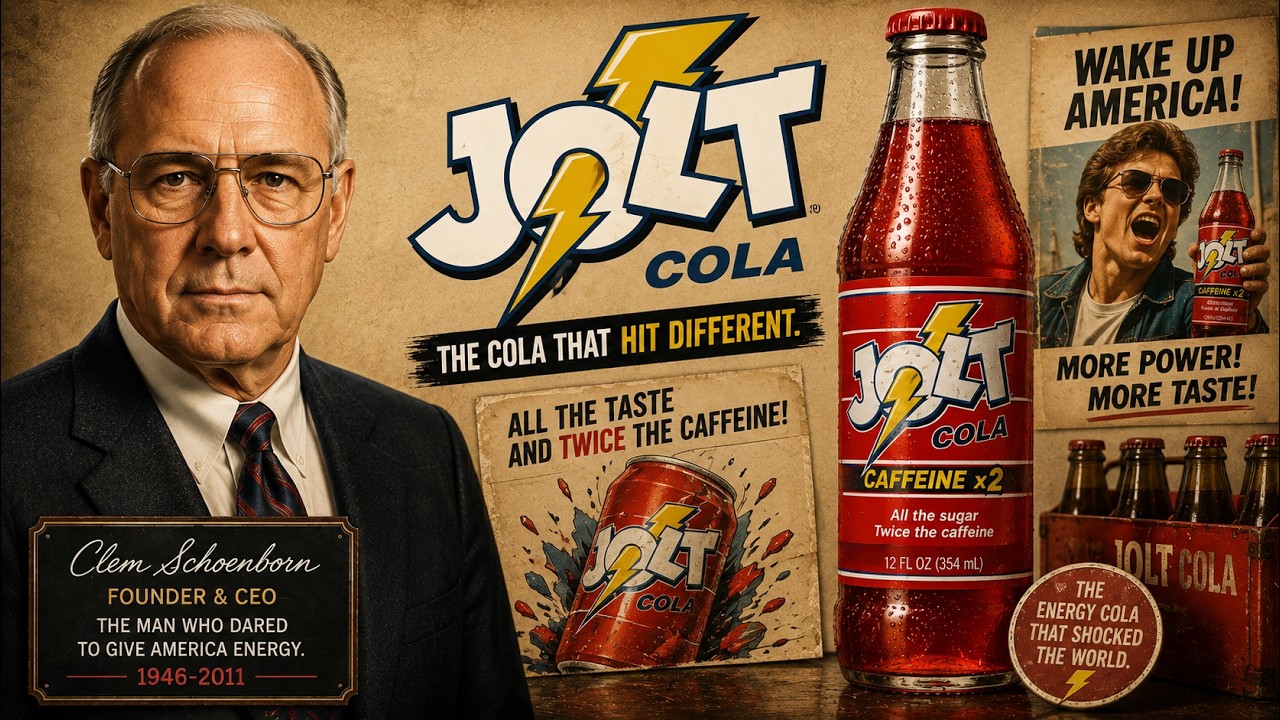
9, about seventy milligrams per twelve-ounce can, exactly double what Coca-Cola or Pepsi carried. The sugar content was ten teaspoons per can, made with real cane sugar at a moment when Coca-Cola had just switched to high fructose corn syrup. In April 1986, Jolt Cola launched in Rochester. The slogan on the can read: All the sugar and twice the caffeine.
It was not an ad agency tagline. It was a literal description. The health establishment responded immediately. A consumer watchdog director called Jolt reprehensible.
Legislators in California and New York discussed restricting high-caffeine sodas from minors. C. J. Rapp answered every criticism with the same argument: a can of Jolt contained less than a fifth of the caffeine in a standard cup of coffee.
Within twelve months, Jolt had franchise distribution in twenty states. By 1987, sales reached a million dollars. The next year they dropped forty-four percent, but distribution kept expanding. By the end of the decade, Jolt was available in forty-four states and Canada.
Joseph Rapp had been right. There was a market on the other side of the room. Jolt was the first carbonated soft drink in American history to sell at a premium above Coca-Cola and Pepsi. The logic was simple: the company could not win a price war, so it reframed the product.
Jolt competed on function, not refreshment. You paid more because you got more. That positioning, a beverage sold for what it did rather than how it tasted, was the founding logic of the entire energy drink industry. C.
J. Rapp understood that controversy was the only marketing budget he had. He gave interviews to anyone, responded to critics by name, and turned the health debate into a news cycle that became free advertising. The result was coverage money could not have purchased: David Letterman, Good Morning America, CNN.
A soda the government was arguing about was a story. Parents objecting and health advocates calling it irresponsible only strengthened its appeal to a generation raised on diet everything. To a certain twenty-year-old, the can read less like a nutrition label and more like a manifesto. Then the programmers found it.
In the late 1980s, software developers worked brutal hours in cramped offices and university labs. Jolt was available at twenty-four-hour convenience stores. It worked, and word spread through a community that communicated faster than any other professional group in America. By the early 1990s, Jolt was the unofficial beverage of the American software industry.
Dr. Dobb’s Journal ran a cover story on it. In 1991, Software Development Magazine launched the Jolt Award, given annually to the best computer books, tools, and software, with a logo modeled on the Jolt can. The award ran until 2009, the same year Jolt went bankrupt.
The soda and the award it inspired died together. Hollywood noticed. In 1992, Wayne’s World showed a character reaching for a Jolt. In 1993, Jurassic Park put the cans on Dennis Nedry’s workstation.
The filmmakers wanted his desk to look like a real programmer’s desk, and a real programmer’s desk in 1993 had Jolt on it. In 1995, the film Hackers delivered a line no marketing department could have scripted: Jolt Cola, the soft drink of the elite hacker. Through the late 1980s and 1990s, the company expanded. Lower-calorie versions and flavor extensions followed: Cherry Bomb, Citrus Climax, Orange Blast, Electric Blue.
The names were direct and aggressive, designed to communicate energy. In 2003, the brand extended into gum, mints, and candy. International distribution ran in Canada, Japan, and the Philippines. By the mid-1990s, Jolt operated in forty-four states and multiple markets.
Its market share never topped one percent, but it had built a category, not a brand. In 1997, Red Bull launched in the United States, generating thirty-five million dollars in its first year. It added taurine and B vitamins, priced above anything in the soda aisle, packaged itself in a slim eight-ounce can, and told consumers it was not a soda at all. The programmers who had kept Jolt under their desks in 1991 were senior engineers by 2001.
Red Bull felt like a professional tool. Jolt felt like a college dorm staple. The customers did not leave because Jolt had changed. They left because Red Bull gave them a reason to upgrade.
The category Jolt invented was now owned by someone else. Around 2005, C. J. Rapp made a decision consistent with everything he had ever done.
He decided to go further. He designed a new package: a resealable bottle shaped like an AA battery, cobalt blue, bold logo. Jolt gave you energy. Batteries gave devices energy.
The concept was clever. It was also catastrophically expensive to produce. The tooling costs and compressed margins could not be absorbed by the company’s revenue. In 2008, Rapp signed a contract with Rexam for 90 million units.
He did not inform his board or his investors. When the invoice arrived, the company could not pay it. The board moved quickly. C.
J. Rapp was removed as CEO of his own company. Without him, the institutional knowledge that held Jolt together evaporated. Distributors dropped the brand for Red Bull and Monster.
Shelf space contracted. Sales fell, then fell again. On September 28, 2009, the Jolt Company filed for Chapter 11 bankruptcy, citing its inability to pay Rexam. Not a competitor, not a regulator, not a shift in taste.
A contract for 90 million cans ended twenty-four years of operation. Rapp spent eight years in litigation over his removal. The brand passed to creditors and eventually to a Manhattan entity. Distribution ceased.
The last cans were sold without announcement. Jolt did not stay dead. In September 2017, cans appeared on Dollar General shelves across America, priced at one dollar each. The new ownership had struck a deal through what a spokesperson described as a chance meeting on an airplane.
Former drinkers bought them in quantity. By 2019, the cans were gone again. No explanation. A third revival came in 2025, when a Florida sports nutrition company acquired the license.
Its founder had grown up in the 1980s forbidden from drinking Jolt, which meant he remembered it as something worth wanting. The new version is not the 1986 product. It contains 200 milligrams of caffeine per sixteen-ounce can, nearly three times the original, and zero sugar. It is, by every functional definition, an energy drink that carries the Jolt name.
To survive, it had to become what it inspired.