Salt is everywhere, and nowhere. A white crystal so common it vanishes into the background of daily life, yet so essential that without it, the human body simply stops. No cell in the body can produce sodium. If consumption ceases entirely, nerves fail, muscles seize, the brain swells with fluid, and death follows within days.
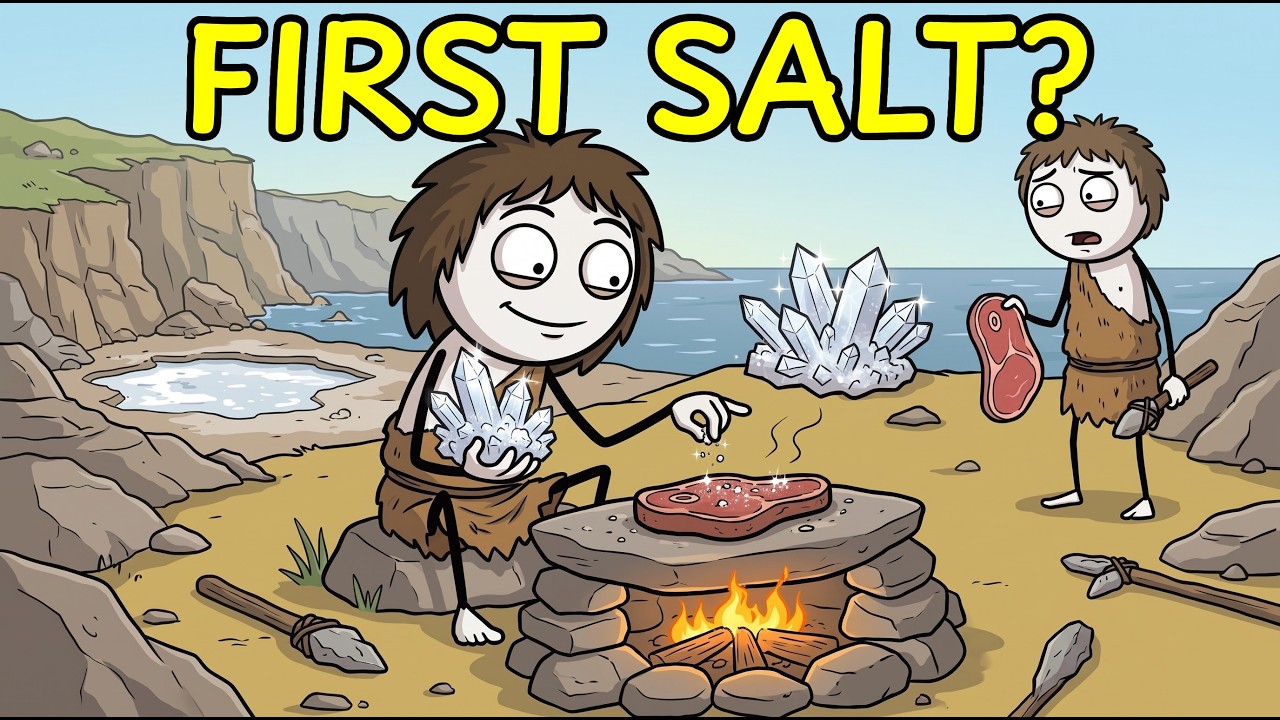
Every animal on Earth faces the same biological imperative. Deer travel twenty miles to reach salt licks. Elephants in Kenya venture deep into a pitch-black cave on Mount Elgon, scraping salt from the walls with their tusks. Parrots gather by the hundreds on exposed clay banks in the Amazon.
The entire animal kingdom is quietly, desperately obsessed with finding salt. Humans are no different, except for one thing. We learned to produce it. For most of human evolutionary history, this was unnecessary.
Raw muscle meat contains between 50 and 80 milligrams of sodium per 100 grams, and blood carries about 3. 5 grams per liter. Organ meats concentrate it even further. Paleolithic hunters who ate wild game, drank blood, and cracked bones for marrow consumed all the sodium they needed without ever encountering a single salt crystal.
The Inuit of the Arctic, documented by ethnographers into the twentieth century, added almost no salt to their diet. Their seal, walrus, caribou, and fish provided more than enough. They had no word for salt as a separate substance. They didn’t need one.
The problem began with agriculture. When human societies in the Fertile Crescent, the Yangtze Valley, Mesoamerica, and sub-Saharan Africa shifted from hunting to farming roughly ten to twelve thousand years ago, their diets changed dramatically. Wheat, barley, rice, millet, corn, and beans are rich in calories and almost entirely devoid of sodium. A 1985 study by Boyd Eaton of Emory University, published in the *New England Journal of Medicine*, estimated that Paleolithic diets contained about 0.
5 to 1. 5 grams of sodium daily, mostly from animal tissue. Modern humans consume nine to twelve grams of salt per day. The difference between those numbers is the entire history of salt.
The body responded exactly as evolution designed it to. It craved salt. Australian physiologist Derek Denton spent decades studying this phenomenon, publishing his landmark work *The Hunger for Salt* in 1982. Through controlled experiments on sheep, cattle, rabbits, and rats, he proved that sodium appetite is not learned or cultural.
It is an innate instinct. An animal deprived of sodium will seek it with an urgency comparable to thirst. The drive is regulated by aldosterone and angiotensin II, hormones that act on the brain’s reward and motivation centers. Salt hunger is one of the oldest drives in the mammalian nervous system.
Every Neolithic farmer who woke up longing for something sharp and mineral after weeks of barley porridge was feeling that ancient pull. How did they find it? Most likely, they watched the animals. Herbivores face the same problem as farmers, and across the world they congregate at natural salt springs and exposed mineral deposits.
Prehistoric humans, following game trails, would have noticed animals licking rocks and soil. They tasted the water. They tasted the earth. They recognized that sharp, almost electric sensation on the tongue as what their bodies demanded.
Tasting salt is one thing. Producing it is quite another. The earliest known evidence of deliberate salt production in Europe comes from Poiana Slatinei, near the village of Lunca in Neamț County, Romania. Archaeologist Olivier Weller of the CNRS in Paris dated the site’s salt production to approximately 6050 BCE.
The location sits above a natural salt spring where groundwater, having dissolved underground salt deposits, rises to the surface as brine. The Neolithic inhabitants collected this brine, poured it into large coarse ceramic vessels, and boiled it over fires until the water evaporated. What remained was solid, transportable salt. The evidence lies in the pottery itself, distinctive thick-walled shards called briquetage, thousands of them, indicating organized, sustained production on a community scale.
This was one of the first industries in European history. Similar developments occurred independently across the world. At Solnitsata in northeastern Bulgaria, a settlement that translates literally as “salt pit,” excavation led by Vasil Nikolov of the Bulgarian Academy of Sciences revealed a salt production center dating to around 5500 BCE. Between 4700 and 4200 BCE, the settlement was encircled by massive stone walls up to three meters thick, described by Nikolov as the oldest known fortified settlement in Europe.
No one builds walls that thick unless what they protect is valuable enough to steal. Nikolov estimated the site produced four to five thousand kilograms of salt annually. The surplus went to trade. Thirty-five kilometers away lies the Varna Necropolis, discovered in 1972, containing more than six kilograms of gold artifacts dating to between 4560 and 4450 BCE, the oldest worked gold known to humanity.
Archaeologists including Nikolov have suggested that the wealth behind that gold came from the salt trade. Salt from a spring may have funded the first great fortunes in European history. In China, Lake Yuncheng in Shanxi Province, historically called “Salt Pond,” supplied salt through simple solar evaporation for at least four to five thousand years. Chinese historical texts trace salt extraction there to the Xia Dynasty, roughly 2100 to 1600 BCE, and likely earlier.
Archaeologist Li Liu of Stanford University has noted that control over salt resources may have been a factor in the formation of China’s earliest states. Those who controlled salt controlled the region. At Duzdagi, meaning “Salt Mountain,” in Azerbaijan, a joint Azerbaijani-French team led by Catherine Marro and Veli Bakhshaliyev documented rock salt mining dating back to at least 4500 BCE. These people did not boil brine.
They descended underground with stone tools and cut salt directly from the mountain. Three methods, three continents. Solar evaporation from a Chinese lake. Boiling brine from Romanian and Bulgarian springs.
Mining salt from an Azerbaijani mountain. All leading to the same product within a similar window of human development. Salt did more than improve taste. It preserved food.
The chemistry is simple. High concentrations of salt draw water out of cells through osmosis, reducing the water activity available for microbial growth. Fresh meat has a water activity of about 0. 99.
Most bacteria need above 0. 91 to reproduce. Heavily salted, dried food can fall below 0. 75, where almost nothing grows.
Before refrigeration, before canning, salt was the only reliable way to prevent meat and fish from spoiling. This single capability changed the course of civilization. A hunter could preserve an autumn kill and eat it through winter. A fisherman could salt fish on the coast and transport it hundreds of kilometers inland.
An army could be supplied for a months-long campaign. A ship could carry salted meat across the ocean. Salt transformed perishable food into durable goods, and durable goods are taxable, storable, and tradable. Salt also enabled controlled fermentation.
Salting cabbage at two to three percent concentration draws out water, creating a brine that suppresses spoilage organisms while providing an ideal environment for lactic acid bacteria, which produce preservative acids. This is sauerkraut. This is kimchi. Roman garum, a fermented fish sauce produced industrially across the Mediterranean, used salt concentrations of twenty to thirty percent.
Cheese depends on salt to control moisture and bacterial activity during aging. Without salt, there is no cheese, no kimchi, no soy sauce, no fish sauce, no bacon, no pickles. Once salt could do all this, it became power. The Romans built the Via Salaria, the Salt Road, one of the oldest routes in Italy, to carry salt inland from coastal pans at the mouth of the Tiber.
Pliny the Elder noted that the Latin word *salarium*, from which the English “salary” derives, was associated with salt, though the common claim that Roman soldiers were paid in salt is an oversimplification. The word *salarium* was more likely an allowance given to soldiers to purchase salt. Yet the linguistic connection is real. “Salary,” “salad,” “sausage,” and “sauce” all trace their roots to Latin words meaning salted.
In China, salt became an instrument of state power earlier and more clearly than anywhere else. In 119 BCE, Emperor Wu of the Han Dynasty established a government monopoly on salt and iron, funding military campaigns against the Xiongnu nomads on the northern frontier. In 81 BCE, a formal court debate was recorded between Confucian scholars opposing the monopoly and officials defending it. The text, compiled by Huan Kuan, is called *Yantie Lun*, the *Discussions on Salt and Iron*.
This 2,100-year-old argument about taxation and state control of essential resources remains one of the earliest recorded policy debates in history. In China, salt technology was also extraordinary. By the first century BCE, engineers in Sichuan Province were drilling brine wells using bamboo rods tipped with iron, reaching depths of a hundred meters or more. By the Song Dynasty, wells in Zigong reached several hundred meters.
Natural gas released during drilling was piped through bamboo tubes to fuel the fires that evaporated the brine. The Chinese were drilling for saltwater at depths no one else on Earth would reach for another thousand years. Across the Sahara, salt was traded for gold. Caravan routes connected the salt mines of Taghaza in modern-day northern Mali, where houses and mosques were built from salt blocks, to the gold-producing regions of West Africa.
Moroccan traveler Ibn Battuta visited Taghaza in 1352 and described the trade. In the gold-rich savannas where salt was scarce, it was reportedly exchanged ounce for ounce with gold. Mansa Musa, who ruled the Mali Empire from about 1312 to 1337 and is often described as the richest person in history, controlled these routes. In France, salt became a hated tax.
The *gabelle*, first imposed in 1341, varied wildly between regions. In the high-tax zones, prices reached ten to fourteen times production cost. Every person over eight was required to buy a set amount of salt annually from royal warehouses, regardless of need. The price disparities fueled an extensive smuggling trade, and smugglers faced imprisonment or death.
The gabelle was listed among the grievances before the Estates-General in 1789. The National Constituent Assembly abolished it in March 1790. Napoleon reinstated it in 1806. It was not permanently abolished until 1946.
In India, salt became a symbol of independence. The British colonial government taxed salt and monopolized its production under the Salt Act of 1882. On March 12, 1930, Mahatma Gandhi set out from his Sabarmati ashram with 78 followers, walking 390 kilometers to the coastal village of Dandi on the Arabian Sea. On April 6, he picked up a piece of natural salt from the mudflats, breaking British law.
Tens of thousands of Indians followed by illegally producing or buying salt. More than 60,000 were arrested. The Salt March became a defining moment of the Indian independence movement. Cities bear salt’s name.
Salzburg, from the German *Salz* and *Burg*, means salt fortress. Hallstatt, from an ancient word for salt, names an entire era of European prehistory. Wieliczka in Poland has operated since the thirteenth century and became a UNESCO World Heritage site in 1978. The name of a city containing the word “salt” in an unfamiliar language is the economic foundation of a settlement encoded in its identity.
Hallstatt itself deserves particular attention. Salt mining there dates back to at least 1200 BCE, and the site is so significant that the first phase of the European Iron Age, roughly 800 to 450 BCE, is named Hallstatt culture after it. In 1846, mining engineer Johann Georg Ramsauer began systematic excavations of a vast cemetery near the mine, uncovering over 980 graves containing thousands of bronze and iron artifacts. But what makes Hallstatt truly unique is what the salt preserved.
Deep salt-saturated mines created conditions that preserved organic materials that would have decomposed anywhere else: wooden mining tools, hafted axes, backpacks with wooden frames and leather straps, woven textiles with colorful patterns, leather shoes and hats, even the remains of miners’ meals. A 2021 study in *Current Biology* analyzing ancient Bronze Age feces from the mine found evidence of a diet rich in whole grains, wheat, barley, and fruit, along with *Penicillium roqueforti*, the mold used in blue cheese, and brewer’s yeast. The miners were eating blue cheese and drinking beer between 1300 and 1000 BCE. It is the oldest evidence of cheese ripening in Europe, preserved in the excrement of a salt miner who ate his lunch underground three thousand years ago.
The human discovery of salt was not a single event. It did not spread from one origin point. It is a convergent invention. The biological need existed always, embedded in the mammalian nervous system through hundreds of millions of years of evolution, powered by the sodium-potassium pump identified by Jens Christian Skou in 1957 and driven by the innate sodium appetite documented by Derek Denton in 1982.
The need remained silent as long as meat satisfied it. When agriculture replaced hunting and the human diet shifted to near-sodium-free grains, that silent need became urgent. People searched for salt the way herbivores always had, at natural springs and salt lakes. They watched the animals.
They tasted the water. They tasted the soil. Then they learned to produce it, by boiling, by evaporation, or by mining, using whatever the local geology provided. The chemistry of salt is identical everywhere.
More than ninety-five percent of it is the same compound, and its biological function is universal. The need was global. The solutions were local. From that simple white crystal, humans built trade routes across continents, cities named for the substance that funded them, empires that taxed it, and revolutions that rose against it.
Salt gave us words for salary and salad, sauce and sausage. One mineral, drawn from the earth, dissolved in water, crystallized by fire or sun, quietly reshaped the human world more completely than almost any other substance in history. Every time someone salts a steak, an egg, or a pot of soup, they are doing what a Neolithic farmer did at a spring in Romania eight thousand years ago.
They are replacing the one mineral the body cannot produce itself, answering a hunger older than the human species itself.