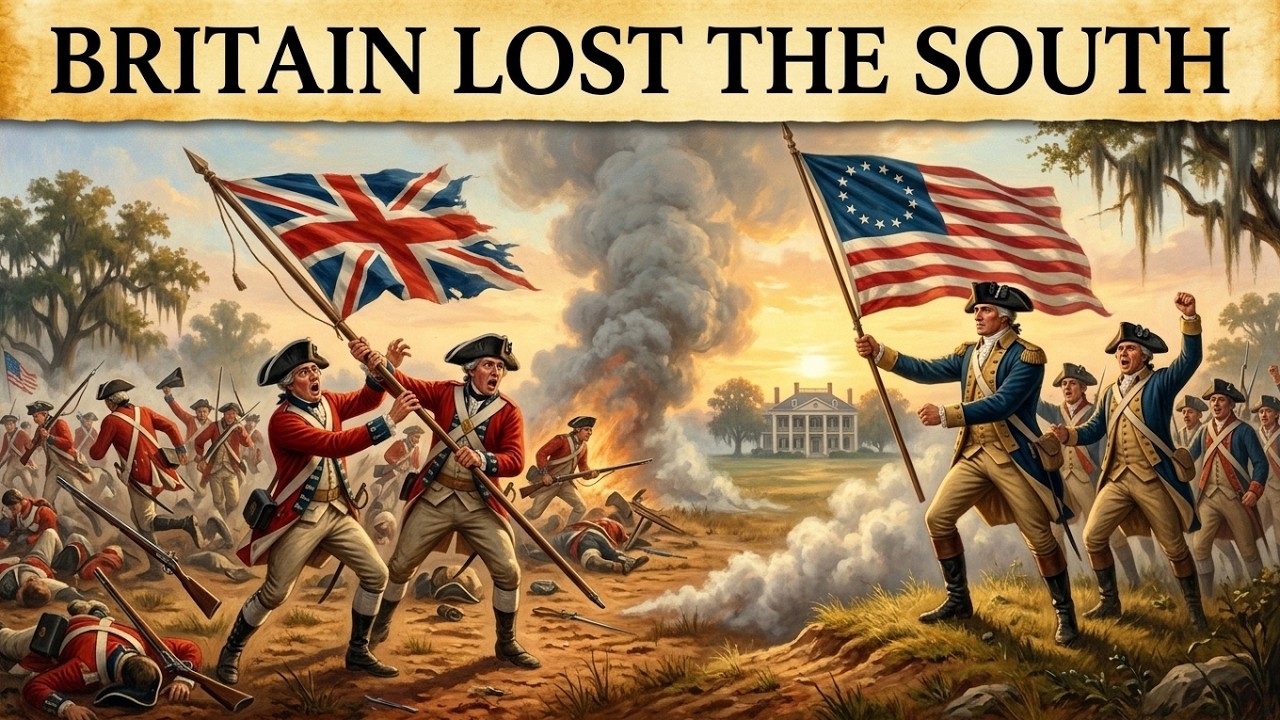
The battle that finally destroyed the last British field army in the American South took place on September 8, 1781, at a place called Eutaw Springs. By any conventional measure, the American commander lost it. But the man who lost it had spent the entire war in the South losing battles, and by the end of 1781 the British had been driven from the entire southern backcountry and trapped inside Charleston with nowhere to go. His name was Nathanael Greene, and the battle at that obscure creek in South Carolina became the bloodiest engagement of the entire Revolutionary War.
To understand how one clash at an unknown stream ended British control of the South for good, you have to grasp how desperate the American position had been before Greene arrived. By the summer of 1780, the British were winning the war in the South convincingly. Their strategy was straightforward: seize the major ports, push inland through the countryside, rally Loyalist support as they advanced, and strangle the rebellion from the bottom up. The plan was working.
Savannah fell in late 1778. Charleston surrendered in May 1780 in the worst American defeat of the war, with more than 5,000 Continental soldiers captured in a single day, more men than Washington commanded in most of his battles. British commander Lord Cornwallis then moved inland, establishing fortified posts stretching from the coast deep into the Carolina backcountry. In August, at Camden, the American army under General Horatio Gates, the hero of Saratoga, was shattered so completely that Gates fled the battlefield on horseback and rode nearly sixty miles without stopping.
The army lost nearly a thousand men killed or captured, and the survivors scattered into the swamps with nothing but the clothes on their backs. The Southern Continental Army effectively ceased to exist as an organized force. Congress was embarrassed. The cause seemed finished south of Virginia.
It was then that George Washington made the decision that changed everything. Over the objections of a Congress that had insisted on choosing its own generals for the Southern theater, Washington picked Nathanael Greene. Greene had been a Quaker from Rhode Island who taught himself military strategy from books, held no rank before the war, and had spent 1779 and 1780 in the unglamorous job of army quartermaster, keeping supply lines running. He was not the obvious choice for field command in the middle of a disaster, but Washington understood something few in Congress did.
Greene understood logistics, terrain, and the fact that winning a war did not always require winning battles. When Greene arrived at Charlotte, North Carolina, on December 2, 1780, he found roughly 2,300 men on paper, and the reality was worse. Many lacked shoes, some had no coats in the middle of winter, ammunition was scarce, and food was scarcer. Cornwallis commanded nearly twice his strength with far better supplies and some of the finest professional soldiers in the world.
A conventional general would have avoided Cornwallis entirely. Greene instead divided his small army in half. He sent about 600 men under Daniel Morgan west into the Carolina countryside and took the rest eastward toward Cheraw. The move defied every principle of eighteenth-century warfare, but Greene understood that splitting his army would force Cornwallis to split his own.
Cornwallis could not ignore Morgan roaming behind his lines, nor could he leave Greene unobserved, so he divided his forces and sent Banastre Tarleton to chase Morgan. That decision produced the Battle of Cowpens in January 1781, where Morgan sprung a trap that nearly wiped out Tarleton’s command. Tarleton lost more than 800 men in under an hour and barely escaped with his life. Cornwallis was furious.
He burned his baggage train, every tent, every wagon, every comfort his army carried, to lighten his column, and chased Greene north in a desperate pursuit known as the Race to the Dan. For weeks the armies raced across the North Carolina countryside in the heart of winter. Greene stayed just far enough ahead to avoid being caught, crossed the Dan into Virginia, then turned back around. At Guilford Courthouse in March 1781, he finally gave Cornwallis the pitched battle he had been chasing.
Greene arranged his troops in three lines, militia in front and regulars behind, and allowed the British to break through each line at terrible cost. Cornwallis won the battle technically, but lost more than a quarter of his army in the process. He fell back to the coast at Wilmington. Then he made a fateful decision.
Instead of returning to reclaim South Carolina, he marched north into Virginia, chasing what he thought would be a decisive campaign. He left the Carolinas behind with a scattered chain of garrisons and a field force of about 2,500 men to hold everything the British had spent two years conquering. Greene did the opposite. While Cornwallis chased glory in Virginia, Greene marched his exhausted but intact army south, directly back into South Carolina, and began dismantling those isolated British garrisons one by one.
Fort Watson fell. Fort Motte fell. Orangeburg fell. Augusta, Georgetown, and Ninety Six fell.
Greene coordinated with partisan leaders who knew the swamps and back roads better than anyone. Francis Marion, the Swamp Fox, struck British supply lines from the low country. Andrew Pickens pressed Loyalist strongholds in the upcountry. Henry Lee’s Legion moved like mounted ghosts, hitting and vanishing before the British could respond.
Greene lost some engagements along the way. At Hobkirk’s Hill in April, a British counterattack forced his men off the field. At Ninety Six in June, his siege failed when British reinforcements arrived. But every time Greene lost a battle, the British paid a price in men they could not replace, and after every fight Greene kept his army intact, regrouped, and came back again.
The British commander Lord Rawdon, who had fought Greene for months, collapsed physically from the campaign. He handed command to Lieutenant Colonel Alexander Stuart and sailed for England. By late August 1781, Stuart’s force was all that remained of the British field army in South Carolina. He had nearly 2,000 men, a mix of British regulars, Loyalist units, cavalry, and five artillery pieces.
He marched northwest from Charleston toward the branches of the Santee River, then fell back to a camp at Eutaw Springs along Eutaw Creek, near the plantation of a Loyalist named Patrick Roche. Stuart settled there and sent unarmed foraging parties out every morning to dig sweet potatoes for his shortage of bread. Greene, meanwhile, was gathering reinforcements. Continental regulars from Maryland, Delaware, and Virginia marched to join him, along with Henry Lee’s cavalry, William Washington’s dragoons, Francis Marion’s South Carolina militia, and Andrew Pickens with more militia from the backcountry.
By the eve of September 8, Greene had mustered nearly 2,200 men. They were ragged and many were barefoot, but the campaign had forged them, and they were hungry for this fight. At four in the morning on September 8, Greene’s army moved toward Eutaw Springs. They advanced in two columns along the river road from Burdell’s plantation, about seven miles away.
Henry Lee’s Legion led the way. The morning was already hot. Around eight o’clock, Lee’s advance collided with a British foraging party. Stuart was taken completely by surprise, with a quarter of his force scattered in the woods digging sweet potatoes.
The British abandoned their uneaten breakfasts and hurried to form a line of battle about two hundred yards west of Eutaw Springs. Greene deployed his army in three lines, a formation adapted from Daniel Morgan’s success at Cowpens eight months earlier. The front line was made up of South and North Carolina militia under Marion and Pickens. The second line was North Carolina Continentals.
The third line, his strike force, was the regular Continental troops from Maryland and Virginia, the best soldiers Greene had. The militia opened fire and advanced toward the woods. In the next hour, something happened almost no one expected. The militia did not retreat.
They held under the brutal heat, fired volley after volley into the British line, trading shots at close range through the dense trees. The noise was deafening and the gun smoke hung in the still air, making visibility nearly impossible. These were not the raw recruits whose ranks had melted at Camden a year before. Many were veterans of guerilla warfare who had spent the previous twelve months ambushing British patrols and raiding Loyalist supply wagons with Marion and Pickens.
They held their positions until their ammunition ran out, then fell back in order, exactly as planned. As the North Carolina Continentals advanced to replace them, the second line struck the British hard. Fighting grew ferocious, with bayonets and rifle butts used in violent clashes. Then Greene sent in his third line, the Maryland and Virginia regulars, supported by Lee’s infantry and Robert Kirkwood’s Delaware troops.
The Continental soldiers surged forward with bayonets. The British line collapsed under the pressure, and the center broke entirely. The redcoats fled in chaos back through their camp, leaving tents, supplies, weapons, and the uneaten breakfast behind. For a few minutes, it looked as though Greene was about to achieve what he never had: a complete, decisive victory.
Then everything went wrong. Greene’s soldiers swept into the British camp and found it full of food, rum, and supplies. They had been marching for days on meager rations in the Carolina heat. Some had not eaten a full meal in a week.
Their clothes were ragged and torn, some fought barefoot over ground littered with broken branches and spent ammunition. And suddenly, right in front of them, were tables of British food still warm from the abandoned breakfast, barrels of rum and wine, tents full of blankets, shoes, and equipment. The discipline that had held through two hours of brutal fighting collapsed in seconds. Soldiers threw down their weapons and began eating, opened the rum barrels and drank, rifled the tents and stuffed their pockets with everything they could carry.
Officers screamed for them to stop, reform, and continue the attack. No one listened. The advance halted completely as hundreds of American soldiers turned into a disorganized mob scattered across the British camp. While the American attack stalled, something was happening on the British right flank that would change the course of the battle.
Major John Majoribanks, pronounced Marjoribanks, led a force of elite British light infantry and grenadiers. When the American advance had overrun his position, Majoribanks pulled his men into a dense thicket of tangled blackjack oaks on the banks of Eutaw Creek. The thicket was nearly impenetrable, and Majoribanks used it as his fortress. Greene sent William Washington’s cavalry to flush him out.
Washington tried to ride his horses through the thicket, but the horses could not break through the tangled underbrush. He attempted to go around the position and attack from the flank, which exposed him to heavy fire. His horse was shot out from under him, a British soldier bayoneted him in the chest, and Washington was captured and led away as a prisoner. His cavalry scattered.
At the same time, a British officer named Major Sheridan led what remained of his unit into the brick house of the Roche plantation. The house was solid, two stories of brick with thick walls that musket balls could not penetrate. The British barricaded themselves inside and began firing from the upper windows. Greene ordered four six-pounder cannons brought up to destroy the house.
The artillerymen positioned their guns and fired, but the brick walls held. British fire from the house killed enough of the gun crews that the Americans had to abandon their artillery, leaving the cannons in the open. Here Majoribanks saw his opportunity. He led his men out of the thicket toward the British camp and attacked the disorganized, looting Americans.
Stuart rallied whatever troops he could find behind the house, and Colonel Coffin’s cavalry charged from the left. Suddenly the Americans, who five minutes earlier had been on the verge of a decisive victory, were being attacked from three directions at once while half their force was drunk or too scattered to fight. The result was utter chaos. The Americans who stayed in formation fought fiercely, but the momentum was gone.
Greene watched the situation collapse and made the decision that defined his career. He pulled his army off the battlefield. He did not throw his last reserves into a desperate gamble. He collected his wounded, rallied his scattered units, and withdrew seven miles back to Burdell’s plantation.
He saved his army to fight another day. Stuart controlled the field that night, which by the standards of eighteenth-century warfare meant a British victory at Eutaw Springs. But look at the real cost of that victory. The battle lasted more than four hours in the brutal September heat.
Total casualties on both sides exceeded 1,400 men out of roughly 4,200 engaged, meaning one in three men who fought that day was killed, wounded, or captured, the highest percentage of total casualties of any single battle in the entire Revolutionary War. For the British, the numbers were catastrophic. Stuart lost around 700 men, with about 85 killed, more than 300 wounded, and hundreds captured or missing. According to some estimates, the British casualty rate exceeded 44 percent.
Nearly half of the British soldiers who fought at Eutaw Springs fell. It was the highest casualty rate any army sustained in any single battle of the war. Stuart looked at what remained of his force the next morning and made the only logical decision. His army had been cut nearly in half.
He had lost officers he could not replace, men he could not recruit, and supplies he could not provide. The camp at Eutaw Springs was full of dead and dying from both sides, and he did not have the manpower to bury them all. On September 9, he abandoned the camp. He left his dead unburied in the field and left 70 of his most seriously wounded behind because he simply could not move them.
He retreated first to Monck’s Corner, then directly to Charleston, and his army never came out from behind those walls again. Major Majoribanks, the officer who had seemingly turned the battle in the blackjack thicket, was wounded in the fighting. He died a few weeks later and was buried at a nearby plantation, later reburied when the original site was flooded. Technically, Greene had lost another battle.
His record in the South remained without victories. But what he actually achieved was remarkable. The last British field army in the Carolinas was finished as a fighting force. The survivors of Stuart’s army were locked inside Charleston, unable to project power, reinforce anyone, or do anything but remain behind their fortifications and wait.
Every British outpost in the interior of South Carolina was gone. Every Loyalist stronghold had fallen. The backcountry belonged to the Americans. The timing mattered enormously.
Six weeks later, on October 19, 1781, Lord Cornwallis surrendered with his entire army at Yorktown, Virginia. One of the reasons Cornwallis found himself trapped there was that Stuart’s army, which could have marched north to reinforce him or provided a route of escape southward, was bottled up in Charleston and could not move. Nathaniel Greene had not won a single battle in the South. He said so himself.
He wrote to a friend that there were few commanders who had fled more than he had. But he always added the second part: he made sure he never fled far, and he usually ran forward at the same speed he ran backward. That was not false modesty; it was an accurate description of what Greene had done over fifteen months of continuous campaigning. He fought at Guilford Courthouse and lost, but Cornwallis was so weakened he had to abandon the Carolinas.
He fought at Hobkirk’s Hill and lost, but the British evacuated Camden anyway. He besieged Ninety Six and failed, but the British abandoned it for good a few weeks later. He fought at Eutaw Springs and lost, but Stuart’s army retreated to Charleston and never came out. Every loss was a strategic victory.
Every battle cost the British more than it cost Greene. Greene could replace his losses with new militia and recruits flooding south from Virginia and North Carolina, while the British fought 3,000 miles from home with a supply line across the Atlantic. Every British soldier killed at Eutaw Springs, every Loyalist captured at Hobkirk’s Hill, every redcoat wounded at Guilford Courthouse was a man the Crown could not easily replace. Greene understood this equation from the start.
He did not need to destroy the British army in one glorious afternoon. He needed to bleed it slowly, battle after battle, post after post, skirmish after skirmish, until there was nothing left. That is exactly what he did. After September 8, 1781, there was no British army capable of fighting in the field south of Virginia.
The last soldiers Britain possessed south of the Virginia line were hiding behind fortifications and would remain there until the war formally ended. On December 14, 1782, more than a year after Eutaw Springs, Greene’s army entered Charleston as the British evacuated the city for the final time. Nathanael Greene never won a single battle, but he won the war in the South through sheer perseverance, strategic genius, and a willingness to absorb losses that would have broken most commanders. He died four years later in 1786 at age 43, most likely from a heat stroke suffered on his Georgia plantation.
He was buried in Savannah on land a grateful state granted him in recognition of his service, and history long forgot him. His grave was actually lost for nearly a century before being rediscovered in 1801 under a building in downtown Savannah. Schoolchildren learn about Washington’s crossing of the Delaware and the Siege of Yorktown, but almost no one learns about the Quaker from Rhode Island who taught himself to fight from books and then outmaneuvered the best army in the world without winning a single engagement. Eutaw Springs itself has been largely forgotten.
The battlefield is now partly submerged under Lake Marion, created in the 1940s. A small park near Eutawville, South Carolina, marks the site. Most people pass by without any idea that one of the most brutal battles in American history took place in those woods along that creek. But what happened at Eutaw Springs on that burning September morning changed the course of the American Revolution.
It proved you do not need to win every battle to win the war. It proved that an army held together by will and strategy can outlast an army that wins on the battlefield but bleeds itself dry in doing so. And it proved that a commander who knows when to retreat is sometimes more dangerous than the one who knows how to attack. Greene retreated often, but he always came back.
And in the end, there was no one left to run from him.