On the 3rd of June, 1944, with the Allied invasion of Normandy already loading at England’s southern ports, a courtier in his late fifties sat across a desk at Buckingham Palace from King George VI and refused to let him sail into battle. The King, defied by his own private secretary, surrendered the argument within hours. Days later, the same courtier turned the same constitutional logic on Winston Churchill, and the Prime Minister yielded as well. Neither the King nor his Prime Minister observed the D-Day landings.
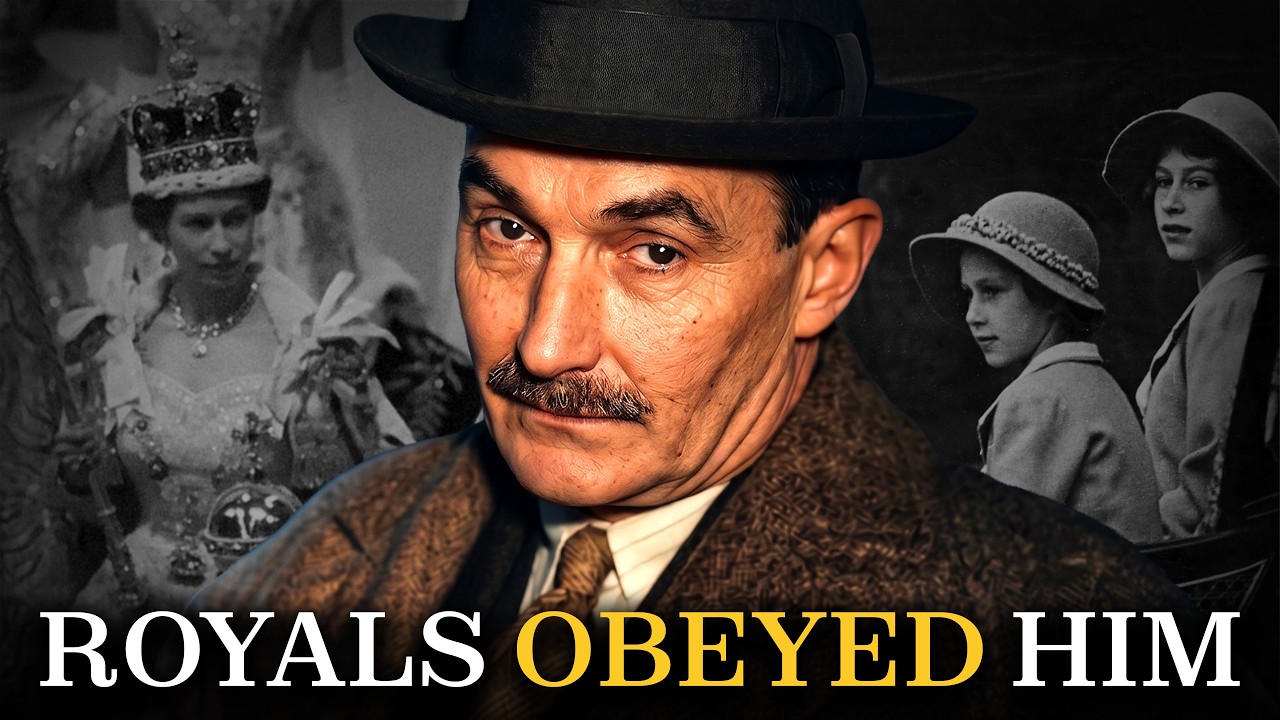
Both remained in London, where the business of government could continue. The man who had done this was Sir Alan Lascelles, known to family and friends as Tommy. He held no elected office, possessed no constitutional authority of his own, and yet exerted extraordinary influence over kings and prime ministers across three reigns. His fingerprints touched nearly every royal crisis of the mid-twentieth century, from the abdication of Edward VIII to the dissolution conventions still followed today.
Lascelles was born on the 11th of April, 1887, at Sutton Waldron in Dorset, into the late Victorian aristocracy. His grandfather was the fourth Earl of Harewood, and the family seat at Harewood House carried the slow, ordered rhythms of country gentility. His mother died before his third birthday, leaving him in the care of an emotionally austere father and a household of distant relations who treated children with polite indifference. The loss shaped him.
Tommy grew up reserved, watchful, and inclined toward books. The ruthless objectivity for which he became known took root in that early lesson: the world owed no one its sympathy, and the only sensible response was to study it carefully. He attended Hazelhurst Preparatory School, then Marlborough College, then Trinity College, Oxford. He emerged bookish and sharp-tongued, drawn to literature and history rather than playing fields, and developed the dry wit that contemporaries found either bracing or terrifying.
When war broke out in August 1914, Tommy joined the Bedfordshire Yeomanry, a cavalry regiment that, like much of the British Army, soon adapted to a kind of warfare nobody had imagined. By 1916 his unit reached the Western Front, where cavalry, robbed of the open battlefield by trenches and machine guns, fought dismounted alongside the infantry. The war shaped him permanently. He watched friends from school and Oxford die in numbers that scarcely seemed credible.
Whatever romantic notions he had carried into uniform did not survive the Somme. In December 1917 he earned the Military Cross for gallantry and rose to captain. He rarely spoke of his service afterward. What he had learned in Flanders sharpened into an instinct for the cost of poor decisions taken by men in authority.
After the armistice came a brief, unhappy stretch in civilian life before he accepted an appointment as aide-de-camp to his brother-in-law, Lord Lloyd, the new governor of Bombay. India in 1919 and 1920 churned with unrest. The massacre at Amritsar had shaken the moral foundations of the Raj, and Gandhi’s non-cooperation movement began to take shape. Tommy observed it all from Government House.
In Delhi in 1920 he married Joan Francis Vere Thesiger, daughter of the outgoing Viceroy, binding himself still more tightly into the imperial aristocratic network. The marriage produced three children and lasted until his death sixty-one years later. In 1920, Tommy received an offer to serve as assistant private secretary to Edward, Prince of Wales, heir to the British throne. At thirty-three, decorated, well-married, and well-connected, he walked into the most exhausting chapter of his life.
The prince ranked as the most photographed man on Earth, slim, fair-haired, restless, and rumored to charm everyone within thirty seconds. To the British public, he embodied a modern, golden future. Tommy found a man of charm without application, restless energy without curiosity. The prince refused to read state papers, drank heavily, conducted affairs with married women in plain sight of the household, and treated his office mainly as a service for shielding his pleasures.
The strain between the two men grew with the years. Tommy feared what the prince might one day do to the Crown when his father lay in the grave. In August 1927, during the prince’s tour of Canada, he did something almost unheard of for a courtier: he sought a private conversation with Prime Minister Stanley Baldwin in Ottawa and warned him plainly about the unfitness of the heir. According to Tommy’s own diary, he told Baldwin that he sometimes felt the best thing that could happen to the prince and the country would be for him to break his neck out hunting.
Baldwin reportedly replied, “God forgive me. I have often thought the same. ”
In November 1928, after another quarrel, Tommy offered his resignation directly to his master, telling him to his face that he was going rapidly to the devil. The prince accepted with a shrug.
Tommy walked out in January 1929, his health damaged and his faith in his immediate employer broken beyond repair. He spent years in calmer service in Canada before being called back in late 1935 as the health of King George V declined. He accepted the post of Assistant Private Secretary and sailed home in time to witness the old king’s death and the catastrophe he had long predicted. In January 1936, the man he had warned ascended the throne as King Edward VIII.
Within months the king’s relationship with Wallis Simpson, an American divorcee, had become an open secret. Tommy operated deeply inside the internal mechanics of the resistance. He helped draft the warning letter to the king, coordinated the household’s quiet opposition, and kept the palace, Downing Street, and the Church moving in step. When Edward VIII signed the instrument of abdication on the 10th of December, 1936, Tommy recorded no triumph, only grim relief.
George VI, the stammering younger brother, lacked Edward’s nature in almost every respect. He was shy, dutiful, and acutely conscious of his limitations. In July 1943, Tommy rose to principal private secretary, the most powerful courtier post in the country. He controlled the flow of state papers between monarch and cabinet, drafted the king’s letters to the prime minister, and liaised with the civil service, the church, the dominions, and the press.
Between him and the king there developed complete trust. His diaries, later published, reveal a man working at a pitch of constant strain, recording the king’s exchanges with Churchill in unsparing detail. In the spring of 1944, both the King and Churchill formed the idea of observing the Normandy landings in person from a Royal Navy flagship. Tommy disagreed with savage clarity.
On the 3rd of June, he sat across from the King and put a constitutional question in plain terms: if both King and Prime Minister perished from a mine or torpedo in the Channel, what advice would the King leave his eighteen-year-old daughter, Princess Elizabeth, on choosing her first Prime Minister? The King had not considered the question. He realized at once that his private secretary had pinned him. Within hours he wrote to Churchill withdrawing from the venture and asking the Prime Minister to do the same.
Churchill refused, drafting an angry reply, but over the next forty-eight hours Tommy, with the King’s full backing, wore him down. By the evening of the 5th of June, hours before the first troops sailed, Churchill capitulated. Tommy held no legal authority over either man. What he held was the ability to reduce a tangled question of duty into a single, undeniable constitutional principle and hold it in front of his masters until they agreed.
In 1950, a new constitutional question troubled the political class. Britain had a Labour government under Clement Attlee, the first majority Labour ministry in history, and a real prospect existed that the Prime Minister might ask the King for an early dissolution. Could the King lawfully refuse? The unwritten constitution gave no clear answer.
On the 2nd of May, 1950, a letter appeared in The Times under the pseudonym Senex, Latin for an old man. It set out three conditions under which a sovereign would be constitutionally entitled to refuse dissolution: the existing Parliament must still be able to do its job, an election would be detrimental to the national economy, and the King must be able to find another Prime Minister who could govern with a working majority. Tommy had written it. Everyone who mattered guessed the source.
The three conditions entered constitutional doctrine as the Lascelles principles. George VI died at Sandringham on the 6th of February, 1952, exhausted and undermined by lung cancer. His daughter, twenty-five-year-old Elizabeth, received the news in Kenya. By the time she landed in her black mourning clothes, Tommy had already begun arranging the machinery of the new reign.
He ran coronation planning, drafted her speeches, and briefed her on constitutional realities. Historians have argued ever since whether his traditionalism kept the young Queen at one remove from the social changes of post-war Britain or provided a steadying presence through immense pressure. In the spring of 1953, a new crisis arrived from inside the Queen’s own family. Princess Margaret had fallen in love with Group Captain Peter Townsend, a charming, decent divorced commoner sixteen years her senior.
Under the Royal Marriages Act of 1772, the Queen could not consent without cabinet agreement, and the cabinet, advised by Churchill, opposed it. Tommy advised the Queen accordingly: consent was not legally available in 1953, and the only path ran through delay. He coordinated with the Foreign Office to send Townsend to Brussels as air attaché. The decision pressed harshly on Margaret and carved a wound that never quite healed.
The crisis reached its public climax in October 1955, when Margaret announced she would not marry Townsend after all, nearly two years after Tommy had retired. He left the post of Principal Private Secretary on the 31st of December, 1953, at sixty-six, weary and ready to lay down the burden. The Queen granted him the honorary post of Extra Equerry and accepted his retirement with reluctance. He moved into a grace-and-favor residence at Kensington Palace, where he spent the next twenty-seven years.
His wife Joan died in 1971. Tommy outlived her by ten years, dying on the 10th of August, 1981, at ninety-four, lucid almost to the end. The obituaries described him as the last of the great Victorian courtiers. He left his diaries to his daughter with instructions to make them available to historians.
The first volume, In Royal Service, appeared in 1989 and caused a sensation. A second, King’s Counselor, followed in 2006. Through these private pages, the twentieth-century British monarchy acquired its sharpest internal chronicler. He had never courted celebrity, and his name slipped quickly from public memory.
Yet the constitutional principles he articulated, anonymous and unrepealed, sit somewhere in every Prime Minister’s mental furniture when the question of an early dissolution drifts into the air. For a man so committed to invisibility, his shadow proved unusually long.