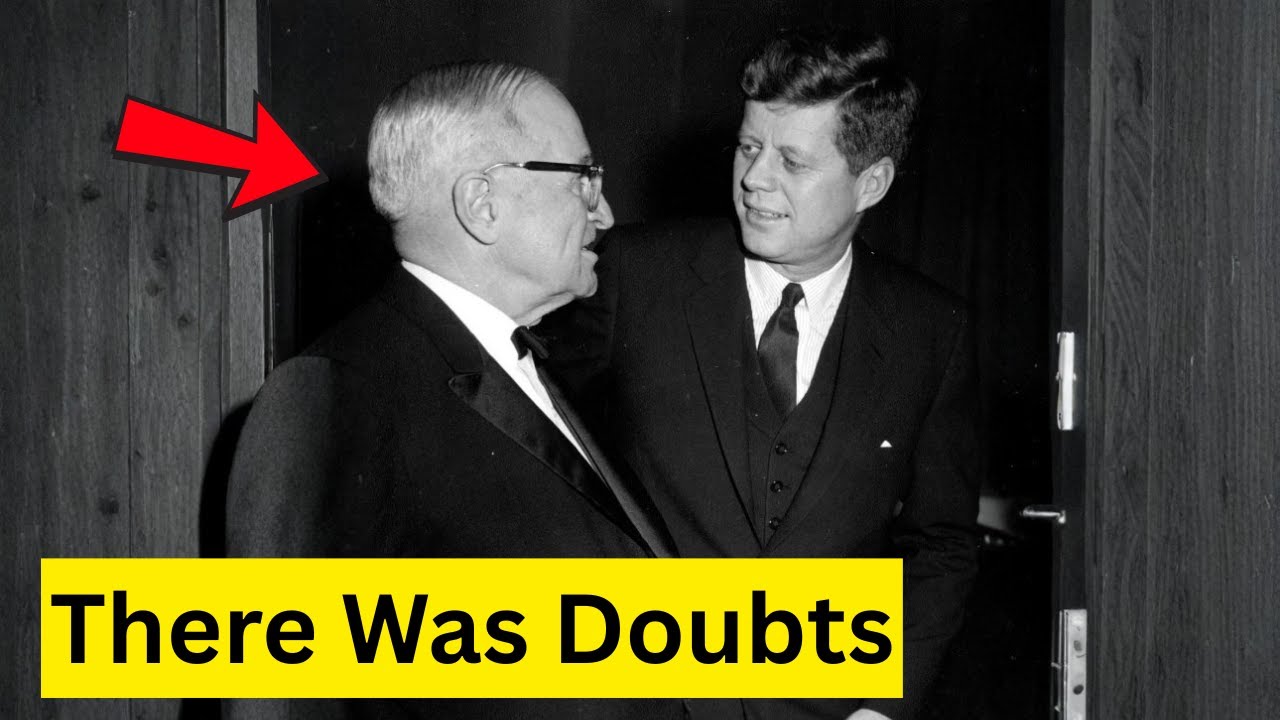
In January 1961, Harry S. Truman was no longer president. At 76, he was living quietly in Independence, Missouri, watching a new generation step into the most dangerous office on earth.
The man preparing to take that office was young, polished, charismatic, and confident in a way Truman never was. His name was John Fitzgerald Kennedy.
To the public, it looked like a clean handoff between generations, the war hero passing the torch to the youthful Cold War leader. But privately, Truman felt something else entirely.
Not hostility. Not jealousy. Something far more unsettling: unease.
As Truman watched Kennedy assemble his team, listen to his advisers, and speak about America's role in the world, he began to sense that the presidency itself had changed. He wasn't sure the young man stepping into it fully understood what he was inheriting.
Truman had taken office suddenly, without preparation, without warning, during the greatest crisis in human history. Roosevelt had barely told him anything.
Within weeks, Truman was making decisions that would reshape the world forever. He learned the hard way that power does not announce its consequences in advance.
Kennedy, by contrast, had grown up around power. And that difference mattered.
Truman was shaped by scarcity. He was born poor, worked on farms, failed in business, and clawed his way up through politics.
He distrusted smooth talkers. He distrusted credentials. He distrusted anyone who looked too comfortable with authority.
Kennedy came from the opposite world. He was born into wealth, educated at elite institutions, and surrounded from childhood by diplomats, bankers, and political strategists.
His father, Joseph P. Kennedy, had been an ambassador, a power broker, and a master of behind-the-scenes influence.
To Truman, this background raised a quiet alarm. Not because Kennedy was unpatriotic, and not because he was unintelligent, but because he had never been forced to sit alone with the weight of irreversible decisions.
Truman knew that feeling intimately. In 1945, he had stared at options no president ever wanted to see.
There were no clean choices, no good outcomes, only decisions that traded one kind of suffering for another.
Truman learned that the presidency was not a position of confidence. It was a position of doubt, and doubt, Truman believed, had to come from inside you.
As Kennedy built his administration, Truman watched as a new phrase entered the political bloodstream: the best and the brightest.
Young, brilliant minds from Harvard, MIT, and Yale. Economists, strategists, systems thinkers. Men who believed global crisis could be managed like equations, that international tensions could be controlled with enough intelligence, enough planning, enough precision.
This worried Truman deeply. He had lived through moments when plans collapsed instantly, when intelligence was incomplete, when theory was useless, when human unpredictability shattered every assumption.
Truman believed advisers should inform decisions, not dominate them. He wasn't convinced Kennedy saw the difference.
After leaving office, Truman became increasingly outspoken about one institution in particular: the Central Intelligence Agency.
He had approved its creation. He had intended it to gather information, not shape policy. But by the late 1950s, Truman believed the agency had evolved into something else entirely.

It ran operations. It influenced strategy. It presented options that quietly pushed presidents in certain directions. It acted in shadows where accountability faded.
Truman feared that the presidency was being surrounded. And when Kennedy became president, Truman feared that someone so young, so trusting of systems might mistake confidence for control.
This wasn't about Kennedy's character. It was about scale.
Kennedy entered office at a time when America's global reach was enormous: alliances, surveillance networks, military positioning, and strategic doctrines that spanned the planet. The levers of power were far more complex than they had been in 1945.
Truman had learned by being thrown into chaos. Kennedy was inheriting an architecture built by others. Truman worried that architecture now had its own momentum.
Early in Kennedy's presidency, events seemed to confirm Truman's anxiety. Decisions were made based on optimistic projections. Advisers spoke with certainty. Plans assumed compliance, precision, and minimal fallout.
Truman watched from Missouri, increasingly convinced that the presidency had become surrounded by people who spoke fluently but risked thinking abstractly, men who saw the world as systems. Truman saw it as people.
When things went wrong early in Kennedy's term, Truman didn't celebrate. He didn't criticize publicly in a hostile way, but privately, he was deeply troubled.
He later said that he feared presidents were being funneled into actions they did not fully control. That the machinery of Cold War power could move faster than individual judgment.
And Kennedy, he believed, was walking into that machinery without enough scar tissue.
It's important to understand what Truman didn't do. He did not oppose Kennedy politically. He did not undermine him publicly. He did not paint him as reckless or unfit.

In fact, Truman supported Kennedy during the election. He preferred him over Nixon. He believed Kennedy was sincere and intelligent.
But sincerity was not what haunted Truman. Experience was.
Truman never forgot how alone he felt making decisions in 1945. How advice poured in from every direction, often conflicting, often incomplete. How ultimately no adviser shares the consequences, only the president does.
That lesson had been burned into him. And watching Kennedy, Truman feared that modern presidents might never feel that solitude, that layers of advisers, planners, and institutions might insulate them from the raw weight of choice.
In Truman's mind, that insulation was dangerous, because insulation breeds confidence. And confidence, in Truman's experience, was often misplaced.
Toward the end of his life, Truman spoke openly about his concerns, not just about Kennedy, but about the presidency itself. About how power had accumulated. About how secrecy had expanded. About how decision-making had shifted away from elected responsibility toward permanent institutions.
Kennedy was not the cause of this. He was the symbol of it. Young, brilliant, surrounded by experts, confident in systems designed to manage a world that Truman believed resisted management.
If Truman distrusted anything, it wasn't JFK. It was the idea that history could be controlled. Truman had seen history punch through planning too many times to believe that.
And so the tension people later describe as Truman not trusting Kennedy is really something else entirely. It is the tension between two eras of leadership.
One forged in chaos, the other shaped by design. One born into uncertainty, the other trained to solve it.
Truman never doubted Kennedy's intentions, but he doubted whether anyone could safely inherit the modern presidency without being swallowed by it. That fear never left him, and in many ways, it still hasn't left the office itself.