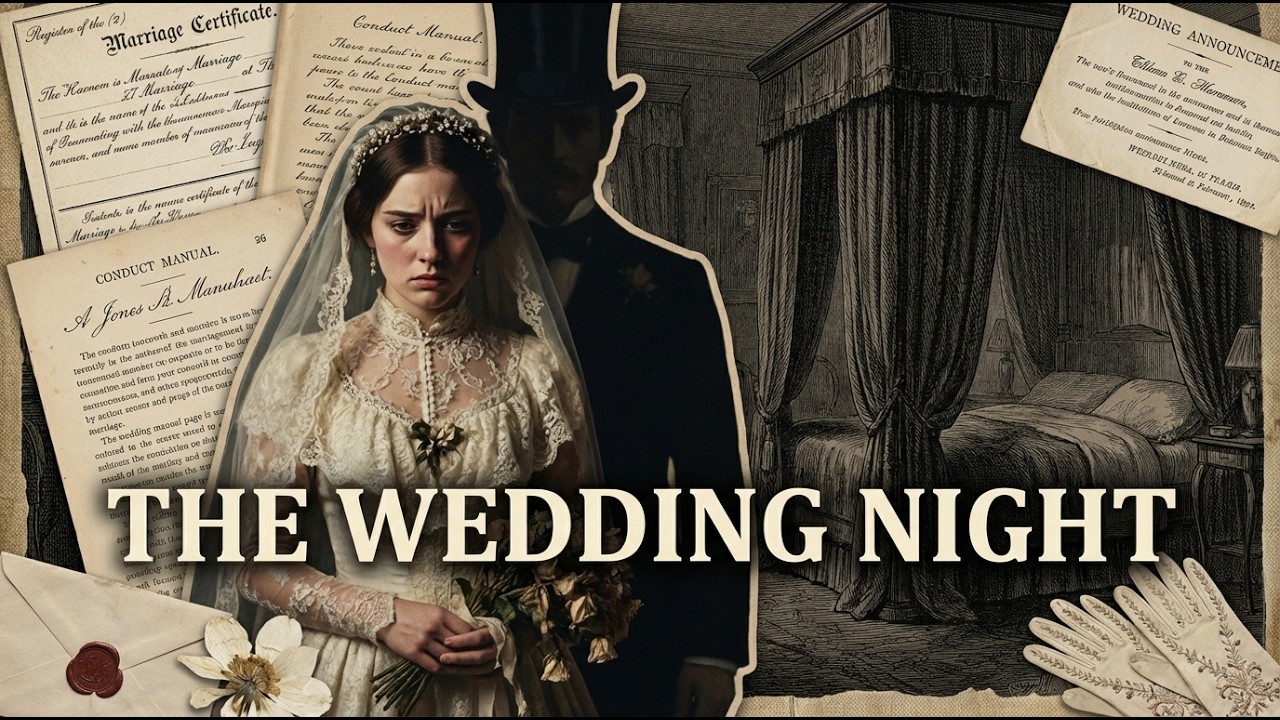
The pristine white gown, the delicate lace, and the carefully arranged flowers created a portrait of perfection, but beneath the surface of the Victorian wedding lay a chasm of ignorance, fear, and legal subjugation that historians say was one of the most carefully maintained silences in all of social history.
A young woman, often as young as 17 or 19, would arrive at her wedding night having spent months embroidering a nightgown by lamplight, her fingers tracing intricate patterns while her mother sat nearby and said nothing useful about what was to come. The needlework was exquisite, a displacement of all the anxiety and anticipation into thread and linen because there was nowhere else for it to go. When the bride asked her married cousin what marriage was truly like, the cousin smiled in a way that closed the subject entirely and poured another cup of tea.
 The preparation, or rather the deliberate lack thereof, was not an accident of Victorian modesty. It was by design, a managed requirement enforced through education, social pressure, and the threat of complete social destruction. Medical texts of the era were written in language so abstract and remote from the physical body that even women who actively sought out information came away no more informed than when they started.
Mothers who had themselves experienced the reality of marriage were actively discouraged from sharing that reality with their daughters, as though knowledge itself were a form of contamination that could ruin a young woman before the institution of marriage had the chance to absorb her.
Historical accounts describe a culture of orchestrated ignorance where the most common advice given to a bride on the eve of her wedding was a chilling three-word instruction: “Endure it, dear.” The mother would sit on the edge of the bed, take her daughter’s hands, tell her to be obedient, assure her that her husband would guide her, and then leave the room without looking back. That was often the complete extent of a Victorian woman’s intimate education before marriage.
The structural asymmetry of experience that met on that first night was profound and deliberately maintained. The bride was expected to be pure, untouched, and her innocence was not merely preferred but was the central condition of her value on the marriage market. A woman who had any prior physical experience was considered ruined, unmarriageable, and morally compromised in a way that could never quite be repaired.
The groom faced no such requirement. Records suggest that many Victorian men, particularly those of the middle and upper classes, had prior worldly experiences before marriage, and this was understood in certain social circles as the necessary management of physical expectations.
Men were considered to have physical needs that required a legitimate outlet, while women were considered, in the dominant medical and social thinking of the era, not to have such needs at all. If they did, those needs were a sign of pathology rather than health. The two people who met in the marriage bed on that first night arrived from entirely different worlds of knowledge and experience, and no one thought it necessary to close that gap.
No one, in fact, acknowledged the gap existed.
What followed was, in many documented cases, confusion, fear, and physical discomfort that no one had warned the bride to expect. Historical accounts describe women who did not fully understand what they were experiencing, women who froze, women who lay still and wept quietly and waited for it to be over. Women who, in the days that followed, confided to diaries never to be shared that they had felt something very close to fear in that first night and something very close to grief in the mornings after.
The wedding chamber itself would have been carefully prepared, with fresh linen, flowers, a fire already laid in the grate, a pitcher of water, and candles set at intervals around the room burning down toward some inevitable moment. The space was designed to communicate romance, but what it actually communicated to a young woman standing in it for the first time without a chaperone was a kind of finality. The silence in that room must have been extraordinary, given that the entire scaffolding of Victorian courtship, the chaperoned walks, the formal calls, and the carefully managed conversations, had existed specifically to prevent two people from ever being truly alone together.
Men, too, felt the particular pressure of that moment. A marriage was not legally complete until it had been physically sealed, and failure to formalize the marriage could be grounds for annulment. The pressure to perform transformed what might otherwise have been a moment of genuine closeness into something more resembling a test, and tests, when both parties are aware they are being taken, rarely go the way anyone intended.
 The weeks that followed brought their own particular weight. The expectation of pregnancy was immediate and unambiguous, as marriage in the Victorian moral framework was inseparable from reproduction. A woman who did not conceive within a reasonable period became the subject of quiet concern, whispered speculation, and the particular diminishing pity that polite society reserves for those who fail at what has been designated their primary purpose.
Records suggest that many Victorian women experienced their marriages as a continuous sequence of pregnancies, each one arriving before the physical and emotional demands of the last had been fully processed.
Birth control existed in limited forms, but its use was widely considered immoral, and it was rarely something a wife had the unilateral power to enforce. The husband’s desires governed the frequency of intimacy, and the wife carried the consequences. The physical reality of Victorian married life for women was, by any clear-eyed accounting, genuinely dangerous.
Childbirth in the 19th century carried a mortality risk that most women today cannot fully imagine, with the lifetime probability of dying in or shortly after childbirth being significant for married women across all classes.
Puerperal fever, the infection that followed delivery in unsanitary conditions, killed thousands of women every year well into the latter half of the century. A Victorian woman who married young and remained married for a normal span of years could expect to be pregnant many times over, and she could also expect to lose children, as infant mortality was at levels that would be considered catastrophic by any modern standard.
The legal framework surrounding marriage was equally devastating. The doctrine of coverture meant that a wife’s independent legal existence was entirely absorbed into her husband’s upon marriage. She could not own property, could not sign contracts, and could not, in most circumstances, retain her own earnings.
Upon marriage, she and everything she had ever owned became, in the eyes of the law, her husband’s. The Married Women’s Property Act did not arrive until 1882, and even then its protections were limited and vigorously contested.
A woman who entered marriage entered, in the most literal legal sense, a disappearance, and she was trained from her earliest years to be grateful for the opportunity. Divorce for the vast majority of the Victorian era was a practical impossibility. Before the Matrimonial Causes Act of 1857, a full legal divorce required a private act of Parliament, an expense and an effort available only to the extraordinarily wealthy and the extraordinarily determined.
After 1857, divorce could be obtained through the civil courts, but the standards applied to wives and husbands were, by explicit legislative design, entirely different. A husband could divorce a wife on the ground of adultery alone, while a wife seeking to divorce her husband was required to prove adultery plus at least one additional aggravating factor, such as cruelty, desertion, bigamy, or incest. A husband’s simple infidelity was not, in the eyes of Victorian law, sufficient justification for a wife to leave.
 The message written into that law could not have been clearer. Marriage was an institution that women were expected to endure. Even a woman who successfully navigated the courts and obtained a divorce faced consequences that amounted to a second and longer punishment.
She lost social standing immediately and often permanently, was excluded from drawing rooms she had previously been welcomed into, and faced serious difficulty finding employment, remarrying, or being received in many of the spaces that had previously been available to her as a respectable wife.
The experience of marriage was not uniform across Victorian society, and the differences between classes were striking. Among the upper classes, marriages were primarily arrangements, strategic alliances for the consolidation of estates, the management of inheritance, and the calculated union of surnames and fortunes. Love was not the goal, and emotional compatibility was not among the listed requirements.
A young woman might be introduced to her future husband, assessed for her breeding, her dowry, and the manageability of her temperament, and engaged within a matter of weeks.
Wealthy Victorian couples frequently slept in separate bedrooms, maintained entirely separate social schedules, and conducted their daily lives in careful parallel rather than in any genuine communion. Marital life was often focused on the production of heirs, and once the heir had been produced, and ideally a spare secured against misfortune, the couple retreated into their respective spheres, and the arrangement continued with politeness and restraint until death dissolved it.
Further down the social order, the pressures took a different form but were no less total in their weight. Among the working classes, marriage was less about dynasty and more about immediate daily survival. Two incomes, however meager and unreliable, could sustain a household in ways that one income could not.
The working class Victorian wife did not simply manage a home; she was the home. She cooked and cleaned and sewed and mended, managed the household accounts with the discipline of someone who knows that a shilling miscounted means a child going without dinner, and performed all of this labor while in some state of pregnancy, recovery, or preparation for the next pregnancy.
Her work was total, unceasing, and almost entirely absent from the economic record of the era. It did not count as labor. It was simply what women did.
Emotional isolation was a notable feature of many of these marriages, not because warmth was absent, but because there was genuinely no space for it. Exhaustion is its own kind of wall, and when every waking hour is consumed by the mechanics of survival, tenderness becomes something that must be indefinitely deferred, and for many women, deferred meant lost.
 And yet, amidst all of this, there was also love, complicated, real, sometimes extraordinary love. Diaries from the period describe women who came to regard their husbands as their closest companions and most intimate confidants. Men who wrote to their wives in language of such tenderness that it still pierces across a century and a half of silence.
The Victorian marriage was not a monolith but a vast, varied human spectrum, and the full truth of it requires holding both realities at once, the beauty and the burden, the tenderness and the trap.
Unmarried older women, the aunts, the sisters who never found a match, faced their own form of social diminishment. A woman who had not been absorbed into a man’s household by a certain age was a figure of pity, of faint contempt, and of the social awkwardness that settles around anyone who has visibly failed at what the world considers their primary function. She was a reminder of what the system classified as waste.
The institution held itself together not by brute force alone but by something far more durable: the genuine, deeply held belief of the majority of people living within it that this was simply the natural order of things. That women were suited to obedience and men to authority, and that the arrangement was not a system of control but simply life as it was correctly organized. That belief, internalized, performed, and passed from mother to daughter with a kiss on the forehead and three words of instruction, was the most powerful constraint of all.
The legal frameworks that reduced a wife to her husband’s property have been dismantled, slowly and incompletely, across generations of sustained and costly effort by women who fought from inside a system that told them their desires were irrelevant. Women can now own property, can divorce, can refuse, and can, within limits that still require vigilance, choose. These things seem obvious now, but they were not obvious then.
They were radical, they were contested, and they were, in some cases, achieved only after women had spent entire lives in advocacy and never lived to see the changes they made possible.
And yet it would be too comfortable and too historically irresponsible to declare the distance total. Some of what the Victorians embedded into their understanding of marriage, the expectations around women’s bodies, the idea that a good wife is primarily defined by what she gives rather than what she receives, and the quiet, persistent pressure to endure rather than to object, did not simply dissolve when the century ended. These echoes are fainter now, significantly fainter, in many parts of the world, but they have not disappeared entirely, and anyone paying attention can still hear them.
The young woman who stitched her wedding nightgown by lamplight, month after careful month, preparing for a night she was not permitted to understand, deserves to be seen clearly, not romanticized, not pitied from a comfortable distance, but understood. Her resilience, her ingenuity, and her quiet and often invisible adaptations to an impossible situation are part of the historical record, and they belong in the light. History is not a costume.
It is a record of lives actually lived.